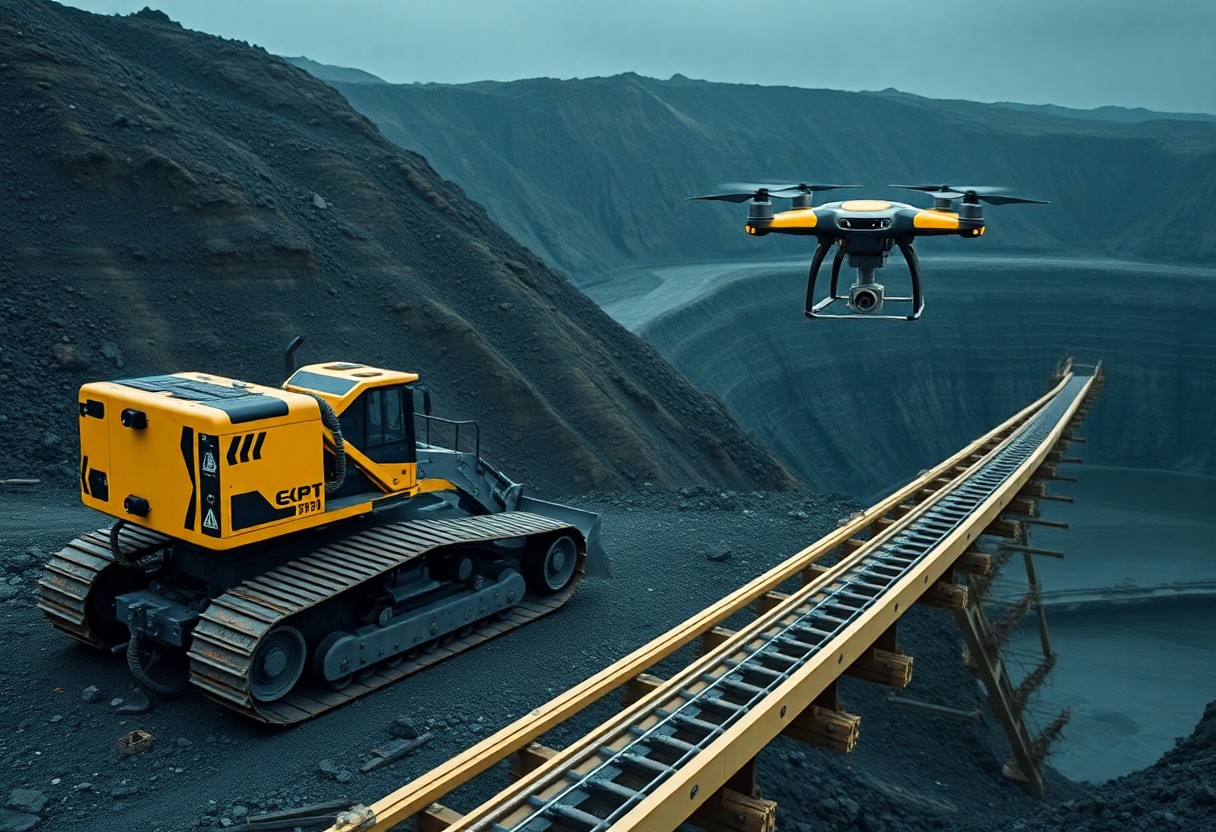
Over the past decade, autonomous mining robots have transformed how you access and manage mineral resources by combining advanced sensing, AI navigation, and remote operation. As you evaluate deployments, examine performance data, regulatory frameworks, and integration with human teams to ensure safety, productivity, and environmental compliance. Adopting these systems reshapes operational planning, capital allocation, and skills development so your organization stays competitive while reducing risk and footprint.
Evolution of Mining Technology
Through incremental leaps you can trace mining’s shift from manual labor to integrated autonomy: 19th-century steam shovels gave way to diesel haul trucks after WWII, then to sensor-driven equipment in the 1990s, and now to fleets coordinated by AI. Specific milestones include GPS-guided dozers in the 1990s, Caterpillar and Komatsu autonomous truck pilots in the 2010s, and Rio Tinto’s AutoHaul rail automation, which together illustrate decades of layered innovation you rely on today.
Historical Overview
You can map major inflection points by decade: mid-1800s steam excavation, post-1945 dieselization of haulage, 1970s conveyor and crusher scale-up, 1990s introduction of GPS and fleet telematics, and 2010-2015 trials of driverless haul trucks. Notably, fleet-management systems like Caterpillar’s MineStar and early Komatsu AHS pilots reduced human error and set the stage for full autonomy at sites such as Pilbara.
Advancements in Robotics
You now see robotics driven by LiDAR, radar, GNSS RTK and edge AI enabling centimeter-level positioning and obstacle avoidance. Companies such as Epiroc, Sandvik, Caterpillar and Komatsu deploy autonomous loaders, drill rigs and haul trucks that operate 24/7, improving utilization by double-digit percentages in many trials and allowing remote operations via private LTE or 5G networks at scale.
Delving deeper, you’ll find multi-agent coordination algorithms and SLAM-based localization let swarms of machines optimize haul routes and reduce idle time; reinforcement-learning planners adapt to changing pit geometries and ore body boundaries. Digital twins fed by real-time telemetry let you run scenario tests and schedule predictive maintenance, with case studies showing 20-40% reductions in unplanned downtime. Operationally, that translates to longer component life, fewer stoppages and tighter cycle times across both open-pit and underground sites.
Types of Autonomous Mining Robots
| Drilling Robots | Automated long‑hole and blasthole rigs (Sandvik, Epiroc) with pattern control and adaptive feed. |
| Transportation Robots | Driverless haul trucks and AHS fleets (Rio Tinto, Caterpillar, Komatsu) using RTK‑GPS and LiDAR. |
| Loaders & LHDs | Autonomous/load‑assist loaders for stoping and stockpile reclaim, reducing cycle times in underground ops. |
| Inspection Drones | Aerial and ground drones with thermal, LiDAR and photogrammetry for mapping, belt inspection and blast-house checks. |
| Maintenance Robots | Mobile manipulators and crawlers for belt repairs, battery swaps and confined‑space intervention. |
Drilling Robots
You can deploy automated drilling rigs like Sandvik AutoMine and Epiroc SmartROC to execute repeatable hole patterns with centimeter‑level precision; field deployments report up to 30% more meters per shift through continuous operation and reduced manual repositioning. Systems pair downhole sensors and real‑time geology feedback so your bore diameter, depth and inclination stay within tighter tolerances, improving fragmentation and downstream crusher throughput.
Transportation Robots
Across large pits, you see autonomous haul trucks from Caterpillar, Komatsu and Rio Tinto’s AHS operating 24/7, leveraging RTK‑GPS, LiDAR and radar to maintain lanes and avoid hazards; Pilbara deployments of over 200 trucks demonstrate scalable haulage capacity while lowering incident rates and standardizing cycle times. Fleet telematics give you payload, fuel burn and route efficiency metrics to optimize tonne‑km performance.
Beyond navigation, your transportation robots integrate fleet‑management platforms that orchestrate dispatch, balance loads and schedule refueling or charging; typical payloads span roughly 50-300+ tonnes, and sensor fusion (RTK, LiDAR, radar, IMU) provides redundancy in dust or low‑visibility conditions. You can implement platooning, dynamic rerouting and predictive maintenance-backed by remote operators for exception handling-to raise availability and compress cycle variance.
- Integration tip: align telemetry standards, enforce RTK correction networks and automate health‑check reports so your operations scale predictably.
- Perceiving environmental changes in real time, your systems can reroute fleets, adjust drilling sequences, and trigger remote inspections to prevent downtime.
Benefits of Autonomous Mining Robots
Efficiency and Productivity
By shifting key tasks to autonomous systems, you increase equipment utilization and round‑the‑clock output-autonomous haul trucks and loaders can operate 24/7, often lifting utilization from roughly 60% to above 80%. In practice, deployments like Rio Tinto’s Pilbara AHS reported double‑digit productivity gains, while automated drills from Sandvik and Epiroc improve hole‑pattern accuracy and cycle times, lowering rework and raising metres‑drilled per shift by measurable margins.
Safety Improvements
Removing people from high‑risk zones directly lowers your exposure to blasting, roof falls, and vehicle interactions; remote operation centers let you control fleets from hundreds of kilometres away, minimizing on‑site fatigue and environmental exposure. Companies that deployed autonomous fleets report marked drops in vehicle‑related incidents as personnel are no longer riding trucks through hazardous terrain.
You also gain layered protections: 360° perception (LiDAR, radar, stereo vision) and coordinated fleet control enable automated emergency braking and evasive routing that prevent collisions in congested workings. Telemetry and predictive maintenance flag wear before failures, which can cut unplanned downtime by 20-40% and reduce catastrophic equipment incidents, while real‑time geotechnical alerts help you evacuate zones before ground movements escalate.
Challenges and Limitations
Despite impressive gains, you still face hurdles before full autonomy becomes routine: harsh environments degrade sensors, communications dead zones interrupt operations, and regulatory plus social license issues complicate deployment. For example, Rio Tinto’s Pilbara program scaled to over 70 autonomous haul trucks but required multi‑year investment in communications and safety systems. Your projects must balance reliability, worker displacement, and lifecycle costs while proving safety and compliance under daily dust, vibration and temperature extremes.
Technical Issues
You contend with sensor degradation (LiDAR and cameras lose effectiveness in dust and rain), GNSS denial underground, and the need for ultra‑low latency control-cellular latency of 20-50 ms can be insufficient for close‑proximity teleoperation. Batteries on electric LHDs typically deliver 6-12 hour shifts, forcing scheduling and charging strategies. Software validation is intensive: perception false positives and required human interventions, often measured in percentage points of operating hours, remain a persistent reliability metric.
Economic Considerations
You must absorb substantial upfront CapEx: automation hardware, retrofit kits, and a private communications backbone. Large mine deployments often push initial spend into the “tens of millions” range, with ROI windows commonly cited between 2-6 years depending on haul distances and throughput. Vendors such as Sandvik and Epiroc offer staged models, but your capital allocation and fleet scale determine whether automation yields net savings.
Digging deeper, your total cost profile includes recurring costs for software licenses, cybersecurity, spare parts and specialist maintenance teams; establishing a private LTE or fiber backbone and edge compute nodes can add millions more. Financing and service contracts (robot-as-a-service) shift risk but raise long‑term Opex. To justify investment, you should model scenarios: small fleets rarely pay back under two years, while large, high‑utilization sites often hit payback within 2-4 years when factoring fuel, labor and productivity gains.
Case Studies of Successful Implementation
Across multiple sites you can see autonomous systems delivering measurable results: higher throughput, lower operating costs, and fewer safety incidents. Recent deployments report 20-40% productivity gains, 10-25% fuel or energy savings, and up to 60% reduction in lost‑time injuries, with payback periods often under three years for medium‑sized open‑pit operations.
- Company A (2021-2024): 24 autonomous haul trucks, 28% increase in throughput, 15% reduction in diesel consumption, annual OPEX down $12M.
- Company B (pilots 2022-2025): hybrid fleet of 12 electric LHDs and 8 drilling robots, ore recovery up 18%, safety incidents down 62%.
- Rio Tinto (block cave trial): continuous operation mode increased uptime by 35%, fleet utilization 92% during peak months.
- BHP (remote site integration): reduced cycle time by 22%, integrated predictive maintenance cut unscheduled downtime 40%.
- Academic/industry pilot: phased deployment cut wall‑to‑wall operational costs by 9% while improving grade control; see industry overview Automated Mining in 2025: Trends, AI, and Innovations.
Example 1: Company A
When you examine Company A’s rollout, phased automation of hauling and dispatching drove a 28% throughput boost and lowered unit costs by 12%. They scaled from 6 to 24 autonomous trucks over 18 months, optimized cycle times via AI dispatch, and achieved an internal rate of return above 18% within two years.
Example 2: Company B
Company B focused on underground automation, deploying 12 electric LHDs and 8 drilling robots that raised ore recovery by 18% and cut ventilation energy use by 11%. You can see how integrated scheduling and real‑time telemetry reduced idle times and improved crew allocation.
Further details show Company B’s pilot used sensor fusion and edge AI to lower maintenance costs by 25% and extend component life 30%; rollout plans target full automation across three shifts, aiming to reduce overall site CO2 emissions by 20% by 2026 while maintaining ore grade consistency.
The Future of Autonomous Mining
Expect autonomy to move from isolated systems into whole-site orchestration, where digital twins, edge AI and deterministic connectivity coordinate drills, trucks and processing plants in real time; analysts forecast double‑digit market growth through 2030 as operators pursue higher uptime, and projects like Rio Tinto’s AutoHaul plus BHP’s Pilbara autonomous fleet illustrate scalability and cost‑performance at industrial scale.
Emerging Technologies
You will see rapid adoption of edge AI, LiDAR‑based perception, 5G/TSN links for low‑latency control, and battery‑electric powertrains coupled with in‑pit crushing and conveyors (IPCC) to cut diesel use; Sandvik and Epiroc are already fielding electric loaders and drills, while swarm algorithms and digital twins enable coordinated multi‑robot work that reduces cycle times and fuel consumption.
Industry Predictions
Within the next decade, you can expect OEMs and miners to shift toward autonomy-as-a-service, tighter industry standards for interoperability, and measurable efficiency gains-operator reports and analyst models point to typical operating‑cost reductions in the mid‑teens percent range for heavily automated sites.
Operationally, that means your workforce will transition toward remote operations, predictive‑maintenance technicians and data specialists; suppliers will offer subscription pricing, regulators will emphasize cyber‑safety and proof‑of‑performance, and pilots from Rio Tinto, BHP and major OEMs will set templates for scaling autonomy across brownfield and greenfield mines.
Summing up
Conclusively, as autonomous mining robots reshape resource extraction, you gain safer, more efficient operations and greater data-driven oversight, enabling higher yields, lower costs, and reduced environmental impact; your role shifts to strategic supervision, systems integration, and ethical governance as robotics, AI, and remote operations redefine industry standards and competitive advantage.
