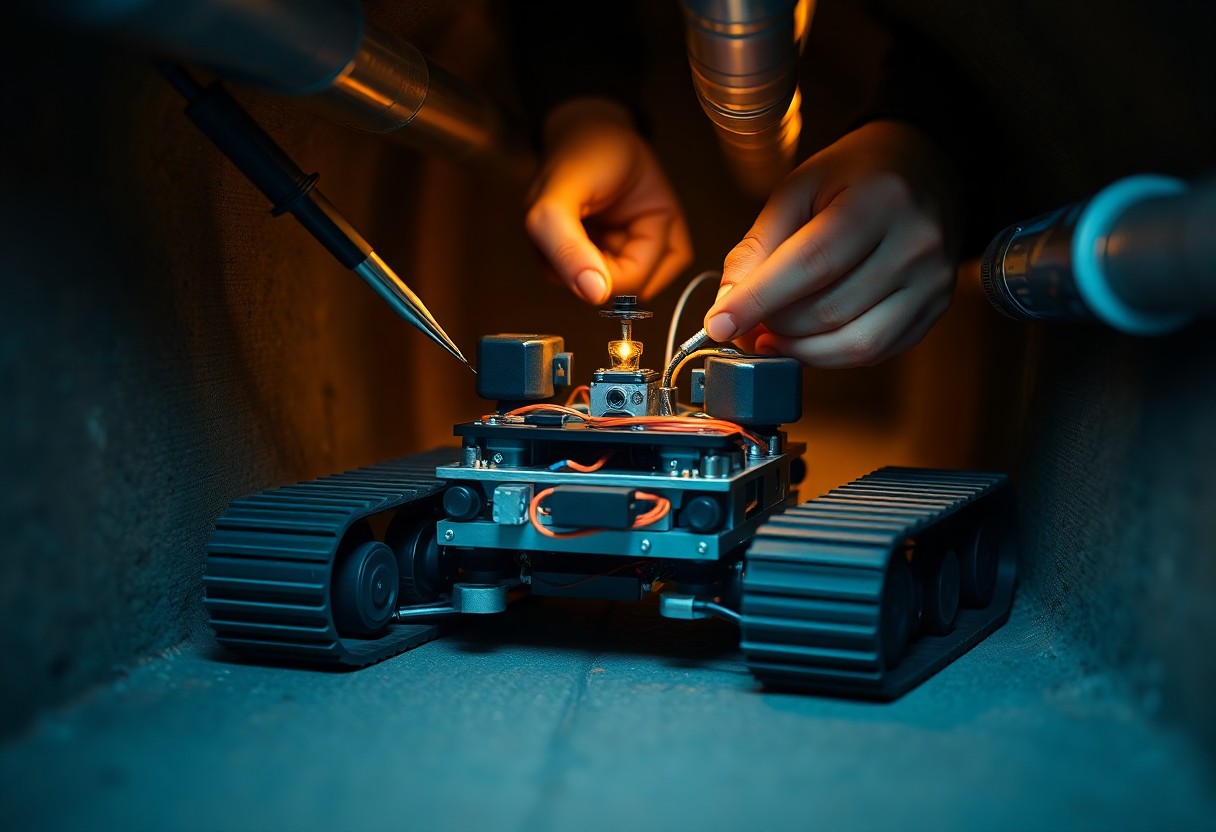
Spaces within machinery and ducts force you to design compact robots that fit, maneuver, and perform tasks efficiently.
Design Principles for Miniaturization
You focus on minimizing footprint by integrating functions, reducing tolerances, and planning thermal and power paths early, ensuring the compact robot fits tight spaces while maintaining performance.
Spatial Optimization and Component Layout
Arrange components to shorten wiring, enable stacked PCBs, and use conformal batteries so you maximize usable volume and preserve maneuverability in confined areas.
Material Selection for High Strength-to-Weight Ratios
Select lightweight alloys, carbon composites, or engineered polymers that balance stiffness and impact resistance so you reduce mass without sacrificing structural integrity.
As you weigh material choices, evaluate density, stiffness, fatigue life, manufacturability, and joining methods to match mission loads and assembly constraints. Aluminum offers machinability and heat conduction, carbon fiber gives superior stiffness-to-weight but needs impact management, and advanced polymers allow complex molding and vibration damping. Prototype, run FEA under expected loads, and test joints to validate performance in confined-operation impacts.
Power Systems and Energy Density
Battery selection prioritizes energy density and form factor so you can fit maximum runtime into tight chassis while balancing weight and thermal constraints.
Integration of High-Capacity Micro-Batteries
Micro-battery modules allow you to trade depth of discharge against space, integrating cells in custom shapes to maximize capacity without increasing footprint.
Efficient Power Management and Distribution
Optimize power architecture so you can reduce losses with centralized monitoring, smart DC-DC conversion, and prioritized supply rails for sensors and actuators.
Design your power management to include dynamic load shedding, telemetry-based diagnostics, and adaptive voltage scaling so you can extend runtime while protecting sensitive electronics. Implement short, high-current traces, filtered distribution nodes, and staged power-up sequences to minimize inrush, reduce voltage sag, and maintain predictable behavior under varying loads.
Locomotion and Actuation
You prioritize compact drive systems and low-profile actuators to squeeze through narrow corridors, balancing torque, speed and thermal limits while minimizing sensor and wiring bulk.
Micro-Motor Selection and Gear Reduction
Select high-torque micro-motors and match gear reduction to maximize stall torque without overheating; choose planetary stages to keep size down and give you tight backlash control.
Kinematic Strategies for Restricted Mobility
Employ kinematic layouts that let you sidestep constraints, such as differential drives, articulated legs, or foldable linkages to reduce turning radius and preserve stability.
When optimizing kinematics, you should prioritize compact joint placement and fewer degrees of freedom to simplify control while retaining maneuverability. Place actuators near the chassis center to lower rotational inertia and use remote transmissions for cramped limbs. Combine passive compliance with active micro-actuation to absorb impacts, test for singular configurations, and set joint limits so you maintain clearance without sacrificing payload or run time.

Sensing and Navigation Systems
Sensing and positioning tech let you operate a compact robot precisely in tight gaps, balancing sensor coverage, computation, and power to keep size minimal while preserving awareness.
Low-Profile Proximity and Depth Sensors
Low-profile proximity and depth sensors let you detect nearby obstacles and measure clearances without increasing chassis height, using time-of-flight, IR, or tiny stereo pairs for fast, local collision avoidance.
Simultaneous Localization and Mapping (SLAM) Algorithms
SLAM algorithms help you build maps and track pose with limited sensors and compute, enabling precise path planning and obstacle avoidance in constrained interiors.
When opting for SLAM for tight-space robots, you should prefer lightweight visual-inertial or 2D LiDAR approaches, tune loop-closure thresholds, use sparse maps and submapping to reduce memory, and offload heavy optimization to intermittent batches or an external processor.
Communication and Signal Processing
You must prioritize compact antennas, selective filtering, and on-board DSP to keep reliable links and clean sensor data inside confined metal and cluttered signal paths.
Robust Wireless Connectivity in Shielded Environments
Shielded spaces force you to use directional antennas, relays, and frequency hopping to maintain connection when direct RF paths are blocked.
Low-Latency Telemetry and Control Data
Low-latency links let you send control updates and receive telemetry within tight timing budgets to keep maneuvering accurate in confined spaces.
Design low-latency systems by prioritizing deterministic links and minimal buffering: use high-priority UDP or custom lightweight protocols, hardware timestamping, and MAC-layer scheduling (TDMA) to guarantee slots. Reduce jitter with packet prioritization and simple FEC, and keep critical control loops on-node so you only send supervisory updates. Profile end-to-end latency and tune buffer sizes for predictable response.
Thermal Management and Heat Dissipation
Thermal management in tight robots demands compact solutions; you should prioritize conductive pathways, heat spreaders, and directed airflow, and consult community requests like please create a robot for narrow spaces : r/Dreame_Tech for real-use constraints.
Passive Cooling Through Conductive Substrates
Substrates with high thermal conductivity let you route heat to chassis areas; you can use thin copper planes, graphite sheets, or metal-matrix inserts to spread heat away from hotspots without adding fans.
Active Airflow Optimization in Confined Spaces
Airflow design forces you to balance small fans, duct geometry, and pressure drops; you should direct intake and exhaust paths, use low-profile blowers, and throttle speeds based on sensor feedback to control temperatures.
You should model internal airflow with CFD or simplified network simulations to identify dead zones and optimize duct cross-sections; place low-profile micro-blowers near heat sources, use smooth tapered channels to minimize losses, add guided vanes to focus flow, and implement closed-loop control with temperature and pressure sensors to adjust blower PWM while trading off power and acoustics.
Final Words
With this in mind you should prioritize compact sensors, articulated mechanisms, efficient power management, and precise control so you can inspect and maneuver within confined spaces safely and effectively.