
Over iterations, you refine hardware, harden software, standardize assembly, optimize supply chains, and validate safety to transition a prototype into a production-ready robot.
Hardware Hardening and Design for Manufacturability
Hardware testing reveals failure modes you must address early: shock, moisture, EMI, and thermal cycling; update enclosures, connectors, and PCB coatings to meet field longevity requirements while keeping assembly straightforward for contract manufacturers.
Transitioning from Rapid Prototyping to Industrial Tooling
Tooling choices force you to consider draft angles, tolerances, and cycle times; standardize part features and materials to shorten mold development and reduce per-unit costs during the production ramp.
Streamlining the Bill of Materials for Mass Production
Consolidate component variants and preferred suppliers so you simplify purchasing, lower inventory carrying costs, and reduce assembly errors by using common footprints and long-life parts.
Optimize your BOM with approved alternates, lifecycle tracking, and packaging preferences; implement part-numbering, MOQ-aware ordering, and cross-referencing to prevent last-minute substitutions and keep certifications intact.
Robust Control Systems and Software Architecture
Engineering control and software stacks for production requires deterministic timing, fault containment, and versioned deployment pipelines so you can maintain safety and uptime across fielded units.
Implementing Production-Grade Middleware and Real-Time Kernels
Implementing production-grade middleware and a real-time kernel ensures your system meets latency and reliability targets while providing observability and graceful degradation paths.
Edge Computing and Over-the-Air (OTA) Update Frameworks
Edge deployments let you process sensor data locally to reduce bandwidth and latency, while OTA frameworks let you push verified updates so you can fix bugs and add features safely.
You should design OTA pipelines with cryptographic signing, delta compression, and atomic A/B partition swaps so failed updates trigger automated rollback. Use device identity and mutual TLS for authentication, staged rollouts with telemetry-based gating, and on-device health checks to verify runtime integrity. Prioritize minimal update size and CPU-friendly apply routines so you maintain service availability on constrained hardware.
Power Management and Electrical Reliability
Power systems must be engineered for production: you should upgrade connectors, fuses, and PCB traces, add telemetry and protection, and validate thermal behavior; see What Happens In The Gap Between Prototype And … for transition strategies.
Industrial Battery Standards and Thermal Mitigation
Batteries must meet IEC and UN transport standards, you should implement active thermal management, cell balancing, BMS fail-safes, and industry-grade enclosure and venting to keep runtime and safety aligned with production expectations.
Sensor Integration and Signal Integrity at Scale
Sensors require standardized connectors, differential signaling, and controlled impedance routing so you keep signal integrity across harnesses and avoid data loss as deployment scales.
Shielding, grounding, connector selection, and ADC sampling strategies should be part of your design validation; perform EMI sweeps, cable length tests, and firmware filtering to guarantee reliable, repeatable sensor performance in field conditions.
Environmental Durability and Stress Testing
Testing exposes prototypes to thermal cycles, humidity, vibration and shock so you can quantify failure points, set acceptance criteria, and schedule targeted redesigns before scaling to production.
Ingress Protection (IP) and Mechanical Lifecycle Validation
Ingress tests and cycle validation reveal dust, water, and wear vulnerabilities so you can select seals, coatings, and bearing materials that meet IP ratings and lifecycle targets for expected field conditions.
Failure Mode and Effects Analysis (FMEA) for Robotics
Analyze component and system failure modes, score severity, occurrence, and detectability, then prioritize actions so you can reduce risk and guide verification plans before full-scale manufacturing.
Develop FMEA by convening cross-functional teams to list failure modes, assign severity/occurrence/detectability ratings, and compute RPNs; you must document mitigation measures, assign owners, and map test cases to each mitigated risk so validation traces directly to design changes and production controls.
Regulatory Compliance and Safety Certification
Regulatory requirements force you to formalize design controls, documentation, and test evidence so auditors accept your robot and reduce legal exposure during product launch.
ISO, CE, and UL Safety Standards
ISO frameworks, CE directives, and UL criteria require you to align mechanical, electrical, and EMC testing with regional rules and compile technical files for conformity assessment.
Functional Safety Protocols and Risk Assessment
Functional safety standards make you perform hazard analysis, define safety functions, and verify protection levels so the robot meets assigned integrity requirements.
Design teams must document system architecture, allocate Safety Integrity Levels, run fault injection and FMEA, and maintain traceable verification so you can prove compliance to assessors and support field maintenance.
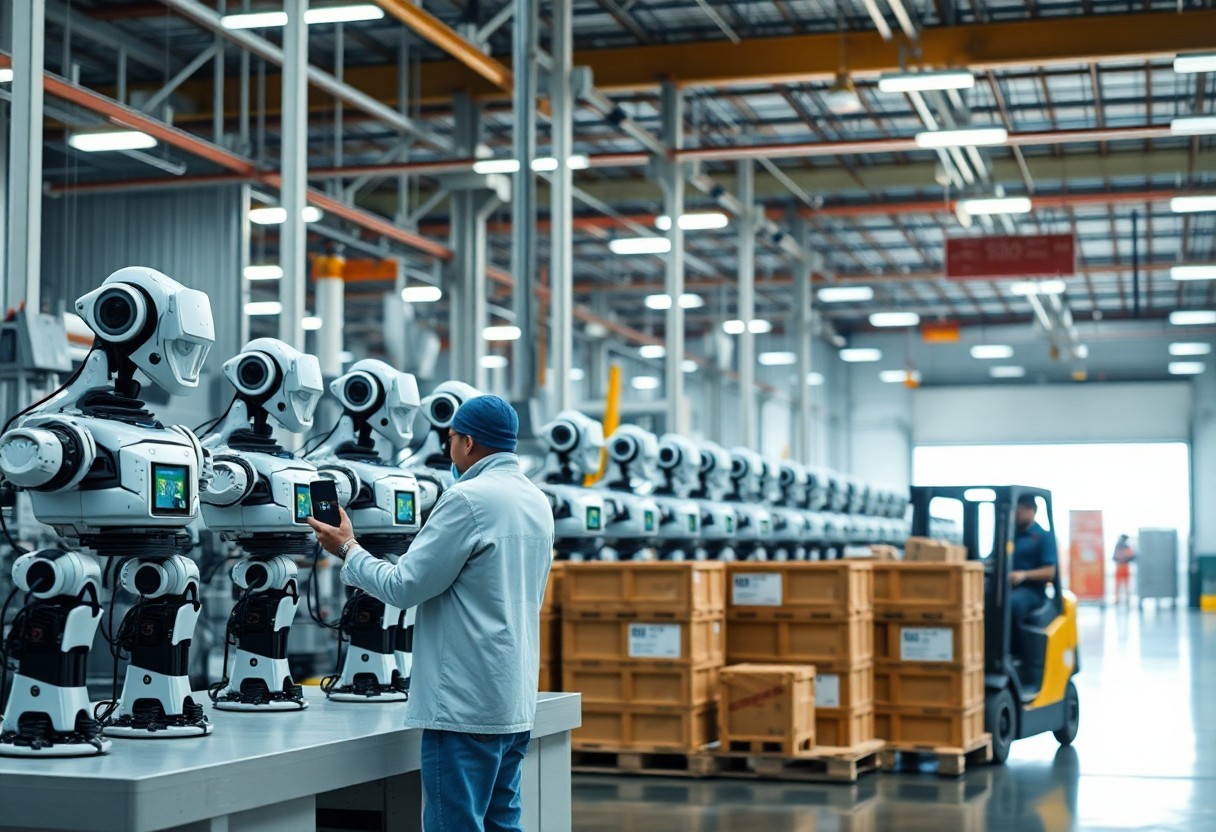
Manufacturing Operations and Supply Chain Scaling
Scaling manufacturing operations requires clear process maps, predictable lead times, and inventory strategies so you can meet production targets while minimizing bottlenecks and excess cost.
Selecting Contract Manufacturers and Quality Control Rigs
You must vet contract manufacturers for capacity, certifications, costing, and traceability, and require inline quality-control rigs plus statistical sampling to detect defects before volume ramp.
Deployment Infrastructure and Fleet Monitoring Systems
Monitor deployment infrastructure so you can stage releases, secure device connectivity, and establish OTA pipelines that allow controlled rollouts and quick rollback across distributed units.
Design monitoring systems that collect telemetry, health metrics, and usage analytics; give you alerting, remote diagnostics, and automated remediation; and integrate with your ticketing and MDM platforms so you can prioritize fixes, measure field performance, and iterate firmware and operational procedures without grounding the entire fleet.
To wrap up
You plan manufacturability, rigorous testing, scalable software, validated suppliers, and maintainable assembly to convert a prototype into a production robot; enforce safety certification, control costs, and document specifications and metrics for consistent deployment.