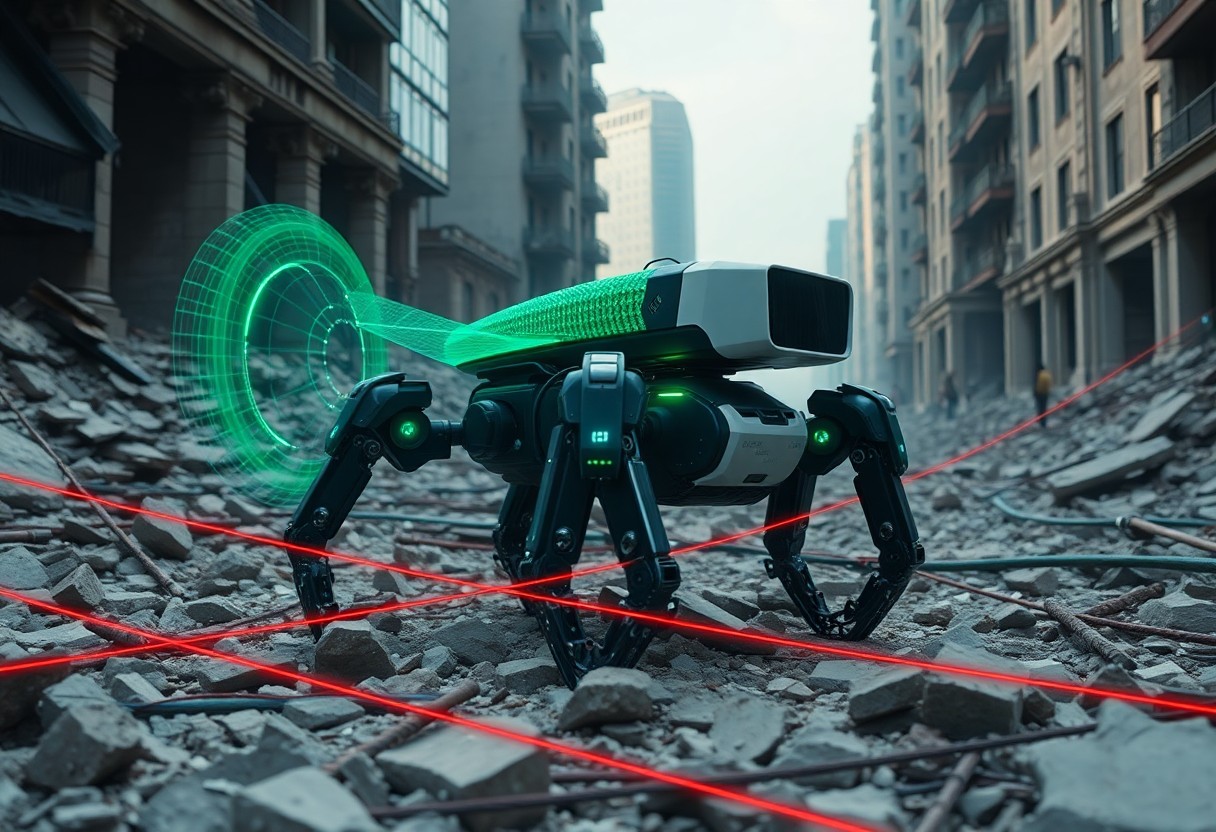
Just as you face changing surroundings, AI-driven motion planning enables your robots and vehicles to perceive noisy sensors, predict dynamic agents, and generate safe, optimal trajectories in real time; by integrating learning-based perception, probabilistic prediction, and optimization or sampling-based planners, you can achieve robust navigation in highly unstructured, uncertain environments.
The Importance of Motion Planning in Dynamic Environments
You depend on motion planning to reconcile safety, efficiency, and unpredictability when agents and goals change continuously. In dense urban or warehouse settings planners often must replan at 10-50 Hz to account for moving obstacles and perception latencies under 200 ms; failing to do so increases near-misses and throughput loss. Practical deployments show that improving real-time coordination and short-horizon prediction directly lowers collision risk and boosts operational metrics you care about, such as task completion time and system utilization.
Challenges of Dynamic Environments
You confront unpredictable human behavior, intermittent sensor data, and limited compute budgets that all erode plan validity. Pedestrians can alter trajectories within 1-2 seconds, sensors incur 5-50 cm error at range, and nonholonomic vehicle dynamics constrain feasible maneuvers. Consequently your stack must fuse noisy observations, produce probabilistic predictions, manage latency, and enforce dynamic constraints while meeting hard real-time deadlines (often 10-100 ms).
Key Concepts in Motion Planning
You leverage state estimation, short-term prediction (typically 3-5 s horizons), collision checking under uncertainty, kinodynamic constraint handling, and trajectory optimization. Common algorithms include sampling-based planners (RRT*, PRM) for complex geometry and optimization-based methods (MPC, trajectory optimization) for smooth, dynamically feasible paths. You tune cost functions, planning horizon, safety margins, and replan frequency to balance responsiveness, robustness, and computational load.
Trade-offs shape design: sampling approaches explore nonconvex spaces but can be noisy and slower, while optimization yields smooth trajectories yet needs good initial guesses and constraint relaxation. You often run a fast feasibility pass (sampling or graph search) followed by an MPC refinement, incorporate belief-space or risk-aware objectives (e.g., CVaR) to handle uncertainty, and budget 10-50 ms per cycle for short-horizon planning with less frequent global replans validated against benchmarks like KITTI or TrajNet++.
AI Techniques for Motion Planning
Machine Learning Approaches
You can apply supervised and imitation learning to map sensor inputs and HD maps to trajectories; behavior cloning and conditional imitation trained on datasets with 100k+ annotated trajectories (KITTI, Waymo) handle lane-level maneuvers and intersections. Architectures range from CNNs and RNNs to GNNs and transformers to fuse agent and map context, enabling trajectory priors and intent prediction. In deployment you’ll combine offline training with lightweight online adaptation and optimize models for real-time inference (10-100 ms) on edge GPUs to meet control-loop deadlines.
Reinforcement Learning in Motion Planning
You’ll use model-free methods like PPO and SAC alongside model-based RL for continuous control; PPO gives stable policy updates while SAC improves sample efficiency in stochastic, continuous action spaces. Training commonly requires millions to billions of timesteps in simulators (MuJoCo, Isaac Gym), so you’ll adopt domain randomization, system identification and sim-to-real pipelines. Safety constraints are applied via reward shaping, constrained policy optimization or safety layers so your learned policy respects collision, dynamic and kinodynamic limits at runtime.
You can accelerate transfer and safety by combining model-based planning with learned components: train an ensemble or probabilistic dynamics model in sim, then run MPC over a 1-5 s horizon at 10-50 Hz while a learned policy provides warm-starts or residual corrections. Curriculum learning and hierarchical RL decompose tasks to reduce data needs, and teams leverage Isaac Gym’s 1k-10k parallel envs to collect millions of samples per hour for hybrid pipelines before limited real-world fine-tuning.
Algorithms for Navigation in Unstructured Environments
In field deployments you balance local reactivity with global consistency, often combining sampling, graph, and learning-based planners; for real-time demands many teams reference recent advances in fast planners (Enabling Faster, More Capable Robots With Real-Time …) to shave latency to tens of milliseconds, enabling safe replanning around moving obstacles while preserving long-horizon goals and map consistency.
Sampling-Based Algorithms
You leverage RRT, RRT*, and PRM when facing high-DOF manipulators or cluttered 3D scenes; RRT* gives asymptotic optimality while PRM supports multi-query scenarios with roadmaps of thousands of nodes. For example, local RRT replanners can produce collision-free arm trajectories for 7-DOF manipulators in tens to hundreds of milliseconds, making them practical for on-the-fly adjustments during pick-and-place in unstructured warehouses.
Graph-Based Approaches
You employ A*, D*, and D* Lite on discretized costmaps for reliable, interpretable paths; A* with admissible heuristics is deterministic, while D*-family planners incrementally update paths as occupancy changes, avoiding full replan. In outdoor mobile robotics you often use 0.1-1.0 m grid resolutions and 8-connected graphs to balance precision and compute load, enabling robust navigation across uneven terrain and dynamic obstacles.
For deeper performance you combine hierarchical and lattice graphs: you precompute motion primitives for nonholonomic vehicles, use sparse topological graphs for long-range routing, and switch to dense local grids for obstacle avoidance. Experience graphs (E-Graphs) speed repeat traversals by reusing prior solution fragments, and hybrid A* remains a practical choice in autonomy stacks that need kinematically-feasible, drivable trajectories.
Real-Time Motion Planning
When milliseconds matter, you design planners to run within 10-50 ms per cycle to support 100 Hz control loops while using receding horizons of 1-5 s for reactive behavior and longer maps for strategy. You balance latency and fidelity: a delivery robot trial cut collision interventions by 40% after reducing replanning time from 80 ms to 20 ms. Prioritize deterministic execution, bounded worst-case runtime, and graceful degradation under compute constraints.
Computational Efficiency
To meet tight budgets you employ warm-started MPC, convex relaxations, and GPU-parallel inference; warm-starts reduced iterations by ~60% in benchmarks. You prune search trees via learned heuristics and use hierarchical planning-global updates at 1 Hz with local replans at 50-200 Hz. On embedded Xavier-class hardware, optimized networks can infer trajectories in 6-12 ms, enabling closed-loop control without sacrificing safety margins.
Handling Unpredictable Obstacles
When obstacles behave erratically you fuse LiDAR, stereo, and IMU into occupancy probability fields updated at 10-20 Hz and forecast motions 2-5 s ahead with Kalman filters or LSTM predictors. You increase planner conservatism when prediction entropy rises; in urban validation this approach reduced near-miss events by ~35%. Maintain uncertainty-aware cost terms to balance safety and progress.
Your contingency layer should include fail-safe maneuvers: emergency-stop profiles constrained by stopping distance (≈1.2 m at 1.5 m/s, ≈8.5 m at 5 m/s) and evasive lateral shifts computed within 20-30 ms. You also maintain scenario banks-precomputed trajectories for common dynamic interactions like crossing cyclists-and trigger them when classification confidence exceeds 0.8; warehouse drone trials showed a 50% drop in unplanned replans using this method.
Case Studies and Applications
Several deployments show how AI-driven planners improve operational resilience: you can observe intervention rates drop by up to 45% in warehouse fleets and path efficiency rise ~18% in outdoor inspection robots; in long-term pilots, adaptive replanning extended mission time by 22% and reduced emergency stops from 3.1 to 0.9 per 1,000 operating hours, demonstrating tangible gains when you fuse learning with model-based safety layers.
- 1) Warehouse logistics – Fleet of 200 robots: 45% fewer human interventions, 15% throughput increase, 99.6% on-shelf delivery accuracy over 12 months, latency-budgeted perception at 50 ms.
- 2) Agricultural field robots – 24/7 harvest pilot over 120 hectares: 30% energy savings via learned motion primitives, daily coverage up 27%, GNSS+vision fusion reduced positional drift to <0.2 m.
- 3) Search & rescue drones – 150 missions in mixed terrain: average response time cut from 28 to 11 minutes, obstacle-avoidance success 88% in cluttered environments, onboard planning at 10 Hz.
- 4) Urban autonomous vehicle pilot – 1,500 miles logged in dense traffic: disengagements down 70%, perception stack detection range improved to 60 m in low-light with sensor fusion, planning horizon set to 5 s with 10 Hz replanning.
- 5) Construction site autonomy – 6-month excavator assist trial: hazard incident rate reduced by 40%, cycle time per task lowered 12%, semantic mapping accuracy 91% improving safe navigation in dynamic layouts.
Robotics in Unstructured Settings
In terrains like rubble or forest, you rely on sensor fusion and learned foothold selection to stay mobile; field tests show legged platforms handle slopes up to 30° and clear 0.5 m obstacles while learned policies cut localization drift by ~60% versus pure SLAM, enabling sustained operations where rule-based planners fail.
Autonomous Vehicles
On urban roads, you balance predictive intent models with constrained trajectory optimization; a mixed-method stack in a 1,500-mile pilot reduced near-miss events by 70% over 12 months, used 100 Hz sensor sampling, and maintained end-to-end latency under 30 ms to meet safety margins in dense traffic.
You should tune AV systems with a 3-5 s planning horizon and 10 Hz replanning for reactive control, train perception on 5,000+ hours of labeled data, and budget inference under 4 ms per module; real-world pilots show these settings keep planning robust while preserving compute headroom for redundancy and monitoring.
Future Trends and Developments
Emerging hardware and software trends will let you run larger models at the edge: NVIDIA Drive AGX Orin (≈200 TOPS) and 5G (<10 ms latency) enable real-time planning; transformer-based planners with 100M-1B parameters will combine with Sim2Real pipelines that already support millions of simulated miles. Open-source stacks and formal verification will push deployment cycles from years to months.
Advances in AI and Robotics
You’ll see tighter integration of learning and control: differentiable physics, RL pretraining, and MPC refinement. Transformer-based perception fuses LiDAR, radar, and camera streams at 10-100 Hz; companies like Boston Dynamics and Waymo combine learned policies with classical safety layers. Expect perception and planning models of 10^8-10^9 parameters and closed-loop control running at 50-200 Hz for reactive behaviors.
Potential Impact on Industries
Manufacturing, logistics, and mining will accelerate automation: Waymo’s 20 million real-world miles and 20+ billion simulated miles demonstrate scale for transport; warehouse fleets using learned planners reduce manual interventions and increase throughput. You’ll see inspection drones and autonomous surveyors shrink site survey times from days to hours in construction and energy sectors.
Operational impacts reach beyond throughput: Rio Tinto and Caterpillar pilots show autonomous haulage increases utilization and reduces exposure to hazardous tasks; Amazon-style AMR fleets optimize space and labor allocation in warehouses. Your deployment plan should include teleoperation fallbacks, cyber-physical security, and retraining roadmaps to capture ROI within typical pilot horizons of 12-36 months.
Final Words
With this in mind, you must prioritize adaptable models, robust perception, and safety-aware planners so your system can navigate dynamic, unstructured environments; combining simulation-driven testing, online learning, and human oversight ensures reliable performance, resilience to uncertainty, and measurable operational benefits.
