
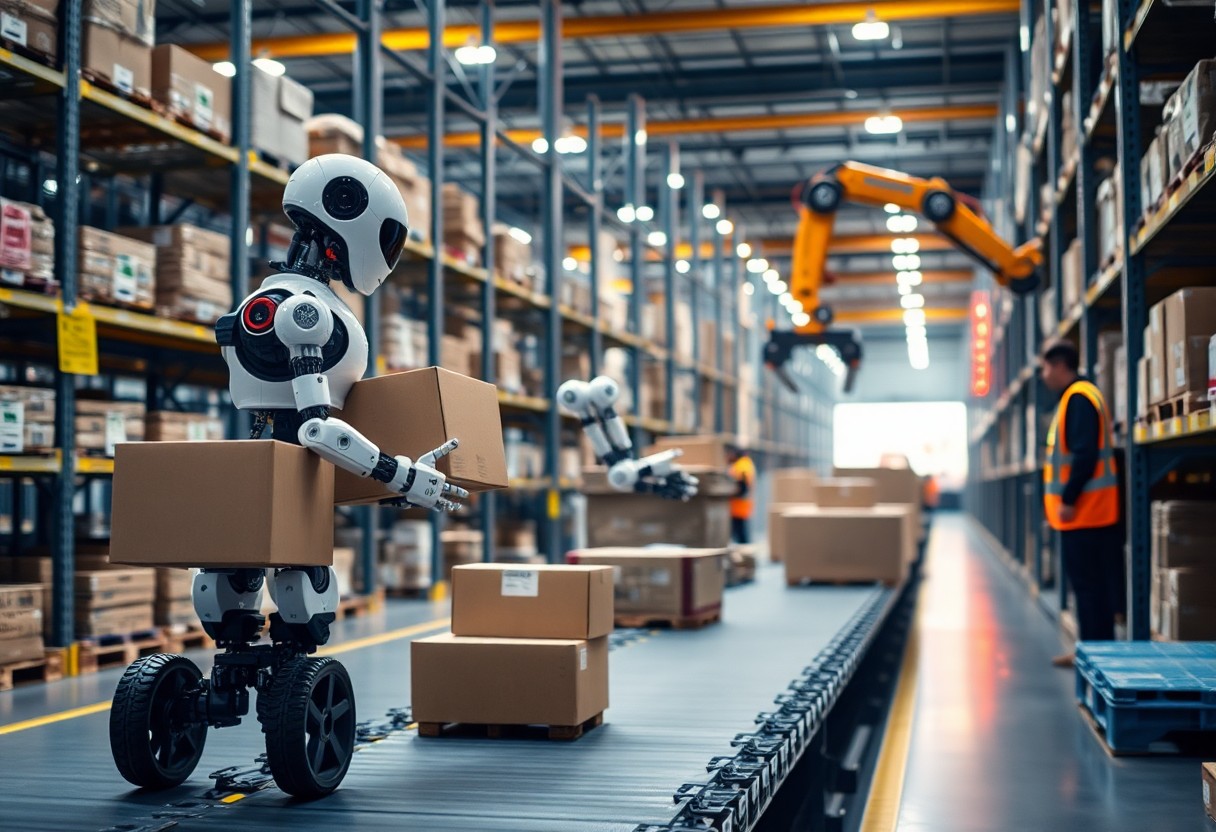
With advancing sensors, modular software, and falling hardware costs, you can expect general-purpose robots to enter real-world workspaces sooner than many predict; understanding their capabilities, limitations, and integration requirements helps you plan for enhanced productivity, safer workflows, and new business models as manufacturers and service providers scale deployment across industries.
Current State of Robotics
In practice you now see robots moving from isolated proofs-of-concept into scaled deployments: mobile manipulators in logistics, Spot used for inspections, Agility Robotics’ Digit in pick-and-place pilots, and UR cobots on factory floors. Hundreds of pilots shifted to production between 2021-24 as edge GPUs like NVIDIA Jetson and ROS 2 integration let you run perception and closed-loop control onboard with lower latency and simpler cloud orchestration.
Advancements in Robotics Technology
Sensors (LiDAR, event cameras), denser tactile arrays, and compact compute (Edge TPUs, Jetson Xavier) combined with sim-to-real pipelines and reinforcement-learning controllers have cut development cycles. You can deploy pretrained grasping and navigation models, pair modular grippers (Robotiq, OnRobot) with standardized ROS 2 stacks, and use digital twins to validate systems-reducing integration time from months to weeks in many cases.
Market Trends and Consumer Demand
Demand is driven by e-commerce growth, labor shortages, and an aging population, and analysts project roughly 15-20% CAGR for robotics applications over the coming decade. You’ll see commercial buyers prioritize predictable ROI-warehouses commonly report payback windows of 12-36 months-while service sectors (healthcare, hospitality, last-mile delivery) push for pilots that can scale to tens or hundreds of units.
Case studies inform purchasing: Ocado’s automated fulfilment centers run dense fleets of bots to raise throughput, while major logistics providers deploy AMRs across hundreds of sites. You should track metrics such as throughput per hour, labor cost per order, and uptime-pilot programs often report 20-50% improvements in travel or pick times, which directly shape procurement and rollout strategies.
Applications of General-Purpose Robots
Across logistics, healthcare, and retail, you’ll see general-purpose robots shifting from pilots to operational roles: Amazon Robotics (formerly Kiva) transformed fulfillment flows, Ocado runs dense robotic grids in multiple warehouses, and hospitals deploy autonomous tugs for supply runs. You can expect these platforms to combine AMR navigation, modular end-effectors, and cloud orchestration to handle bin picking, restocking, and basic patient logistics with measurable throughput and uptime gains.
Manufacturing and Industry
In production, you can use cobots and reprogrammable arms to shorten changeover times and support mixed-model lines; Universal Robots and FANUC arms are common in electronics and automotive cells. High-precision units now deliver sub-millimeter repeatability while payloads span from a few kilograms up to 20+ kg (UR10e-class), enabling tasks from screw driving to precision assembly and in-line vision inspection that reduces defect rates and increases yield.
Service and Domestic Uses
At home and in service sectors, you’ll encounter robots performing cleaning, delivery, telepresence, and basic food prep: Roomba-style vacuums and robotic mowers proved consumer acceptance, while Pepper and delivery bots populate stores and campuses. You can expect general-purpose models to extend those capabilities with interchangeable tools and natural-language interfaces tailored to daily routines and small-business workflows.
Going deeper, you’ll find eldercare pilots in Japan and Europe where robots assist mobility, medication reminders, and social engagement as populations age (Japan’s 65+ cohort is about 28% of the population). You should note practical constraints-battery life typically ranges 4-12 hours, onboard SLAM maps dynamic homes, and safety-rated force limits plus vetted HRI are required before wide deployment-making real-world rollouts iterative and data-driven.
Key Players in the Robotics Market
Across hardware and software you now see incumbents and challengers driving commercialization: established OEMs supply millions of industrial robots, while newer firms push mobile manipulation and AI-first control. You’ll encounter examples like Amazon’s 2012 Kiva acquisition that redefined warehouse scale, Universal Robots (acquired by Teradyne in 2015) popularizing cobots, and Boston Dynamics’ Spot and Stretch reaching commercial customers after Hyundai’s stake in 2021.
Major Manufacturers
You rely on legacy manufacturers for scale and reliability: FANUC, ABB, KUKA and Yaskawa dominate high-volume arms and controllers, Universal Robots made cobots mainstream, and Toyota and Siemens fund long-term robotics research. ABB’s YuMi helped normalize human-robot collaboration, KUKA remains strong in automotive lines, and Boston Dynamics is converting advanced R&D into paid deployments like Spot and the Stretch box-handling system.
Startups and Innovators
You’ll see startups attacking narrow bottlenecks with focused hardware and AI: Agility Robotics builds the biped Digit for logistics tasks, Miso Robotics deployed Flippy in quick-service kitchens, and Covariant supplies machine-learning pick-and-place software for warehouses. These companies win pilots by solving specific failure modes-grasping deformable items, navigating cluttered floors, or automating repetitive human tasks.
You should expect startups to commercialize via partnerships and pilots: many pair their specialized stack with systems integrators or retail partners to prove ROI over 6-18 months, then scale fleet deployments. Examples include kitchen robot pilots that ran for months at White Castle and CaliBurger, and warehouse AI pilots that moved from single-station tests to multi-shift operations once perception and failure-rate targets were met.
Challenges Facing General-Purpose Robots
You’ll face intertwined hurdles: hardware constraints like battery energy density (~250 Wh/kg) limit endurance, while perception and manipulation still fail in clutter-benchmarks show 5-15% misclassification on occluded objects. Integration costs remain high, with early deployments costing hundreds of thousands of dollars per site. The DARPA Robotics Challenge and recent warehouse trials highlight gaps between lab demos and robust, day‑to‑day operation.
Technical Limitations
Your robot must juggle compute, sensing, and dexterity under real‑time constraints: control loops often need sub‑10 ms latency, yet onboard GPUs increase heat and power draw. Perception models can drop from 95% accuracy in curated datasets to 65-80% in the field; manipulation systems achieve 90-99% on trained SKUs but often fall to 60-80% with novel objects. Scaling learning without massive labeled data and ensuring safe, compliant hardware remain core bottlenecks.
Regulatory and Ethical Issues
You’ll confront unclear liability when robots injure people-courts have yet to settle manufacturer versus operator responsibility. Data privacy is enforced by GDPR (fines up to €20M or 4% of global turnover), so video and sensor logs demand strict handling. Governments are proposing sector‑specific rules: the EU AI Act targets high‑risk systems, while U.S. oversight is fragmented between agencies like NHTSA and OSHA, creating compliance complexity for deployments.
You must also address algorithmic bias, explainability, and certification. Buolamwini & Gebru showed facial recognition error disparities up to 34% for darker‑skinned females versus lighter‑skinned males, illustrating risk when robots make social decisions. McKinsey estimates 15-30% of work activities could be automated by 2030, intensifying labor policy pressure. Standards (ISO 10218, ISO 13482) and NIST testing efforts are emerging, yet you’ll likely need bespoke safety cases, audits, and insurer sign‑off before scaling.
Future Prospects for General-Purpose Robots
Within five years, you’ll see pilot projects convert to scaled operations as interoperable software stacks and modular hardware reduce integration time from months to weeks; investors project double-digit growth and manufacturers push toward standards (see How Close Are We to General-Purpose Robots?) – warehouses, hospitals, and field services will lead, with early adopters deploying hundreds per site and total cost of ownership dropping by roughly 30% through software reuse and component commoditization.
Predictions for Market Growth
By 2028-2030 you can expect an industry CAGR around 20-25%, driven by logistics automation and healthcare assistance; pilot-to-production conversion rates should rise from single digits to the 30-40% range, and procurement budgets will shift from one-off projects to multi-year platform contracts, meaning you’ll see larger, repeatable deployments rather than isolated demonstrations.
Potential Innovations
Expect breakthroughs in few-shot and self-supervised learning that let you teach new tasks in hours, not months; reconfigurable grippers and standardized end-effectors will cut tooling costs by 40%, while lower-cost solid-state LiDAR (<$300) and 100-300 TOPS edge chips will enable on-device autonomy for dynamic environments.
Energy improvements from ~250 to ~350 Wh/kg will extend runtimes, letting you run longer shifts between charges; plug-and-play tooling will let you swap end-effectors in under 10 minutes, and sim-to-real pipelines reduce field fine-tuning from weeks to days, so your deployment cycles compress and ROI timelines improve.
Conclusion
On the whole, you are witnessing a rapid convergence of hardware, AI, and ecosystem support that brings general-purpose robots within reach of commercial deployment; you should assess your operational needs, plan for integration and workforce training, and weigh costs against productivity gains as suppliers standardize interfaces and regulations mature.
