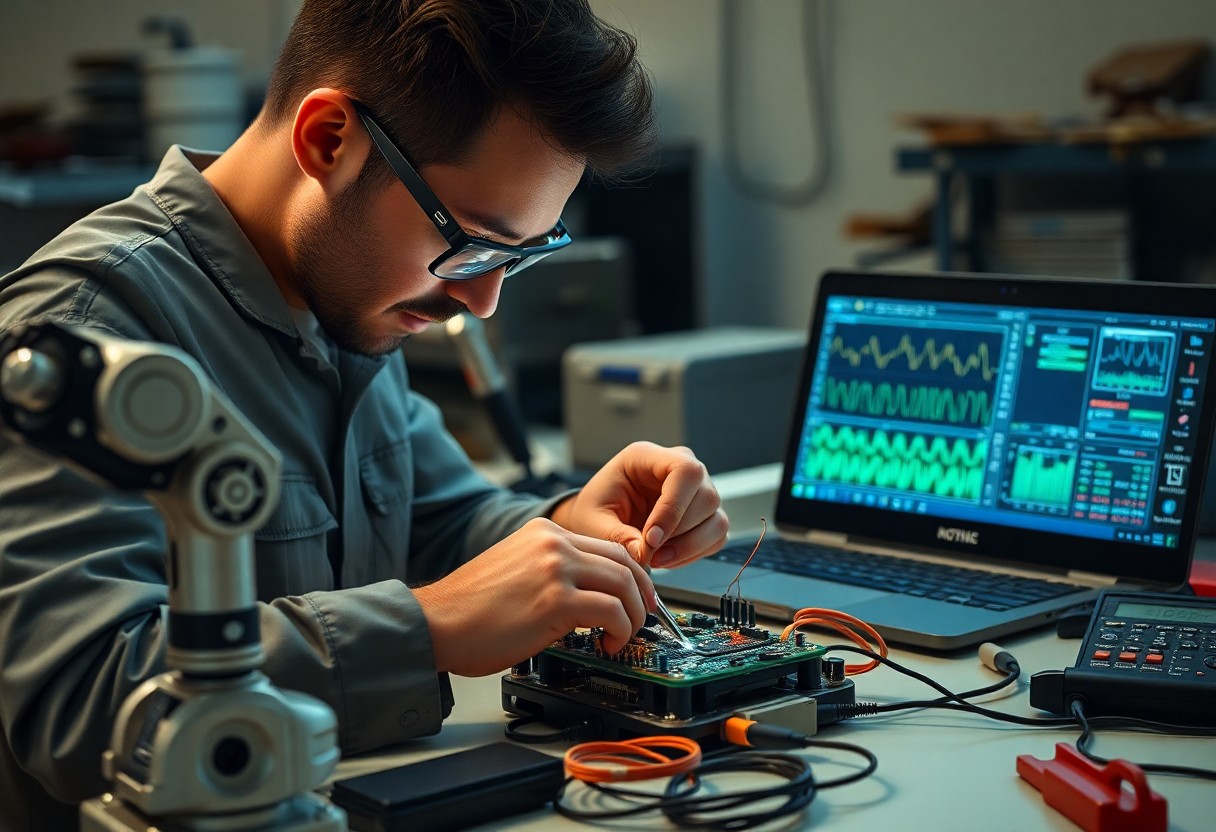
With real-time scheduling and tight sensor-actuator integration, you learn to design deterministic control loops, handle interrupts, and verify timing to guarantee safe, reliable robot behavior.
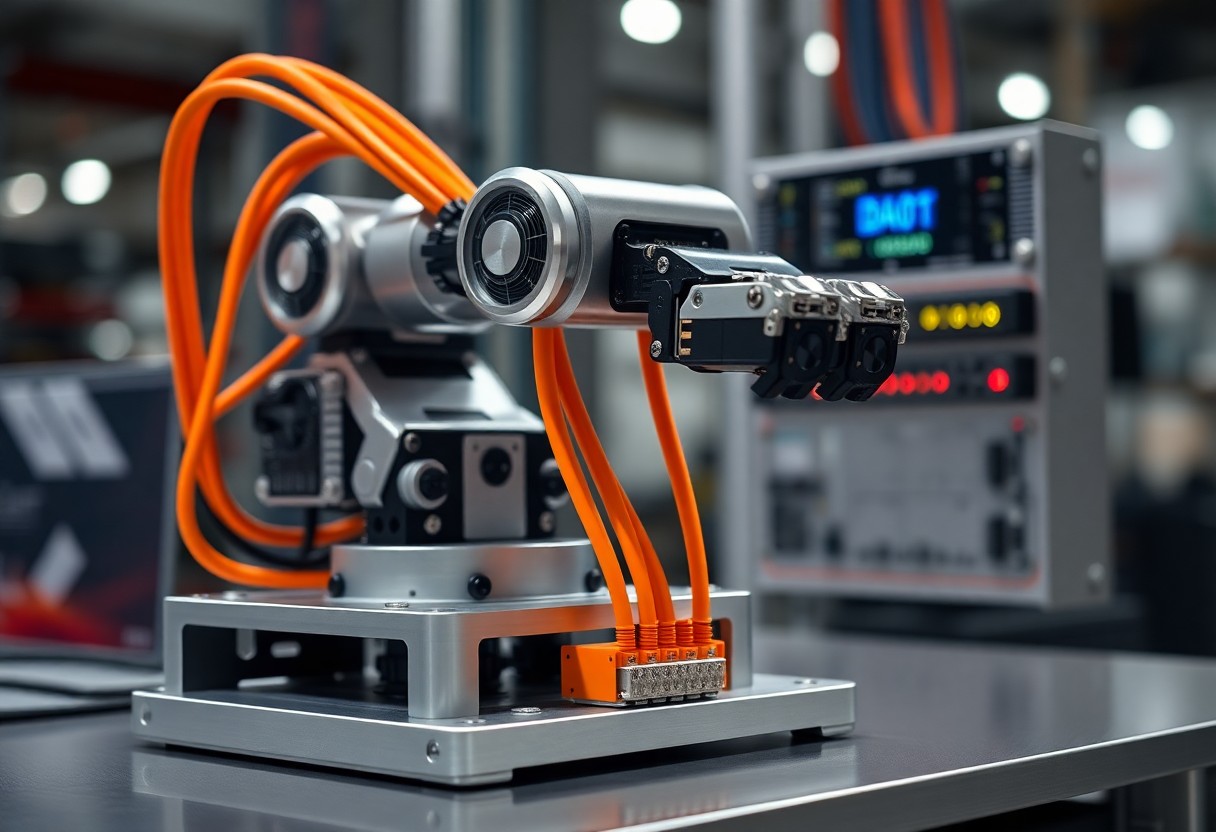
Hardware Architecture for Real-Time Performance
Hardware choices determine latency and determinism; you should partition compute, I/O, and power to meet deadlines, using dedicated processors for safety-critical loops and real-time OS instances to guarantee scheduling.
Selecting High-Performance Microcontrollers and SoCs
Choose processors with deterministic interrupt latency, multiple cores for isolation, hardware timers, and cache controls; you should prefer silicon with real-time capable ISP or DSP blocks and long-term vendor support for low-level drivers.
Communication Protocols: CAN Bus, EtherCAT, and SPI
Balance deterministic fieldbuses and low-latency serial links: you should use CAN for device-level messaging, EtherCAT for hard real-time networked servos, and SPI for high-speed sensor or actuator streams.
When designing network layers, you should configure CAN with extended frames and priority-based arbitration for low jitter, deploy EtherCAT for distributed clocks and sub-microsecond sync, and use SPI with DMA and hardware chip-selects for continuous streaming.
Real-Time Operating Systems (RTOS) Integration
Integration of an RTOS gives you deterministic scheduling, priority-aware resource management, and timing guarantees that keep control loops predictable and safe under load.
Deterministic Task Scheduling and Priority Management
Scheduling policies let you assign priorities, set time slices, and isolate latency-sensitive tasks so you can ensure actuators and sensors meet their deadlines consistently.
Interrupt Handling and Minimizing Context Switching Latency
Interrupts must be short and selective so you can defer heavy processing to threads, keeping ISRs minimal and reducing jitter in control paths.
Optimizing interrupt handling requires you to assign IRQ priorities, offload data movement to DMA, and keep ISRs to the minimum work needed to acknowledge events. Use deferred processing in threads or work queues, apply priority inheritance for shared resources, and measure context-switch times so you can tune preemption thresholds and avoid unnecessary wake-ups that inflate latency.
Control Loop Design and Implementation
Control loops determine how you translate sensor data into actuator commands; you must choose sampling rates, filters, and anti-windup mechanisms to maintain stability while meeting latency and bandwidth constraints in real time.
High-Frequency PID Control and Tuning
Tuning high-frequency PID forces you to control sensor noise, manage derivative filtering, and align loop timing so gains deliver fast responses without oscillation; use hardware-timed interrupts and step tests to validate settings.
State-Space Modeling for Robotic Kinematics
Modeling state-space kinematics lets you represent joint dynamics and coordinate transforms with A, B, C, D matrices, enabling observer design and predictive control for smoother trajectory tracking under disturbance.
Expanding state-space modeling, you build full-system representations including sensor models and actuator dynamics, then design Kalman filters for state estimation and LQR or MPC regulators to meet latency, energy, and safety constraints while simulating disturbance responses before hardware tests.
Sensor Fusion and Data Acquisition
Sensor fusion combines IMU, encoder, and vision streams so you can obtain consistent state estimates; integrate learning methods such as Training a Whole-Body Control Foundation Model to refine control priors and reduce uncertainty in real time.
Integrating IMUs and Encoders for Precise Feedback
IMUs and encoders provide complementary information, so you should align timestamps, calibrate biases, and fuse signals at high rate to maintain tight position and velocity control for closed-loop tasks.
Implementing Kalman Filters for Real-Time State Estimation
Kalman filters let you optimally combine noisy sensor inputs, propagate covariances, and produce low-latency state estimates that feed control loops with minimal delay.
Practical implementation requires you to discretize continuous dynamics, identify process and measurement noise from experiments, select EKF or UKF for nonlinearity, and budget computation-tune covariance and update rates to balance estimation accuracy against real-time CPU and latency constraints.
Actuator Dynamics and Power Electronics
Actuators demand matched drive electronics and thermal planning so you can preserve bandwidth and prevent saturation; consider inductance, motor constant, and switching losses when tuning real-time loops.
Motor Driver Interfacing and PWM Optimization
Interface drivers with correct dead-time, gate drive current, and decoupling so you can reduce EMI, lower switching heat, and optimize PWM frequency and resolution for smoother torque output.
Torque Control and Current Sensing Loops
Torque loops depend on high-bandwidth current sensing and anti-windup PI tuning so you can track setpoints accurately while avoiding saturation and preserving stability under disturbances.
You should synchronize ADC sampling to PWM edges and place the current loop at a higher rate than the position loop so you can clamp currents quickly. Use low-value shunts or Hall-effect sensors with matched amplifiers, and design anti-alias filters to keep phase lag minimal. Apply feedforward torque commands, temperature compensation for winding resistance, and anti-windup plus rate limits to maintain stability during abrupt commands.
Safety Protocols and Fail-Safe Systems
Safety checks and layered fail-safes must be integrated so you can quickly isolate faults, shut down actuators, and preserve sensor data for post-fault analysis. Design interlocks, redundancy, and clear operator alerts so you can respond to incidents without ambiguity.
Watchdog Timers and Real-Time Error Detection
Watchdog timers force periodic health checks so you can detect stalled tasks or missed deadlines and trigger safe-mode transitions. Combine with real-time anomaly monitoring to log faults and maintain deterministic timing for recovery.
Hardware-Level Emergency Stop Integration
Hardware emergency stops must be wired to cut power and disable motor drivers so you can halt motion instantly and independently of software state.
Ensure the E-stop uses a hardwired, normally-closed circuit that directly interrupts motor-enable lines and removes actuator power; you should place redundant switches, monitor switch continuity with simple hardware watchdogs, and isolate the emergency circuit from auxiliary electronics to avoid single-point failures. Test wiring, verify response times, and document procedures for maintenance and audits.
Final Words
Considering all points, you must prioritize precise timing, reliable sensors, responsive control algorithms, and thorough testing to ensure safe, predictable robot behavior in real time.