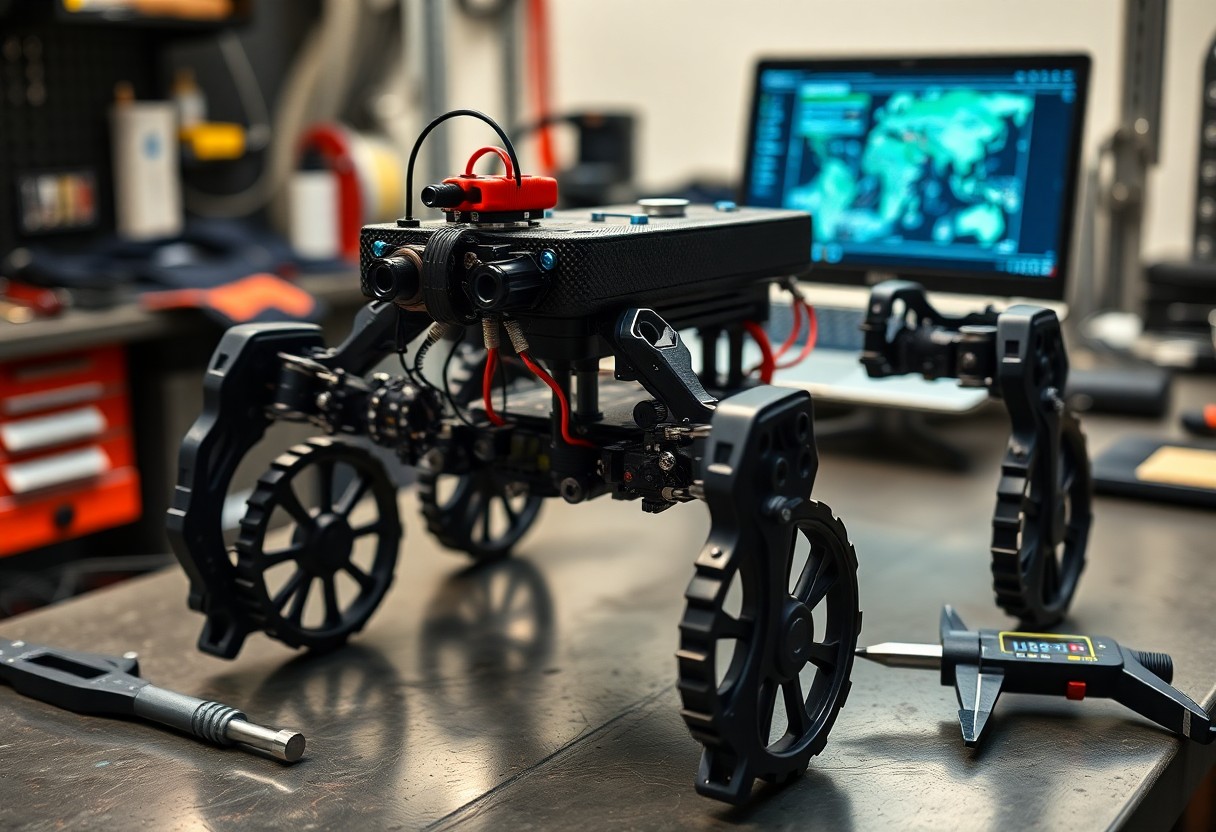
Many designers prioritize weight reduction to boost robot efficiency, so you must choose high-strength low-mass materials, simplify mechanisms, and optimize powertrain and control algorithms to maximize performance without sacrificing durability.
Material Science and Structural Optimization
Materials selection and structural tuning let you shed unnecessary mass while preserving stiffness and fatigue life; you prioritize fiber-reinforced laminates and thin-wall sections along primary load paths to improve actuation efficiency and extend operational range.
High-Strength Composites and Aerospace-Grade Alloys
Composites let you align fibers to specific load vectors, combining low mass with directional strength; aerospace alloys provide high yield and corrosion resistance for joints, enabling slimmer connections and fewer reinforcement layers.
Generative Design and Topology Optimization
Generative design tools let you define performance goals and constraints, then iterate shapes that remove unneeded material while maintaining stiffness; you validate outputs against physical load cases before manufacturing.
In practice you set objective functions for stiffness, strength, and manufacturability, then apply topology optimization to generate skeletal geometries that follow load paths. You translate those geometries into manufacturable parts by imposing printer, mill, or sheet-metal constraints and smoothing stress concentrations. By iterating simulation, prototype testing, and model updates, you refine weight, cost, and service-life trade-offs, using targeted reinforcement only where testing shows need.
High-Efficiency Actuation Systems
High-efficiency actuation systems reduce energy losses and extend runtime; you should prioritize lightweight motors, precision control, and thermal management to maximize output per watt.
Optimizing Torque-to-Weight Ratios in Motor Selection
Selecting motors with high torque-to-weight ratios lets you maintain payload capacity while minimizing mass; evaluate stall torque, continuous torque, and peak efficiency curves against expected duty cycles.
Low-Friction Transmission and Harmonic Drive Integration
Harmonic drives offer compact, high-reduction gearing with low backlash; you should pair them with low-friction bearings and proper lubrication to preserve efficiency and reduce hysteresis.
Carefully integrate harmonic drives by matching input speed, preload settings, and bearing choices to reduce friction under load; you should test thermal buildup, backlash over cycles, and apply appropriate seals and low-viscosity grease for consistent performance.
Energy Storage and Power Management
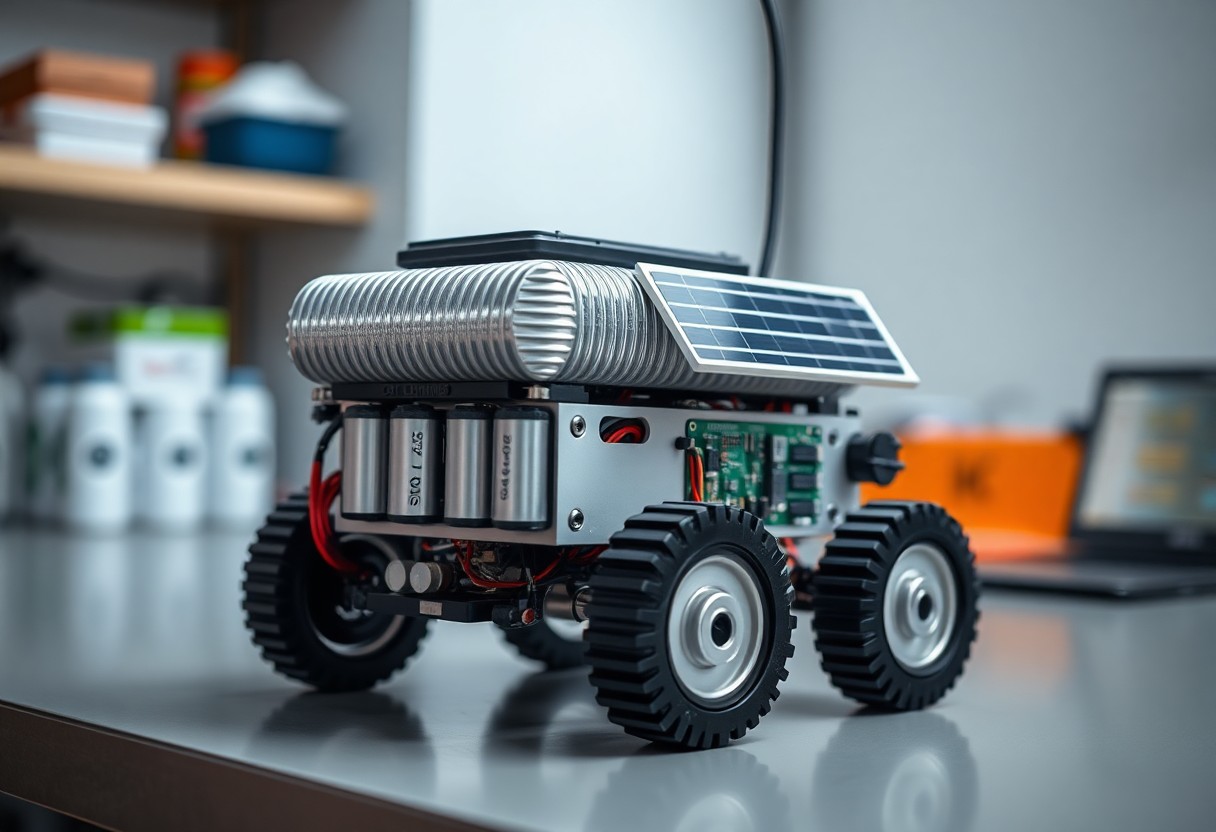
Battery selection and power architecture determine runtime and weight trade-offs; you prioritize high energy-per-mass cells, modular packs, and active thermal control while implementing safety and efficient charging to keep weight low and performance consistent.
High-Density Battery Chemistry and Component Placement
Choose lithium-sulfur or high-energy NMC cells when energy density outweighs cycle life; you position cells low and central to lower center of gravity, use distributed modules to shorten wiring, and integrate cooling channels to maintain performance.
Intelligent Power Distribution and Energy Recovery Systems
Implement smart distribution with bidirectional converters and current sensing so you prioritize propulsion loads, isolate peripherals, and reclaim braking energy; networked controllers let you adjust power budgets in real time for maximum mission efficiency.
Optimize the distribution layer with bidirectional DC‑DC converters, MOSFET-based switching, and dedicated energy-storage buffers like supercapacitors for peak shaving; you program the BMS to perform predictive load scheduling, manage state-of-charge windows, and prioritize regenerative capture during deceleration. Integration with motor controllers and telemetry lets you measure recovery efficiency, tune control loops, and reduce net energy draw across mission profiles.
Control Systems and Computational Efficiency
Control loops tuned for minimal computation let you run more functions on lighter hardware; prioritize event-driven control, reduced sampling rates, and fixed-point math to keep latency low while trimming CPU and power needs.
Lightweight Embedded Processing Architectures
Selecting low-power MCUs with DSP extensions lets you offload heavy math, lower clock rates, and use hardware accelerators for sensor fusion and motor control while keeping interrupt paths deterministic.
Optimized Kinematic Algorithms for Reduced Power Draw
Optimized trajectory planners let you minimize actuator effort by smoothing motion profiles, reducing peak torques and enabling lower supply voltages without sacrificing task accuracy.
Reducing computational overhead further requires simplifying kinematic models to the degrees of freedom actually used, precomputing inverse kinematics or using compact lookup tables, and warm-starting iterative solvers. You can apply low-order polynomial fits, fixed-point arithmetic, sparse linear algebra, and cached subexpressions to cut cycles; combined with feedforward torque shaping and lower-rate replanning, these techniques shrink peak power while preserving performance.
Performance Validation and Metrics
You must set clear, repeatable benchmarks for speed, energy consumption, reliability, and failure modes, then run controlled trials to compare lightweight designs under representative conditions.
Evaluating Dynamic Stability and Payload-to-Weight Ratios
Testing dynamic stability with perturbation trials and measuring payload-to-weight ratios helps you balance agility against carrying capacity while validating control strategies under real-world loads.
Quantifying Operational Longevity and Efficiency Gains
Measuring mean time between failures, cycle life, and energy-per-mission gives you quantifiable longevity and efficiency gains to justify design trade-offs and maintenance schedules.
Analyzing longevity requires accelerated life testing, continuous duty-cycle profiling, and detailed failure logging so you can isolate battery degradation, motor wear, and structural fatigue. You should compute energy-per-task, mean time between failures, and cost-per-operational-hour, then apply regression or survival models to forecast field lifespan. Use those projections to weigh weight savings against extended mission time and reduced servicing.
Summing up
Summing up, you should prioritize lightweight materials, efficient actuators, optimized power management, and streamlined control algorithms to maximize mobility and battery life while reducing mass and component complexity for the most efficient robot design.