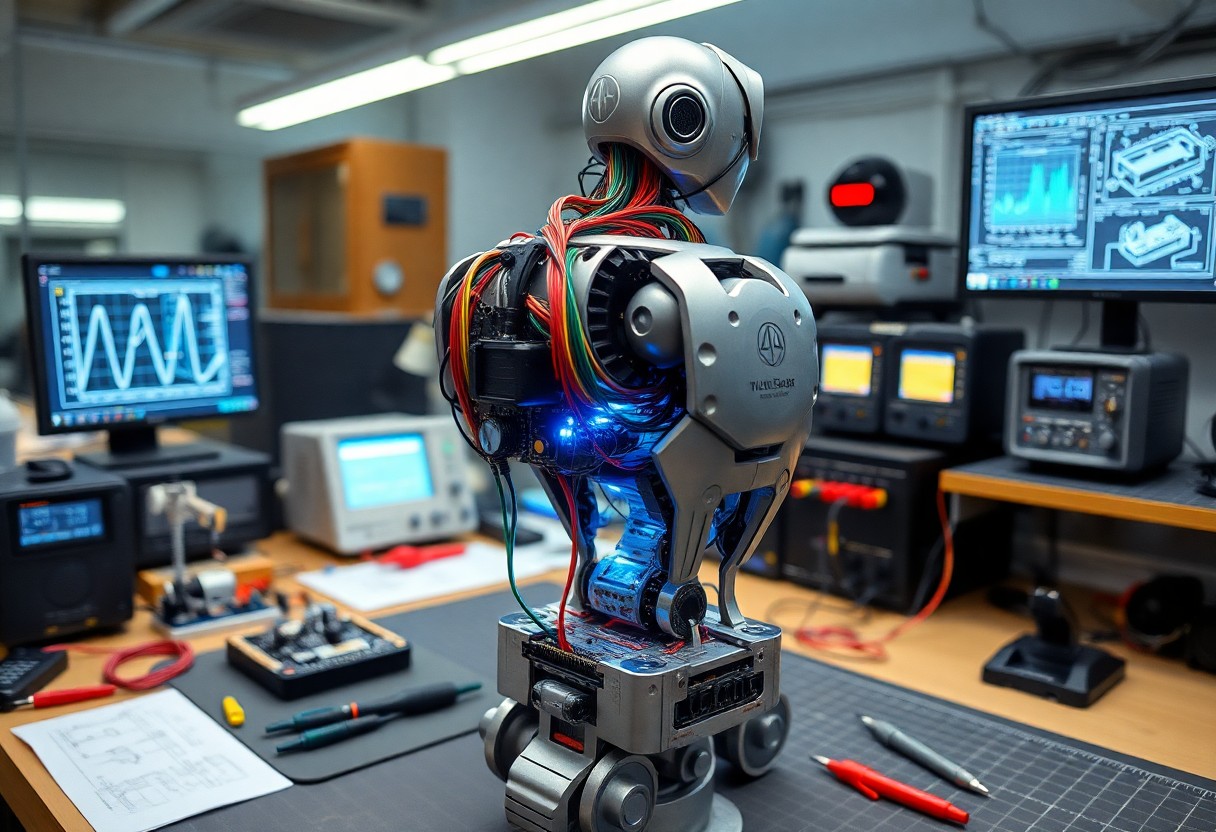
Many research teams construct modular robots so you can test sensors, algorithms, and controls; plan hardware, software, safety, and repeatable experiments to gather valid data.
Conceptual Design and Research Objectives
Clarify the project’s research goals so you can align design choices, sensor suites, and experimental metrics with measurable outcomes.
Defining Functional Specifications
Specify performance targets, environmental constraints, and interface requirements so you can choose actuators, control strategies, and data collection methods that meet experimental needs.
Structural Modeling and Kinematics
Model joint ranges, link dimensions, and kinematic chains so you can predict workspace, singularities, and control complexity before hardware builds.
Examine kinematic modeling using Denavit-Hartenberg parameters and CAD to derive forward and inverse solutions, then compute Jacobians to assess manipulability and singularities you must handle. You should use dynamic modeling and inertia estimates to size actuators and design controllers, validating behavior with multibody simulation and finite element analysis to confirm structural stiffness and compliance under expected loads.
Hardware Selection and Mechanical Assembly
Selecting components and fasteners determines your robot’s stiffness and serviceability; you should weigh compatibility, mass, and maintenance access, and follow practical walkthroughs like How to Make a Robotic Arm Step by Step to align choices with kinematics and payload.
Materials Science for Chassis Durability
Metals and composites influence fatigue life and corrosion resistance, so you should select alloys, coatings, and heat treatments that meet load cycles and environmental exposure while keeping fabrication and repairability in mind.
Actuator Integration and Drive Systems
Motors, gearboxes, and drives must match torque, speed, and control requirements; you should design mounts, couplings, and cooling paths to minimize misalignment, backlash, and thermal stress during tests.
Integration of actuators requires you to coordinate electrical, mechanical, and control interfaces: specify encoder resolution, torque margins, drive current limits, and communication protocols like CAN or EtherCAT; plan wiring, EMI filtering, thermal monitoring, and service access, then validate with torque, step-response, and endurance tests to confirm predictable behavior.
Power Systems and Energy Management
You should size batteries and design energy management to support long experiments and peak loads, balancing run time against weight and safety while integrating power monitoring and failsafe cutoffs to protect equipment and data.
Battery Chemistry and Power Distribution
Consider cell chemistry trade-offs so you choose Li-ion for high energy density, LiFePO4 for increased safety and cycle life, or supercapacitors for high-power bursts; distribute power with redundant buses, proper fusing, and scalable converters.
Thermal Management and Efficiency Optimization
Design cooling and thermal paths so you keep motors, batteries, and controllers within safe temperatures, using heat sinks, conduction paths, forced air, or liquid loops matched to your power density.
Implement temperature sensors, thermal simulation, insulation, and active control so you detect hotspots early, throttle power where needed, and schedule cooling to extend battery life; validate with test cycles and telemetry to refine thresholds and control gains.
Sensor Arrays and Data Acquisition
Sensor arrays combine multiple modalities so you capture spatially and temporally rich measurements; configure sampling rates and synchronization to match experiments while minimizing data overload.
Proprioceptive and Exteroceptive Sensing
Proprioceptive sensors report joint angles, motor currents and accelerations so you monitor internal states and implement closed-loop control alongside exteroceptive inputs for contextual awareness.
Signal Processing and Noise Reduction
Signal processing filters and down-samples inputs so you extract usable features and reduce bandwidth for logging and real-time control.
You should apply analog anti-aliasing filters before ADCs, match sampling rates to signal bandwidth, and choose bit depth that preserves dynamic range. Use low-pass, notch and median filters for noise suppression, and implement Kalman or complementary filters for sensor fusion. Timestamping and synchronized sampling reduce alignment errors; offload heavy transforms via DMA or a DSP to keep control loops deterministic while preserving high-fidelity logs.
Control Systems and Software Architecture
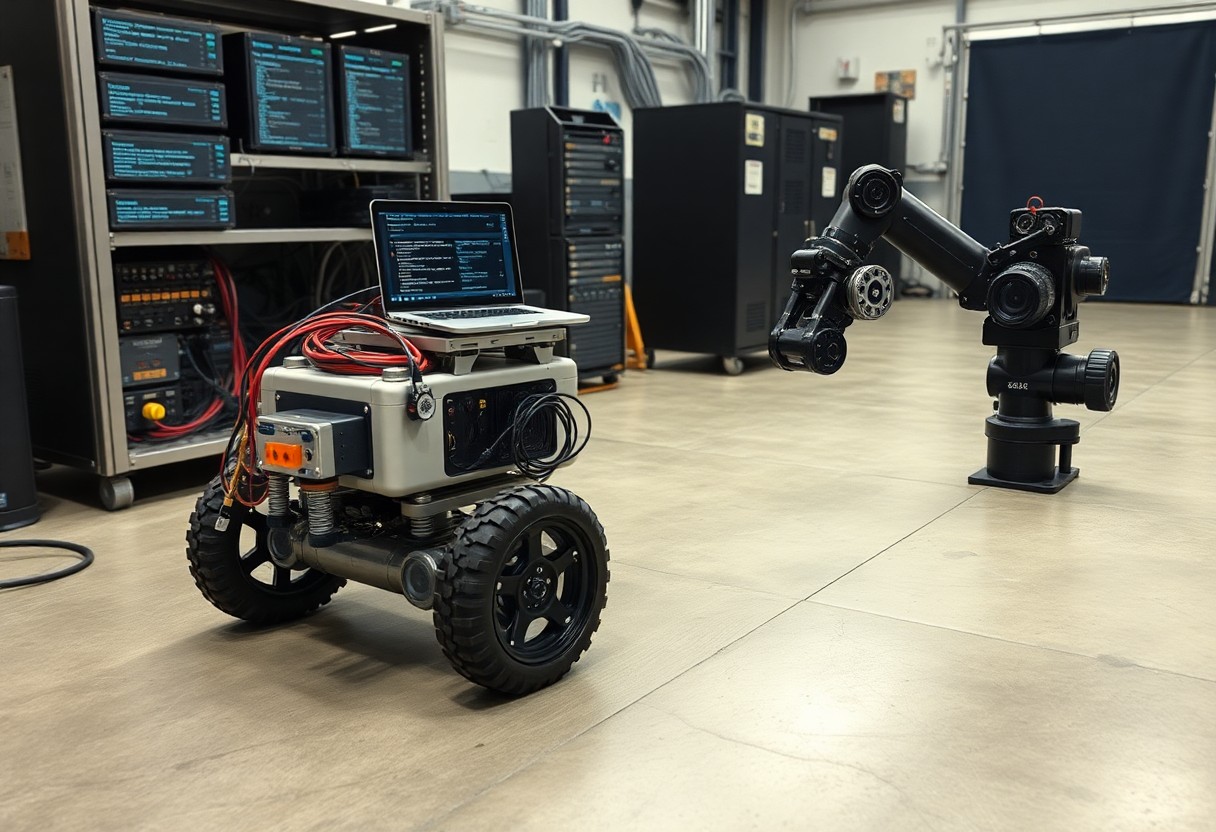
Control systems define how you orchestrate sensors, planners, and actuators into reliable closed loops; design modular, layered architecture with clear interfaces to simplify testing and iteration.
Real-Time Middleware and Firmware Development
Middleware selection determines how you handle real-time communication, priorities, and fallbacks; profile latency, implement priority inheritance, and test on actual hardware to ensure predictable timing.
Algorithm Implementation for Autonomous Operation
Algorithms for autonomy require you to integrate perception, state estimation, planning, and control with clear APIs, deterministic tests, and continuous benchmarks to validate behavior in varied conditions.
Simulation, hardware-in-the-loop trials, and staged field tests let you measure safety margins, identify failure modes, and refine recovery strategies; maintain dataset versioning, automated unit tests, and performance regression checks to keep model behavior consistent as you iterate.
Experimental Methodology and Validation
Validation procedures require you to define repeatable protocols, control variables, and log environmental conditions to ensure experiments yield interpretable, comparable results across trials.
Performance Benchmarking and Calibration
Benchmarking helps you quantify actuator response, sensor latency, and control stability; calibration routines align sensor outputs with ground truth so repeat tests remain consistent and meaningful.
Data Analysis for Scientific Reproducibility
Analysis requires you to standardize preprocessing, document algorithms and parameters, and share code and datasets so peers can reproduce statistical results and validate conclusions.
You must enforce deterministic preprocessing by recording seed values, filter parameters, and imputation rules; store raw and processed datasets with checksums, annotate columns with units and provenance, and version control analysis scripts. Use containerized environments, automated pipelines, and unit tests so others can rerun pipelines, verify statistical assumptions, and confirm that reported metrics reflect genuine effects rather than preprocessing choices.
Final Words
From above you combine clear objectives, solid mechanical design, calibrated sensors, reliable control software, and methodical testing to construct research robots that enable repeatable experiments, data-driven insights, and rapid iteration for new studies.