
It’s your task to design robots for nonstop service by ensuring reliable power systems, modular maintenance access, redundant sensors, and fault-tolerant control so you can maintain uptime, schedule predictive repairs, and optimize long-term performance in demanding environments.
Energy Storage and Power Management
Power architecture must prioritize predictable runtime, thermal handling, and scalable capacity so you maintain continuous operation under mixed loads.
High-Density Battery Chemistry
Lithium-ion cells give you high energy-to-weight ratios, requiring precise charge management, thermal monitoring, and cell balancing to extend cycles and ensure safety.
Autonomous Recharging and Hot-Swapping
Docking solutions let you schedule opportunistic charging and design hot-swap bays so you keep robots operational without long downtime.
Design the recharging system with alignment guides, reliable communication to confirm charge state, and safety interlocks for hot-swap action; include battery state estimation, wear tracking, and graceful fallback behaviors so you avoid unexpected shutdowns and maximize mean time between interventions.
Thermal Regulation and Heat Dissipation
Thermal regulation balances active and passive strategies so you keep motors and electronics within safe limits during continuous operation, minimizing wear and preventing thermal shutdowns through targeted cooling paths and material choices.
Active Cooling for High-Torque Actuators
You should integrate liquid or forced-air systems to remove heat from high-torque actuators, using temperature sensors and closed-loop control to adjust flow based on load and prevent performance loss under sustained duty.
Passive Venting and Heat-Resistant Materials
Design passive vents and select heat-resistant polymers or ceramics so you channel convective flows and delay degradation of enclosures and wiring during continuous duty cycles.
Pair strategic vent placement, gasketing, and heat spreaders so you optimize airflow while limiting dust ingress; choose coatings and layered composites to protect PCBs and connectors from elevated temperatures without adding excessive mass.
Mechanical Reliability and Tribology
Wear on bearings and gears dictates your service cadence, so design contact interfaces for predictable failure modes, accessible inspection points, and straightforward replacement to minimize unplanned stops.
High-Cycle Component Selection
Choose bearings, belts, and materials rated for high-cycle fatigue, apply realistic safety factors, and validate with accelerated life tests so you can predict spares needs and schedule maintenance reliably.
Automated Lubrication and Friction Reduction
Implement automated lubrication systems and low-friction coatings, tune delivery to duty cycles, and monitor consumption so you can cut wear and extend run intervals between interventions.
Sensors for flow, pressure, temperature, and vibration let you run closed-loop lubrication: you can trigger metering only when thresholds are reached, detect contamination or pump failure early, and log usage for CMMS integration. Select lubricants by viscosity, additive compatibility, and contamination tolerance, and incorporate filtration and purge sequences so your system maintains low friction and predictable energy draw over long deployments.
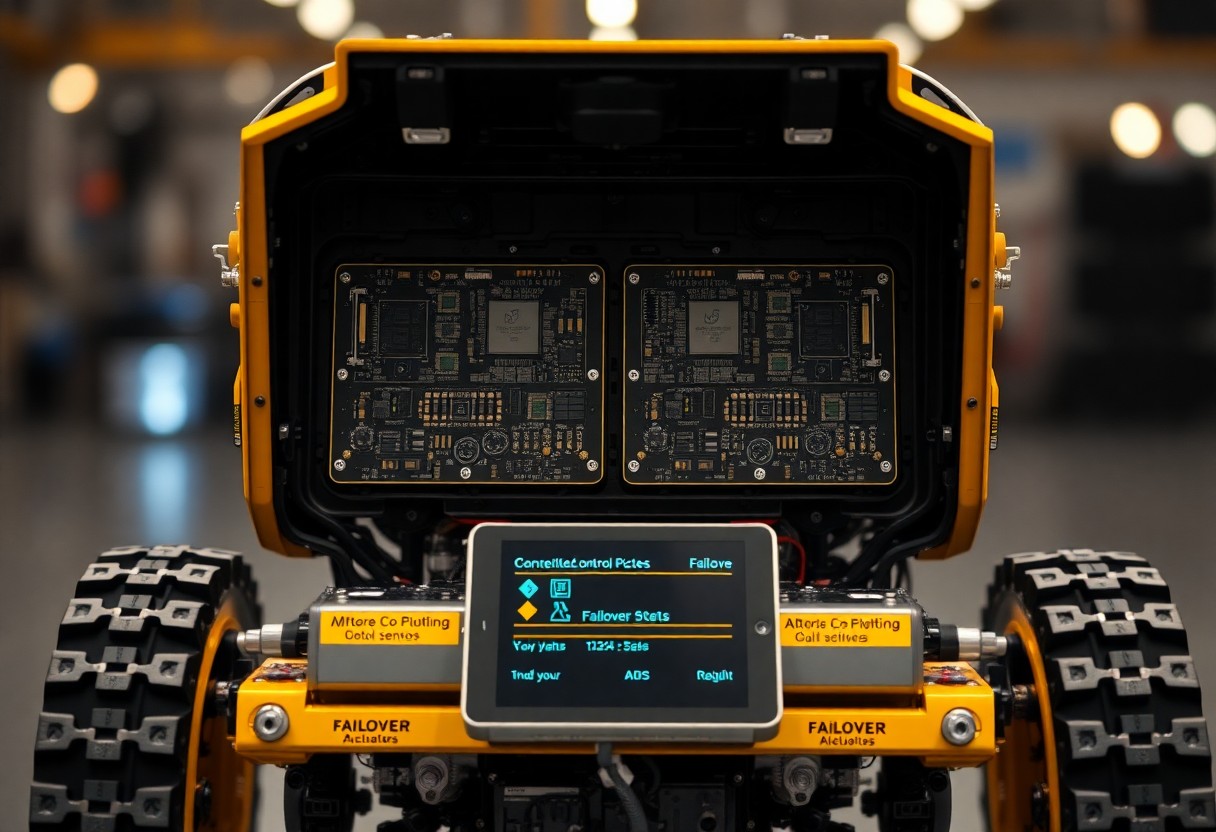
Fault-Tolerant Control Architectures
Systems must detect and isolate faults so you can keep robots running; implement distributed controllers, watchdogs, and graceful degradation. See Transforming Construction: Automation and Robotics for a Safer Future for industry guidance.
Hardware Redundancy and Fail-Safe Systems
Backup sensors, dual actuators, and hot-swappable power modules let you continue missions when components fail; design automatic switchover and clear fault logs so operators can restore full capability quickly.
Modular Design for Rapid Field Servicing
Modules with standardized connectors and clear diagnostics let you replace units in minutes, reducing downtime and simplifying on-site repairs for continuous operation.
Design modularity so you can swap power, sensing, and control boards without tools; include alignment keys, color-coded cabling, and firmware auto-detect to ensure replacements are recognized immediately. Train technicians on common fault signatures, maintain a compact spare-parts kit, and choreograph update procedures so you minimize calibration time and return robots to duty within hours.
Environmental Hardening and Protection
Enclosures designed for harsh conditions combine materials selection, thermal management, and corrosion-resistant finishes so you can sustain continuous operation and reduce maintenance intervals.
Ingress Protection and Sealing Techniques
Sealing strategies such as gasketing, potting, and controlled venting enable you to meet IP ratings, block dust and moisture, and preserve access for scheduled servicing.
EMI Shielding and Signal Integrity
Shielding, careful PCB layout, and disciplined grounding help you minimize emissions, maintain clean signal paths, and reduce susceptibility to external interference during continuous operation.
Grounding and enclosure bonding complement conductive coatings, stitched seams, and high-permeability shields so you can create effective Faraday enclosures; combine those with cable shielding, feedthrough filters, common-mode chokes, and proper PCB stack-up to control return paths and differential routing for stable signal integrity in noisy environments.
Conclusion
Presently you must design redundancy, predictive maintenance, efficient power management, and modular components so robots run continuously with minimal downtime, while you implement secure remote monitoring and clear maintenance protocols to sustain long-term operation.