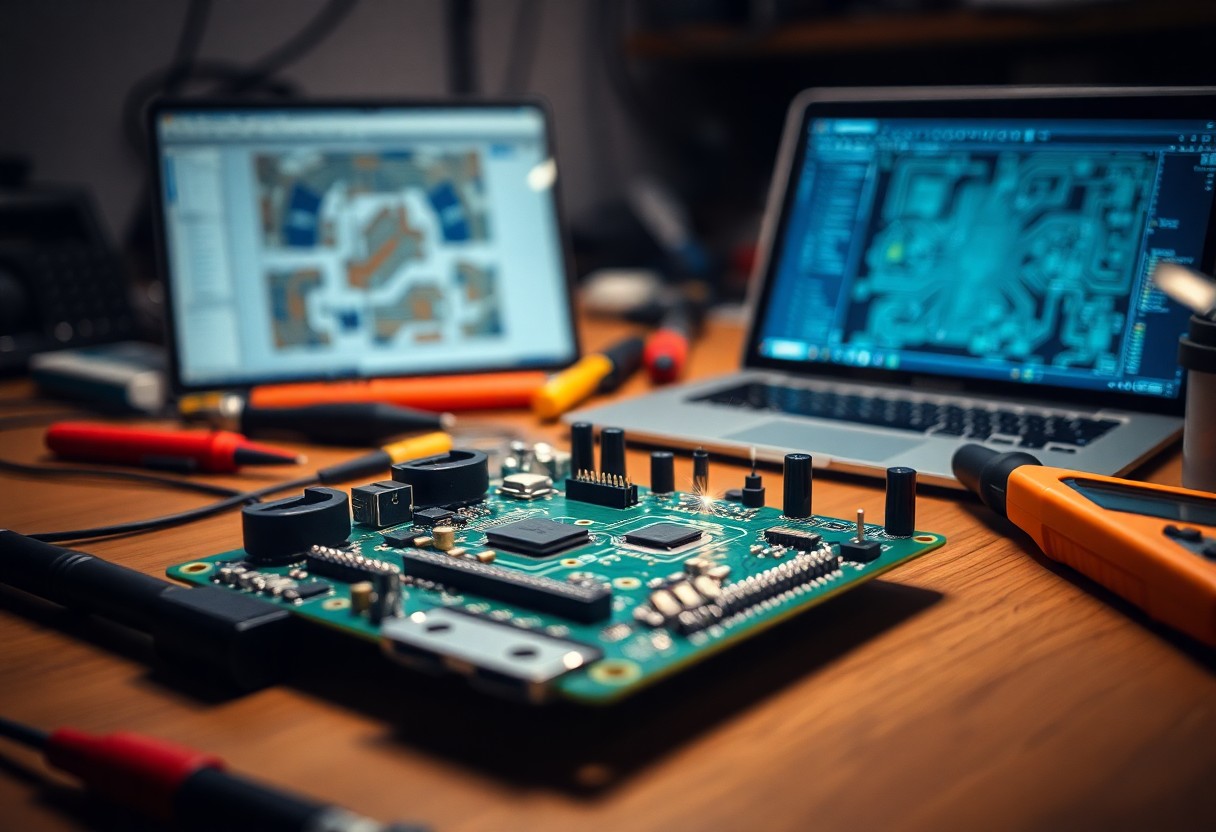
Just follow systematic component selection, PCB layout, firmware architecture, and testing to design and build a Robot Control Board that meets your performance and safety requirements.
Defining System Requirements and Specifications
Scope sets the functional and nonfunctional targets you use to prioritize features, power budgets, environmental ratings, timing constraints, and integration points for the control board, forming the contract between mechanical, electrical, and software teams.
Determining Processing Power and Connectivity Needs
Choose processors and communication interfaces that match your control-loop frequency, sensor throughput, and telemetry volume, balancing MCU cycles, DMA, memory footprint, and interfaces such as CAN, Ethernet, USB, Wi‑Fi, or BLE to meet latency and reliability targets.
Establishing Motor Drive and Sensor Interface Parameters
Define motor voltage and current ranges, encoder or resolver resolution, sampling rates, isolation needs, and protection features so you can specify driver topology, sensing accuracy, and required analog-to-digital performance.
Consider how you select driver topology to match motor type and control method: H-bridge for brushed motors, three-phase inverter for BLDC or AC servos, and microstepping for steppers; size continuous and peak current margins, pick appropriate gate drivers and current-sense techniques, set PWM frequency versus switching losses, design input/output filtering and isolation, and specify fault reporting, thermal limits, and encoder/ADC interfacing to ensure stable, low-latency closed-loop control.
Component Selection and Power Architecture
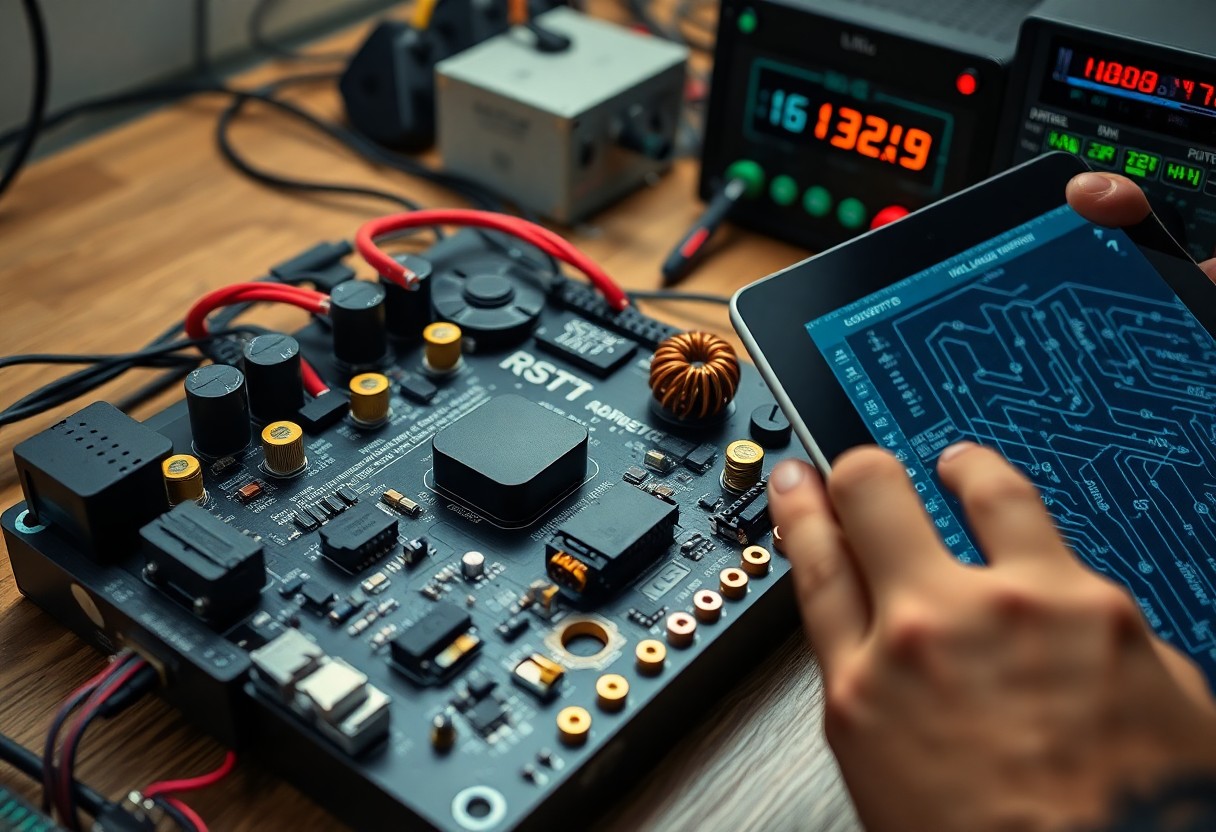
Choices in component selection and power architecture affect reliability; you should balance current budgets, connector types, and thermal headroom while mapping voltage rails to functions and planning PCB copper and fusing.
Selecting Microcontrollers and Logic Level Converters
Microcontrollers determine I/O, timing, and peripheral needs; you should choose parts with sufficient GPIO, DMA, and communication buses, and add level shifters when mixing 3.3V and 5V logic.
Designing Robust Voltage Regulation and Power Distribution
Voltage regulation requires low-noise, efficient converters sized for peak and continuous currents; you should place regulators close to loads, use bulk and decoupling capacitors, and plan thermal dissipation and fusing.
Ensure you pick switching regulators for high-efficiency rails and LDOs for low-noise analog domains; evaluate switching frequency, inrush, and layout constraints. You should implement current sensing, soft-start and reverse-polarity protection, and use thick traces or planes for high-current paths while arranging star grounds to minimize shared impedance.
Schematic Design and Circuit Protection
Schematic layouts should prioritize clear power rails, star grounding, and component placement to reduce noise and simplify protection. You should include fuses, TVS diodes, and current-sensing resistors for overcurrent and transient suppression, and enforce creepage and clearance on high-voltage nets.
Implementing ESD Protection and Signal Conditioning
Protect sensitive interfaces with TVS diodes, series resistors, and common-mode chokes; you should add RC or ferrite filtering and proper termination to preserve signal integrity. Use ESD- and surge-rated connectors and ground shielding to keep communication lines reliable under harsh conditions.
Developing Hardware Safety Interlocks and E-Stop Integration
Design mechanical and electronic interlocks that cut power to actuators and disable control outputs when triggered; you should implement redundant sensors and monitored relays to prevent single-point failures. Place E-stop switches in reachable locations and wire them to a dedicated safety circuit with clear status indicators.
Ensure you define safety categories and meet applicable standards (e.g., ISO 13849, IEC 62061) by using redundant safety relays, dual-channel inputs, and positive-guided contactors so the system fails to a safe state on fault. You should implement hardware monitoring (voltage, relay feedback, watchdog timers), debounce and mechanical latching for E-stops, require manual reset with a visible status LED, and log events to aid diagnostics and certification testing.
PCB Layout and Signal Integrity
PCB layout determines noise paths and return currents; you must route high-speed traces with controlled impedance, separate analog and digital domains, and keep power and ground planes contiguous to minimize EMI and crosstalk.
Multi-layer Stackup and Ground Plane Optimization
Layer stackup balancing signal, power, and ground layers reduces loop inductance; you should place continuous ground planes adjacent to critical signals, use thin dielectric between signal and return planes, and plan via stitching to maintain consistent return paths.
Thermal Management for High-Current Motor Drivers
Thermal design for motor drivers requires wide copper pours, thermal vias under power ICs, and heat spreading to keep junction temperatures low; you must position shunts and sense resistors away from hot zones and provide mounting for external heatsinks.
You should calculate steady-state and transient thermal loads, selecting copper thickness (1-3 oz) and plane areas to lower thermal resistance while accommodating stall currents and peak power. Include dense arrays of plated thermal vias beneath MOSFETs tied to internal planes. Provide solderable pads or mechanical bosses for heatsinks and use thermal interface materials where needed. Place temperature sensors near hot spots for feedback and protection. Validate the design with CFD or thermal simulation and confirm with IR imaging and prolonged load tests to set appropriate current derating thresholds.
Fabrication and Assembly Procedures
Fabrication and precise assembly follow your validated layout; you should choose reliable fabs and follow the guide at Robotics Control PCB Design for Beginners to confirm panelization, solder mask, and fabrication tolerances for your robot control board.
Component Sourcing and BOM Management
Sourcing components requires verified suppliers, lifecycle checks, and alternates; you should maintain a BOM with part numbers, footprints, and approved vendors to prevent long lead times and counterfeits.
Precision Soldering and Quality Control Inspections
Soldering technique and consistent thermal profiles influence joint reliability; you must implement IPC-compliant reflow profiles, controlled hand-soldering procedures, and inline optical inspections to catch defects early.
Inspection procedures should include AOI, X-ray for BGAs, and bed-of-nails ICT so you can detect solder bridges, cold joints, and assembly errors; establish documented acceptance criteria, perform thermal profiling for reflow, use proper stencil and paste application, and run functional burn-in to verify performance and maintain traceability throughout production.
Hardware Validation and Firmware Integration
Validation of the assembled board checks wiring, solder joints, component orientation, and power rails so you catch hardware issues before firmware complicates debugging.
Power-up Sequencing and Continuity Testing
Power-up sequencing confirms rails rise in the correct order, currents stay within limits, and protection circuits behave; you perform continuity checks, staged supply ramps, and thermal scans to locate shorts and open nets.
Low-level Driver Development and Peripheral Verification
Driver development tasks you with initializing clocks, pinmux, and interrupts, then exercising UART, SPI, I²C, ADC, and PWM with loopback and signal-level checks so application code runs on verified peripherals.
Testing low-level drivers requires a methodical workflow you can reproduce across revisions. You start by bringing up the system clock and verifying pinmux with a logic analyzer, then validate peripheral timing with an oscilloscope and protocol analyzers. Use loopback tests, known-good reference boards, and synthetic workloads to exercise DMA, IRQ latency, and error paths. Instrument code with asserts, counters, and logging so firmware exposes hardware marginalities under stress, thermal cycling, and extended burn-in. Integrate driver unit tests into CI and run hardware-in-the-loop checks before merging changes to protect higher-level systems during integration.
Final Words
Conclusively you must verify schematics, choose quality components, implement protection and testing, and document firmware so you can produce a reliable, maintainable robot control board that meets performance and safety requirements.