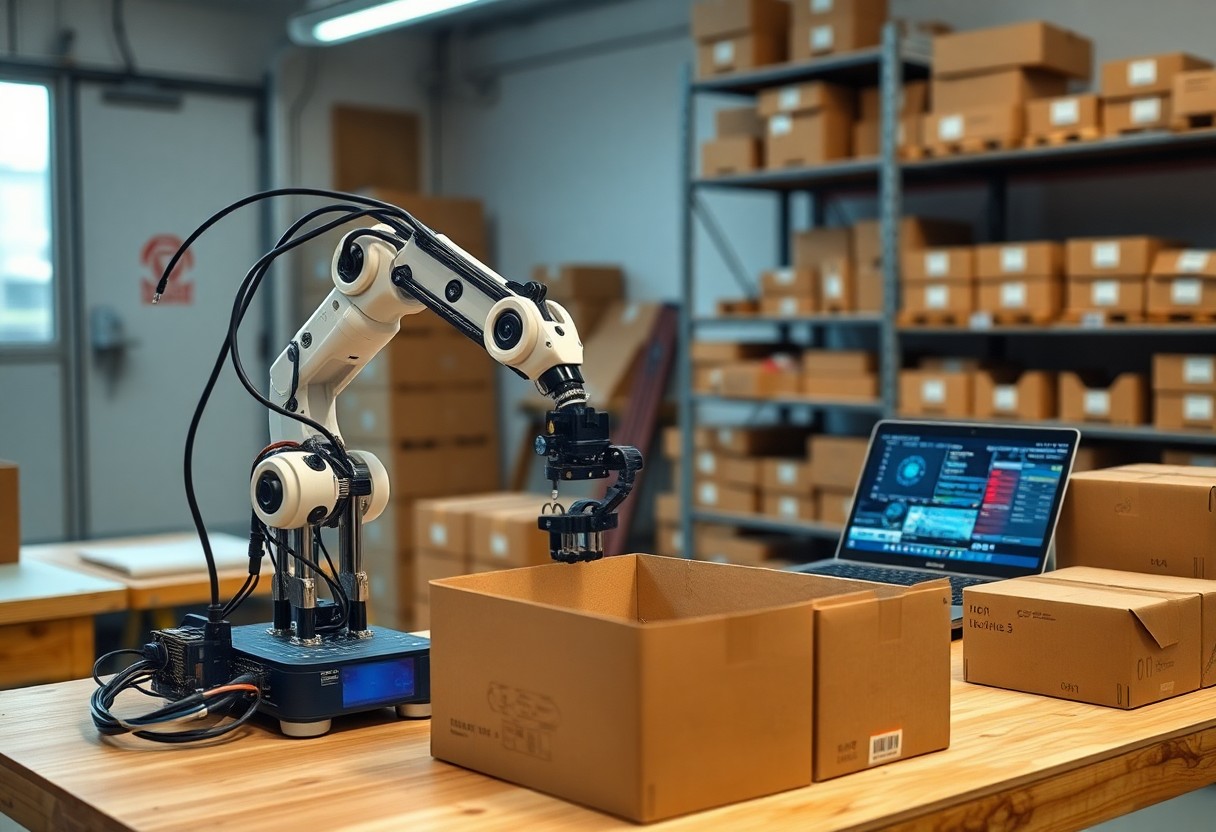
It’s now possible to deploy affordable, modular Low-Cost robots. They streamline repetitive tasks, boost productivity, and lower labor costs. You can scale automation using cloud-based control, pay-as-you-go platforms, and plug-and-play components. This lets your operation improve quality, shorten lead times, and achieve faster ROI. At the same time, it keeps flexibility for future growth.
The Rise of Low-Cost Robotics
Historical Context
Automation used to be out of reach for small businesses. A basic industrial arm cost $30,000-$100,000, and systems took months to integrate. Warehouse pioneers like Kiva demonstrated the payoff but targeted Amazon-scale operations. SMEs remained reliant on manual labor. Over the past decade, hardware costs have dropped, and cloud tooling improved. Now, you can automate repetitive tasks without an enterprise budget.
Technological Advancements
Sensing, compute, and software advances allow you to build capable robots on a budget. Raspberry Pi 4 boards (~$35), Intel RealSense cameras (~$150), and Jetson Nano kits (~$99) bring vision and edge AI to small cells. Open-source ROS offers over 2,000 community packages. Low-cost actuators like the Dobot arm (~$1,600) reduce development time. This enables pick-and-place, inspection, and simple assembly at prices that were once unimaginable.
You can pair commercial AMRs ($25k-$50k) with inexpensive 3D-printed grippers (Ender 3 printers cost ~$200). Modular grippers priced in the low thousands automate material handling. Pretrained machine vision models reduce training data needs. Tools like ROS2, Docker, and TensorRT make deployment repeatable. Small bakeries, machine shops, and e-commerce sellers have reduced labor hours by 20-40% using these off-the-shelf components in tightly scoped workflows.
Benefits of Robotics for Small Businesses
Robots help lower costs, boost speed, and improve quality. Cobots priced $15,000-$45,000 automate pick-and-place, packaging, and inspection without massive capital. Many operators see payback in 6-18 months. Combining robotics with simple MES or vision systems accelerates ROI. For instance, a small contract manufacturer doubled PCB line output by adding two collaborative robots and a camera-guided feeder. Lead times and defects dropped while headcount stayed steady.
Cost Efficiency
Automation reduces labor expenses and error-related waste. Leasing options allow startups to start under $1,000/month. Small food packagers report cutting packing labor by 50% with a $30,000 cobot cell. Heavy labor shifts to supervision and quality control. Energy and maintenance costs are predictable. Payback comes from fewer rejects, lower overtime, and higher machine utilization.
Increased Productivity
Robots ensure consistent cycle times and longer uptime. This allows shifts to run 24/7 without night-shift attrition. A small electronics shop doubled assembly throughput with two cobots and a parts feeder. Lead time fell from 5 days to 2. Standardizing tasks reduces variability, allowing throughput to scale linearly as you add cells.
Operationally, focus on OEE, cycle-time analysis, and takt-time matching. Measuring downtime sources cuts unplanned stops by 30-50% using sensor-driven alerts and scheduled maintenance. Pilot one cell, log cycle times, and balance downstream workstations. Adding vision inspection or lightweight conveyors often yields the largest marginal gains.
Types of Affordable Robotics Solutions
Small operations can deploy several low-cost robot classes. Options include simple pick-and-place arms or mobile movers that replace forklifts. Each class balances cost, footprint, and complexity. Understanding trade-offs helps you choose systems that deliver ROI within months rather than years.
-
Cobots: Safe collaborative arms for assembly and machine tending.
-
AGVs/AMRs: Autonomous transport for warehouses and factories.
-
SCARA/Delta Arms: High-speed pick-and-place for packaging.
-
Desktop/Benchtop Robots: Prototyping and light-assembly automation.
-
Vision + Bin-Picking Kits: Add intelligence to low-cost manipulators.
| Solution | Typical use / Ballpark cost |
|---|---|
| Collaborative Robots (Cobots) | Assembly, machine tending; $15,000-$45,000 |
| Automated Guided Vehicles (AGVs / AMRs) | Material transport, order consolidation; $20,000-$100,000 |
| SCARA / Delta Arms | High-speed pick-and-place, packaging; $8,000-$30,000 |
| Desktop / Benchtop Robots | Small-part assembly, testing; $2,000-$10,000 |
| Vision & Bin-Picking Kits | Object detection for random parts; $3,000-$20,000 |
Collaborative Robots (Cobots)
Cobots handle light assembly, screw-driving, and machine tending. They work alongside operators without full guarding. Payloads range from 3 kg to 20 kg, with reach of 500-1,300 mm. Payback is usually 6-18 months when accounting for cycle-time gains and labor savings.
Automated Guided Vehicles (AGVs)
AGVs automate repetitive internal transport. Costs run $20,000-$100,000 depending on payload and autonomy. Speeds are 0.5-2.0 m/s, with battery runtimes of 6-12 hours. Implementations with magnetic tape or LiDAR-based navigation free up staff and reduce handling errors by 20-40%.
For fleet deployments, consider management software, navigation type (tape, QR, SLAM), and payload needs. AGVs range from 100 kg cart-pushers to 2,000+ kg tow tractors. Integration may require mapping, minor site modifications, or safety fencing. Cloud or local fleet controllers manage routing, charging cycles, and traffic to maintain utilization above 80%.