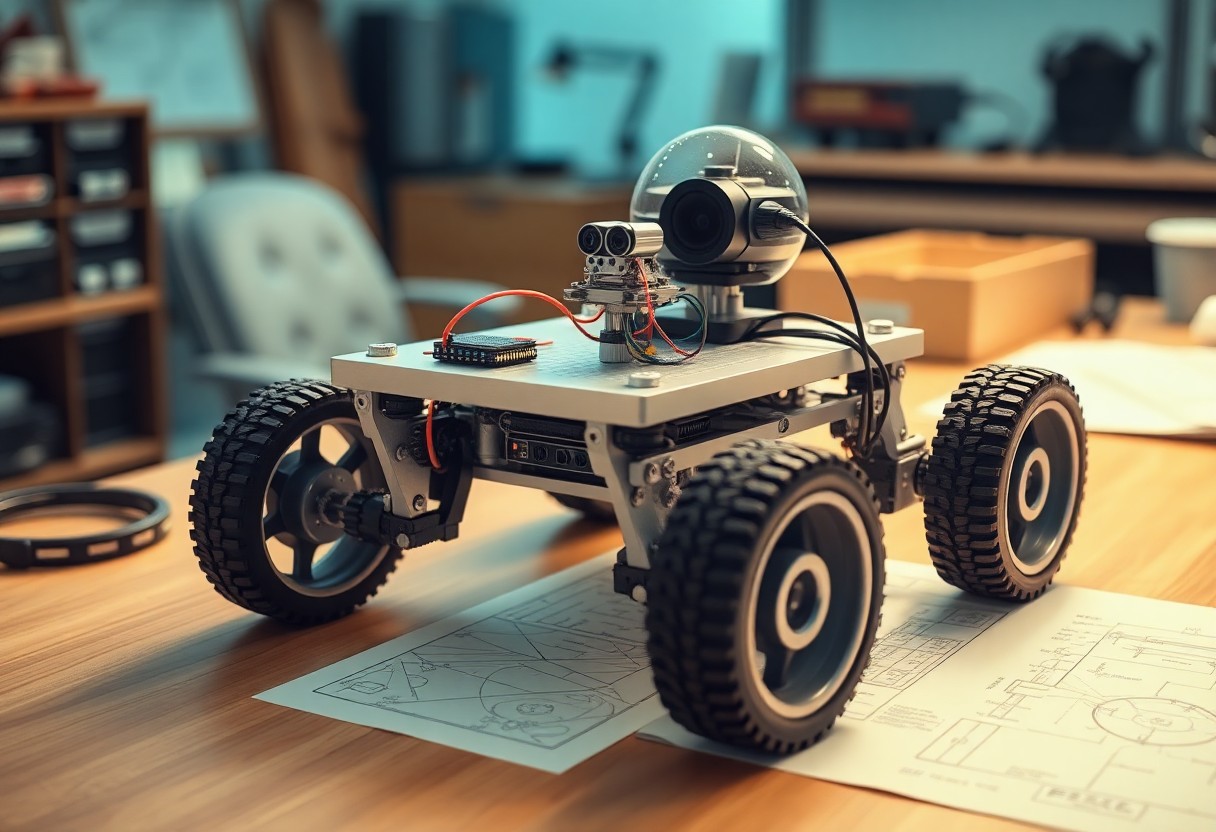
Most mobile robot projects ask you to balance power, sensing, locomotion, control, and materials while meeting weight and cost constraints. You should prioritize clear requirements, modular architecture, and testing to ensure predictable behavior in varied environments.
Mechanical Architecture and Locomotion
Mechanical layout sets wheelbase, center of gravity, and articulation; you should optimize placement for stability, payload clearance, and sensor fields while balancing mass and maneuverability to meet mission requirements.
Selection of Drive Configurations and Kinematics
Choose a drive configuration that matches terrain, speed, and control expectations; you can trade mechanical complexity for agility by selecting differential, skid, omni, or legged kinematics and pairing appropriate motors and controllers.
Structural Integrity and Material Selection
Assess structural requirements against expected static and dynamic loads, then select materials and section profiles that deliver stiffness, fatigue life, and manufacturability while minimizing mass to protect range and handling.
Calculate load paths and safety factors, run finite-element analysis on critical members, and evaluate aluminum, steel, and composite options for strength-to-weight, thermal behavior, corrosion resistance, and repairability; you should detail joint designs and fastener choices to ensure predictable failure modes and simplify maintenance.
Power Systems and Energy Management
Power systems shape endurance and performance, so you must size batteries, plan charging, and implement energy-aware control to meet mission profiles while minimizing weight and thermal limits.
Battery Chemistry and Capacity Optimization
You should select battery chemistry that balances energy density, cycle life, and safety, optimizing capacity for peak currents, depth-of-discharge, and expected runtime to reduce aging and maintain predictable voltage under load.
Power Distribution and Voltage Regulation
Design power distribution with clear voltage domains, proper fusing, and regulated buses so you protect sensitive electronics, control noise, and simplify fault isolation across the robot.
Routing cables by function and separating motor, logic, and sensor buses reduces EMI; you should use localized DC-DC converters, EMI filters, star grounding, and shielded lines. Include current sensing, thermal monitoring, soft-start circuits, and properly rated connectors and wire gauges to manage inrush and ensure safe continuous operation.
Sensing and Perception Systems
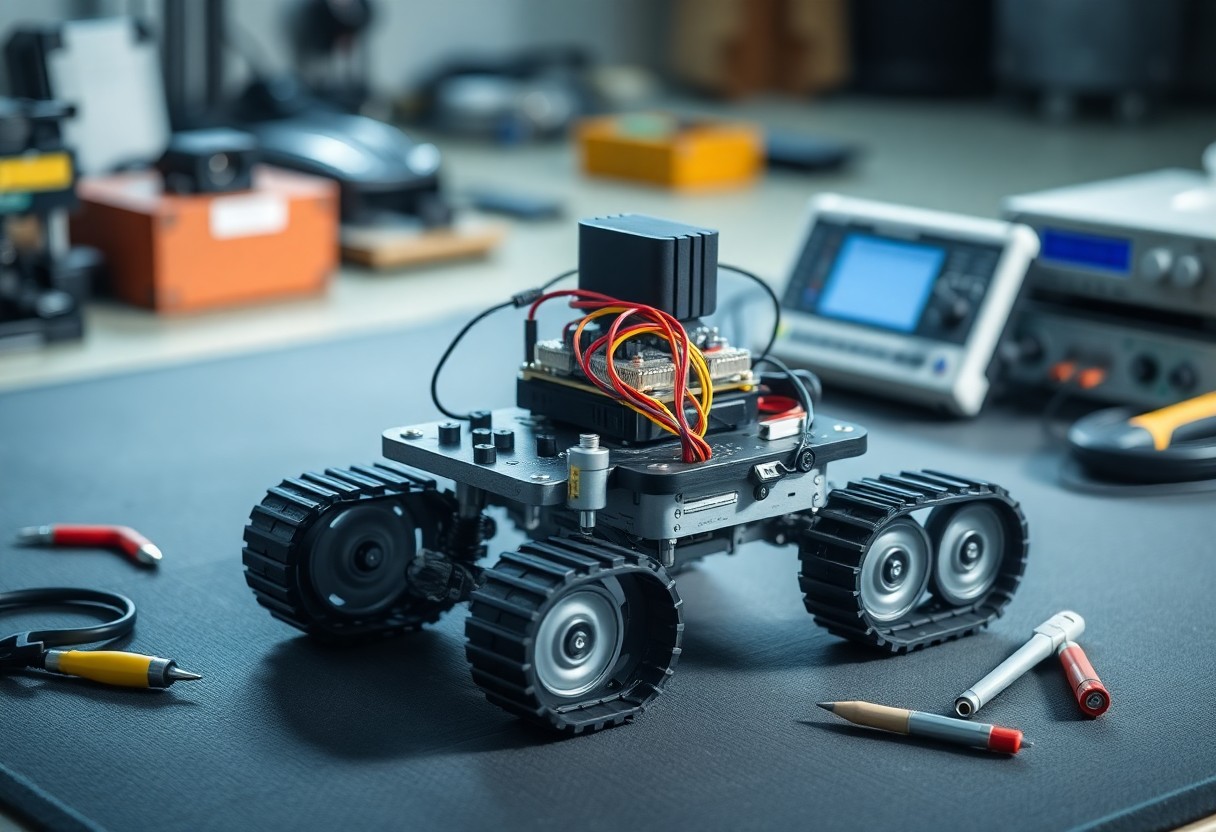
Sensors combine lidar, cameras, IMUs, and sonar so you can build reliable situational awareness, support real-time decision-making, and improve motion planning under varied conditions.
Environmental Mapping and Obstacle Detection
Mapping uses SLAM, occupancy grids, and point-cloud processing so you can detect obstacles, maintain local maps, and adapt routes while avoiding dynamic hazards.
Internal State Monitoring and Odometry
Odometry and sensor fusion let you track wheel slips, pose drift, and battery status to keep control loops accurate and schedule corrective actions.
Fusion of IMU, encoder, and vision data gives you continuous pose estimates; you can apply extended Kalman filters or particle filters to bound drift, detect wheel slip, and trigger recalibration with visual landmarks or GPS fixes when available.
Control Theory and Navigation Algorithms
Control systems let you fuse sensor data, manage state estimation, and steer motion; consult Design Principles Of Autonomous Mobile Robots: An … for applied design examples and trade-offs.
Motion Planning and Pathfinding Strategies
Planning algorithms help you compute collision-free routes, balance optimality with computation, and adapt to dynamic obstacles using sampling, graph search, or optimization methods.
Feedback Control and Stability Analysis
Feedback controllers let you track trajectories, reject disturbances, and bound errors using PID, state feedback, or model predictive approaches tailored to your platform.
Stability analysis guides you to choose controller structure and gains: linearize around operating points to inspect eigenvalues, apply Lyapunov functions for nonlinear guarantees, and test with sensor delays, actuator saturation, and estimator errors; you should validate margins via frequency-domain tests and iterate tuning on hardware-in-the-loop while documenting failure modes for recovery.
Embedded Systems and Software Frameworks
You should align embedded OS choices and hardware abstraction layers with sensor timing and power budgets, keeping interrupt latencies low and ensuring deterministic task scheduling so you meet control loop deadlines.
Middleware Integration and Real-Time Processing
Choose middleware like ROS 2 or micro-ROS to manage node lifecycles, real-time threads, and message priorities while you partition tasks between high- and low-latency domains.
Communication Protocols and Telemetry
Select transport stacks that match link quality-UDP for low-latency control, TCP or MQTT for reliable telemetry-and define compact, versioned message schemas so you preserve state and diagnostics.
Latency targets should drive link selection and buffering strategies: you must implement checksums, sequence numbers, adaptive retransmission, topic throttling, and optional encryption, while you collect timestamps and diagnostic metrics for post‑flight analysis.
Safety Protocols and Fail-safe Mechanisms
Prioritize layered safety measures so you can detect faults, isolate failures, and recover systems without hazardous motion. Combine supervisory controllers, watchdogs, and logging to enforce safe states and support post-incident analysis.
Redundancy in Critical Systems
Design redundant sensors, power paths, and control channels so you retain necessary capabilities during component failures; apply cross-checks and majority voting to avoid single-point failures and enable predictable degraded operation.
Emergency Stop and Collision Avoidance
Implement hardwired emergency-stop circuits combined with active obstacle detection so you can halt actuators instantly; ensure independent hardware stops override software to guarantee cessation of motion.
Integrate mechanical e-stops, monitored safety relays, and safety-rated controllers with lidar, time-of-flight sensors, and bump switches so you detect hazards across ranges and modalities; tune detection latency and braking profiles to your robot’s mass and speed, validate stopping distances through measured tests, and require deliberate reset procedures with clear operator feedback before resuming movement.
Final Words
On the whole you should prioritize clear requirements, modular hardware, efficient control algorithms, careful power management, and iterative testing to produce dependable mobile robots; follow standards, plan for sensors and safety, and validate performance in real environments to ensure successful deployment.