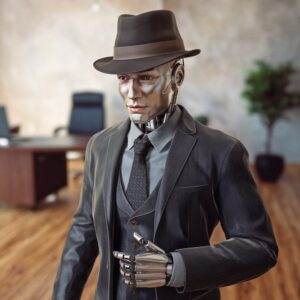
With advances in sensor fusion, learning algorithms, and tactile materials, you can enable your robots to perceive environments through sight, sound, and touch simultaneously; this multimodal approach improves reliability, situational awareness, and human-robot interaction by combining complementary cues, mitigating single-sensor failures, and enabling richer object understanding, navigation, and collaborative manipulation in real-world settings.
The Basis of Multi-Modal Perception
You rely on complementary sensors-cameras (30-60 Hz), IMUs (100-1000 Hz), LiDAR (5-20 Hz), microphones, and tactile arrays-to cover different spatial, temporal, and noise characteristics; effective systems solve calibration, time synchronization, and sensor noise modeling to fuse these streams, using classical estimators or learning-based fusion so your robot maintains accurate state estimates and environment models even when one modality degrades.
Understanding Sensory Integration
You align sensor frames and timestamps, model each sensor’s error characteristics, and choose fusion strategies-EKF/UKF or particle filters for state estimation, and early/late fusion CNNs or attention models for perception; for example, visual-inertial odometry pairs 30 Hz images with 400 Hz IMU bursts to reduce drift in drones and AR devices, delivering robust pose estimates over seconds to minutes.
Importance in Robotics
You see multi-modal perception in self-driving cars (Waymo combining LiDAR, radar, cameras), legged robots (Boston Dynamics using proprioception plus vision), and tactile-enabled manipulators that close the loop on contact tasks, enabling perception under occlusion, adverse weather, or contact-rich interactions where a single sensor would fail.
You must also handle system-level constraints: fusion reduces false positives and increases resilience but adds compute, bandwidth, and latency challenges-planning loops often need 10-100 ms, so you distribute processing (GPU/FPGA, edge CPUs) and prioritize high-rate IMU updates for control while aggregating lower-rate LiDAR/camera data for mapping; teams in DARPA SubT and autonomous-vehicle deployments illustrate these trade-offs in practice.
Vision in Robotics
You push cameras, depth sensors, and event-based imagers into your robot to convert pixels into actionable maps, object poses, and motion cues. Systems using 1920×1080 stereo rigs at 30-60 FPS or Intel RealSense depth modules generate dense point clouds for grasp planning, while event cameras add low-latency motion cues below 1 ms. Modern pipelines fuse convolutional backbones and transformer heads to output segmentation, 6-DoF poses, and depth estimates that your planner uses for real-time interaction.
Techniques for Visual Recognition
You adopt architectures like ResNet/EfficientNet backbones or ViT hybrids and real-time detectors such as YOLOv7/YOLOv8 for object detection, achieving mAP scores in the 0.5-0.8 range depending on dataset and augmentation. Pose estimation uses DenseFusion or PVNet for 6-DoF outputs, while instance segmentation relies on Mask R-CNN or Detectron2. Transfer learning, domain randomization, and synthetic-to-real fine-tuning let you run accurate models on edge GPUs (Jetson Xavier/Orin) at 10-60 FPS.
Applications of Vision Systems
You deploy vision for warehouse bin-picking (Amazon-style systems), AGV navigation, quality inspection, and inspection robots like Boston Dynamics Spot with cameras for site surveys. In manufacturing, high-resolution imaging detects surface defects down to ~0.1 mm; in logistics, vision-guided arms reach >95% pick success for varied SKUs. Autonomous vehicles combine multi-camera rigs with LiDAR for perception stacks used by Waymo and others to handle complex urban scenes.
You integrate vision with tactile and force sensing to close feedback loops: combining 3D vision for grasp planning with tactile confirmation boosts pick-and-place success rates above 95% in many labs. Calibration matters-extrinsic camera accuracy below 5 mm and latency under 30 ms are common targets. You also leverage ROS, OpenCV, and task-specific datasets (YCB, T-LESS) to reproduce benchmarks and iterate models quickly in deployment.
Auditory Processing in Robots
You outfit robots with microphone arrays, DSP pipelines, and neural models to turn waveforms into spatial cues and semantic labels; typical deployments use 2-8+ mics sampled at 16 kHz, combine GCC‑PHAT or SRP‑PHAT for localization, and apply CNN/RNN-based classifiers for speech and event detection. Amazon Echo’s 7‑mic array and Microsoft Kinect’s 4‑mic array illustrate how beamforming plus neural front-ends let you extract voices in far‑field, reverberant rooms for downstream planning and interaction.
Sound Localization and Identification
You estimate direction-of-arrival (DoA) via TDOA and beamforming, with GCC‑PHAT and SRP‑PHAT robust in reverberation while MUSIC or learned DoA networks raise angular resolution. Commercial arrays typically achieve 5-15° accuracy in indoor settings; with larger apertures or deep models you can reach sub‑5° localization. After separation, spectrogram-based CNNs or transformer models classify sound events, enabling you to distinguish speech, alarms, footsteps, or machinery noises in real time.
Impact on Interaction Capabilities
You use auditory cues to manage turn-taking, proxemics, and navigation toward speakers; low-latency pipelines under ~200 ms keep conversations natural. Speaker diarization and voice biometrics let your robot personalize responses, while emotion detection from prosody helps adapt assistance in eldercare or customer service. Platforms like SoftBank’s Pepper combine multi‑mic audio with vision so you can orient, gesture, and respond to users more fluidly in crowded environments.
For example, fusing audio with visual lip cues can cut speech-recognition errors by up to ~30% in noisy scenes, and beamforming typically delivers 6-12 dB SNR improvement depending on geometry. You implement 20-30 ms analysis frames and real‑time beamformers to preserve timing, and field tests show these enhancements speed task completion and reduce false activations in service-robot deployments.
Tactile Sensing Technologies
You layer tactile arrays and single-point sensors onto links and fingertips to capture contact forces, shear, vibration, and temperature; sampling typically runs from 100-2,000 Hz, force sensitivity spans millinewtons to tens of newtons, and spatial resolution ranges from sub-millimeter (optical tactile imagers) to centimeter-scale taxels (soft skins). You deploy these sensors in hands, grippers, and wearable sleeves to close the loop on grasp stability, slip detection, and object compliance estimation.
Types of Tactile Sensors
You choose among piezoresistive and capacitive taxels, piezoelectric vibration pickups, optical tactile imagers like GelSight (sub-50 µm surface detail), and MEMS-based force sensors for compact integration. Any selection depends on contact area, force range (mN-N), spatial resolution (sub-mm-mm), and bandwidth (100-2,000 Hz).
- Piezoresistive: simple readout, used in gripper pads for 0.1-10 N ranges.
- Capacitive: low noise, good for conformal skins and 0.01-5 N sensing.
- Optical (tactile cameras): high spatial resolution for texture/shape capture.
- Piezoelectric: excellent for high-frequency slip/vibration detection.
- MEMS/strain gauges: compact, used in fingertip modules and joint sensors.
| Piezoresistive | Low-cost arrays; 1-5 mm taxel pitch; used in industrial grippers for contact force mapping. |
| Capacitive | Conformal skins (e.g., humanoid torso); high SNR, good for proximity and touch down to tens of mN. |
| Optical (GelSight) | Micron-scale surface imaging; resolves texture and slip for in-hand manipulation and quality inspection. |
| Piezoelectric | High-frequency response (>1 kHz); detects micro-slip and vibration signatures for early slip correction. |
| MEMS / Strain | Compact fingertip modules; integrates force/torque sensing with bandwidths suitable for closed-loop control. |
Role in Human-Robot Interaction
You use tactile feedback to make physical interactions safer and more intuitive: fingertip sensors enable compliant handovers, whole-arm skins detect unplanned contact during navigation, and vibration channels signal subtle events to prosthesis users; many studies show tactile feedback reduces force overshoot and improves task success in manipulation.
For example, integrating a BioTac-style multimodal fingertip (pressure, vibration, temperature) lets you detect slip onset within tens of milliseconds and modulate grip force before object loss; in collaborative assembly tasks, capacitive forearm skins with ≈100-500 taxels provide contact localization to trigger compliant behaviors, and optical tactile sensors let you discriminate textures and small defects during guided inspection.
The Synergy of Multi-Modal Systems
When you fuse streams-cameras (30-60 Hz), IMUs (100-1000 Hz), LiDAR (5-20 Hz), microphones and tactile arrays-you resolve ambiguities each sensor leaves. Research such as Multi-Modal Perception with Vision, Language, and Touch … shows pipelines that align timestamps, calibrate frames, and use learned cross-modal embeddings to improve pose estimates and object identity in cluttered scenes like YCB benchmark bins.
Enhancing Decision-Making
You reduce false positives and tighten control by letting modalities confirm or veto one another: audio flags a contact event, touch measures force, and vision verifies pose. Practical systems use probabilistic fusion or late-stage attention networks to combine cues, align latencies within tens of milliseconds, and feed policies that adapt grasp strategies or locomotion gaits based on combined confidence scores.
Real-World Applications
You deploy multi-modal robots in warehouse picking, prosthetic hands, surgical assistants, inspection drones, and autonomous vehicles; each domain exploits different pairings-vision+touch for grasping, vision+audio for situational awareness, IMU+LiDAR for odometry. Benchmark suites like DEX-Net and YCB help validate these stacks under clutter, varying lighting, and partial occlusion.
For example, in bin-picking you rely on tactile sensors to detect slip that vision misses under occlusion, letting you replan grasps without human intervention. In prosthetics, pressure sensors plus vision let users differentiate fragile versus rigid objects, improving grip force modulation and reducing object drops during everyday tasks.
Challenges in Multi-Modal Perception
Integrating vision, audio, and tactile streams forces you to manage mismatched data rates (cameras at 30-60 FPS vs. LiDAR at 100k-1M points/s), synchronization in the microsecond-to-millisecond range, and divergent noise models; latency budgets for reactive control often sit under 100 ms, so you must balance throughput, on-board compute, and robustness to sensor dropouts while preserving real-time decision quality in cluttered, dynamic environments.
Technical Limitations
You confront hard hardware and algorithmic limits: state-of-the-art models can exceed hundreds of millions of parameters, pushing memory and power beyond typical embedded platforms (Jetson-class devices consume ~10 W+ under load). Calibration drift (IMU bias, camera-LiDAR extrinsics), limited labeled multi-modal datasets, and sim-to-real gaps force you to use pruning, quantization, domain adaptation, and sensor redundancy to meet latency, bandwidth, and reliability targets.
Ethical Considerations
Your systems raise privacy, fairness, and accountability issues: sensor fusion amplifies surveillance capability, invoking GDPR constraints (fines up to 4% of global turnover or €20M) and consent requirements; dataset bias produces disparate performance-studies like Gender Shades found error gaps up to ~34% for darker-skinned females versus under 1% for lighter-skinned males-so you must audit models and data continuously.
Beyond bias and privacy, you must plan for adversarial and safety risks: physical adversarial patches can make objects undetectable in lab tests, and multimodal fusion can obscure fault attribution in incidents, complicating liability. Practical mitigations you should deploy include provenance-tagged datasets, explainable fusion pipelines, on-device anonymization, and routine cross-demographic evaluation with clear remediation paths.
Conclusion
With this in mind, you can appreciate how integrating sight, sound, and touch enables robots to interpret complex environments, adapt behaviors, and interact safely with people and objects; advancing sensor fusion, learning algorithms, and robust hardware will let you deploy more capable, reliable multi-modal systems that meet real-world demands.