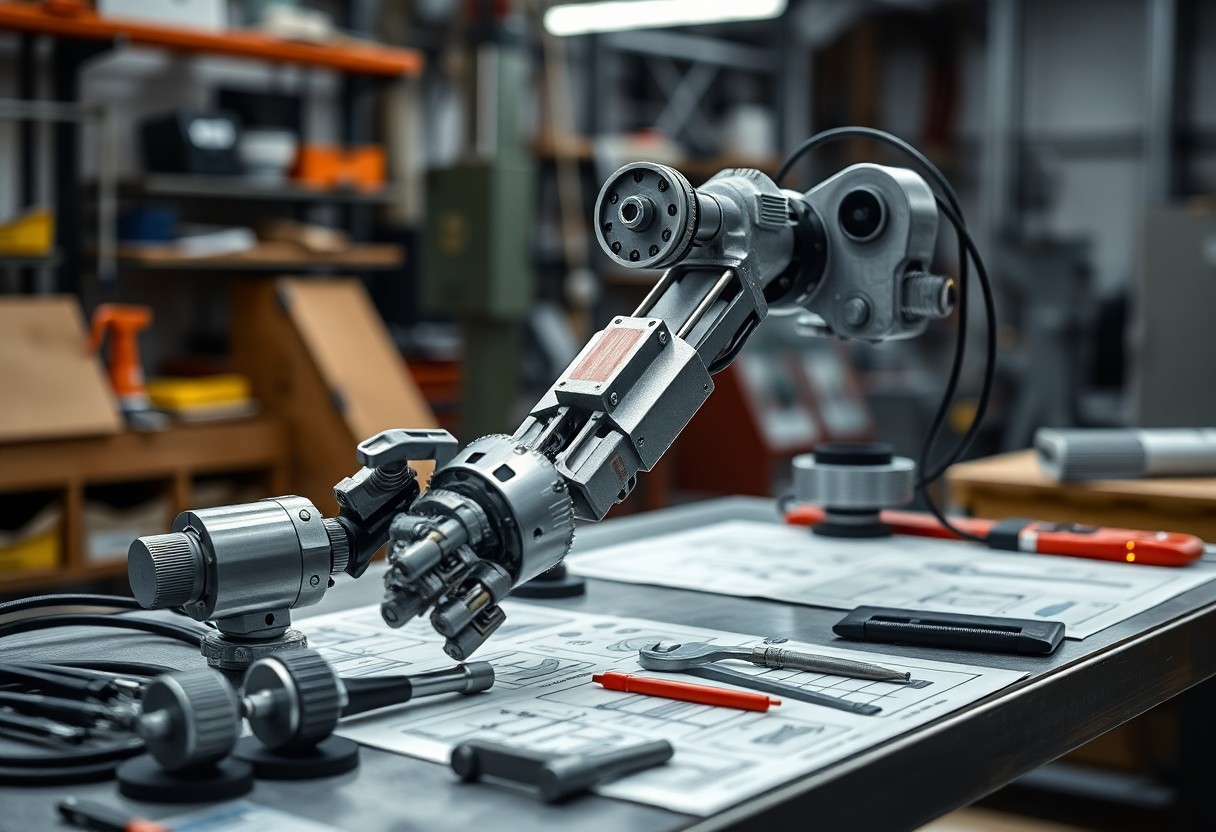
You design link lengths and joint angles to achieve precise kinematics, while assembling motors, sensors, and fasteners with care; accuracy drives performance, sharp pinch points present danger, and servo torque enables strong, repeatable motion.
Mechanical Design and Component Selection
You should match structural requirements, actuator specifications, and safety margins when choosing parts; prioritize load capacity and fail-safe features to prevent catastrophic failure.
Structural Material Properties and Load Bearing
Material selection defines stiffness, mass, and fatigue life; you must calculate bending, shear, and factor of safety so that stress stays below allowable limits to avoid structural failure.
Actuator Selection: Torque and Precision Requirements
Actuators must provide required torque, speed, and positional accuracy; you should size motors with an overload margin while ensuring precision for closed-loop control.
Sizing actuators requires calculating torque at each joint from payload, link lengths, and acceleration profiles; you must separate continuous and peak torque, include gearbox ratios, account for backlash, and verify thermal limits and driver current to avoid motor stall or overheating. Encoder resolution, control bandwidth, and mechanical coupling determine whether you achieve the positional repeatability necessary for your tasks.

Forward Kinematics and Coordinate Frames
Frames anchor each joint’s origin and orientation so you compute the end-effector pose by chaining transforms; assign them consistently to avoid mismatches, since incorrect frame assignment causes major errors.
Denavit-Hartenberg (D-H) Parameterization
D-H parameterization gives you four parameters per link to express joint relationships compactly; use standardized D-H frames and document axis directions to prevent sign and indexing errors.
Spatial Transformation and Workspace Mapping
Transforms let you map joint angles to Cartesian positions so you can visualize the reachable workspace; watch for singularities that reduce controllable directions and define safety limits.
Mapping the workspace requires converting joint-space trajectories into Cartesian paths using homogeneous transforms and rotation matrices so you can plan collisions and reachability. You should compute reachable sets, sample joint combinations, and visualize boundaries, highlighting singular configurations and maximum reach to set safe operating zones. Coordinate frame mismatches and numerical round-off can produce false singularities, so verify transforms and adopt consistent conventions.
Inverse Kinematics and Motion Planning
Kinematics requires you to compute joint trajectories that meet pose goals while avoiding obstacles and respecting joint limits; use real-time planners for responsiveness and collision checks to prevent dangerous contacts.
Analytical Solutions for Joint Positioning
Analytical methods give you closed-form joint angles for common geometries, providing fast and predictable results, though you must handle multiple solutions and enforce joint limits carefully.
Resolving Singularities and Redundancy
Singularities and redundancy require you to detect ill-conditioned poses and apply damping or null-space strategies; singular configurations can produce uncontrolled velocities and must be mitigated.
Monitoring the Jacobian condition number and determinant helps you detect proximity to singularity. When you approach a singular pose, apply damped least squares or a regularized pseudoinverse to limit joint velocity spikes. Exploit redundancy via null-space projection to optimize secondary objectives like joint limit avoidance and obstacle clearance. Limit commanded speeds and add torque caps to prevent dangerous torque spikes.

Control Systems and Electronic Architecture
Control systems coordinate sensors, actuators, and processors so you achieve predictable motion; you must design for low-latency feedback and clear signal routing to avoid interference and unsafe behavior.
Microcontroller Integration and Signal Processing
Microcontrollers handle real-time loops, ADC sampling, and comms; you should prioritize deterministic timing, debounce inputs, and implement filtering to prevent noisy commands reaching motors.
Power Distribution and Feedback Mechanisms
Power distribution requires proper fusing, regulated rails, and star grounding so you avoid short circuits and overcurrent that can damage drivers or create fire hazards.
Ensure your power architecture separates motor and logic domains, uses local decoupling capacitors, and employs isolated supplies where needed; you should include current sensing (shunt or hall) for torque limits, voltage monitoring for brownouts, and clamps/TVS diodes to absorb back-EMF. Feedback requires high-resolution encoders or torque sensors, consistent sampling, filtering, and a watchdog or interlock to cut power on fault conditions to prevent thermal runaway or mechanical damage.
Physical Assembly and Hardware Integration
Assembly demands you fit frames, motors, and sensors carefully; consult How could I start to build a robot arm with ROS? I need … for guidance, and test for electrical polarity and torque limits before power-up.
Structural Alignment and Joint Calibration
Align bearings and links to prevent binding; you must use gauges and shims, then run slow sweeps to set encoder zeroes and tune PID while observing joint torque limits.
End-Effector Integration and Cable Management
Attach end-effector modules with precise alignment and secure connectors; route cables with strain relief and color-coded labels so you can prevent snags and maintain signal integrity.
Secure actuators and tool interfaces with torque-specified fasteners, check connector polarity, and route high-current lines separately; you should add braided shielding and zip-tie anchors to reduce wear, and mark quick-disconnects for emergency removal to avoid pinch points and electrical faults.
Software Implementation and Testing
Code must integrate kinematics, sensor inputs, and safety checks so you can run controllers and test behaviors; enforce hardware limits and watch for collision risks during dry runs.
Trajectory Generation and Motion Profiling
Trajectory planning should produce time-optimal, smooth paths so you can achieve precision without exciting resonances; apply jerk-limited profiles and cap velocities to protect gears and ensure repeatable motion.
System Validation and Error Compensation
Validation routines verify kinematics, encoder offsets, and backlash so you can quantify errors; implement closed-loop tests and online compensation tables to reduce drift and flag any safety failures.
Testing should combine static calibration, dynamic path repeats, and thermal cycling so you can map systematic errors across the workspace. Use precision fixtures and external measurement (laser tracker, camera) to build a pose-error grid, then apply interpolation or model-based compensation and tune PID plus feedforward terms to minimize residuals. Monitor torque and proximity sensors to enforce safety limits and log anomalies; successful compensation yields improved accuracy, while unaddressed offsets can cause collision or part damage.
To wrap up
Upon reflecting, you will see that mastering kinematics and careful assembly lets you predict motion, reduce errors, and build a reliable robot arm; apply systematic joint modeling, precise alignment, and iterative testing to achieve repeatable performance and safe operation.