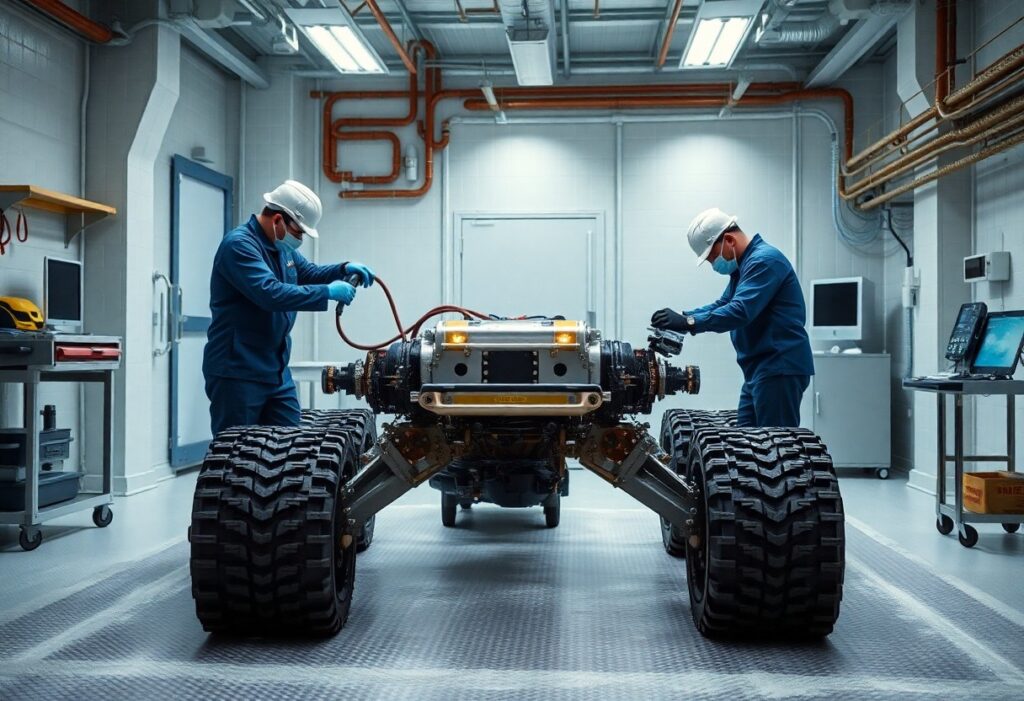
Just know that when you choose materials, aluminum offers lightweight strength and corrosion resistance, steel provides high load capacity but heavier weight and rust risk, and plastics give cost-effective versatility with possible brittleness and flammability.
Steel and Ferrous Metals: Durability for Heavy-Duty Systems
Steel and ferrous alloys give you unmatched durability for heavy-duty robot frames, resisting wear under repeated impacts and high temperatures while requiring attention for corrosion and weight trade-offs.
High Tensile Strength and Fatigue Resistance
Alloys with high tensile strength provide you with greater load capacity and fatigue resistance, extending service life under cyclic stresses but demanding proper heat treatment and inspection.
Applications in Load-Bearing Joints and Industrial Manipulators
Joints built from steel deliver you secure connections for heavy manipulators, offering high load endurance while increasing system mass and requiring careful stress-relief and welding standards.
You should target fatigue-prone locations such as wrist couplings and shoulder pivots, applying heat-treated steel, finite-element-validated geometries, controlled weld procedures, and corrosion protection; neglect raises risk of catastrophic failure, longer downtime, and higher maintenance costs.
Engineering Plastics and Polymers: Versatility and Insulation
You get lightweight, corrosion-resistant parts that deliver excellent electrical insulation and thermal isolation, while watching for flammability and off-gassing at high temperatures that can compromise safety and bonding.
Low-Friction Thermoplastics: Delrin and PTFE
Delrin gives you low friction, dimensional stability, and easy machining, while PTFE supplies ultra-low friction and chemical inertness; expect creep under load from PTFE and the risk of toxic fumes if overheated.
Impact Resistance and Transparency of Polycarbonates
Polycarbonates offer you high impact resistance and clear optics for glazing and lenses, enabling lighter assemblies, but they can scratch easily and may release BPA when heated, affecting use in hot environments.
Consider how polycarbonate’s combination of exceptional impact resistance and optical clarity lets you replace glass with thinner, lighter parts that you can thermoform or machine; protect surfaces with coatings or choose UV-stabilized grades to mitigate scratch susceptibility and UV degradation, and avoid prolonged heat exposure to reduce the chance of BPA leaching and fire hazards-flame-retardant variants are available when you need higher temperature safety.
Material Selection Criteria for Robotic Frameworks
Material selection shapes how you meet payload, stiffness, and durability goals; consult Selecting the Right Material for Robotics: Plastics, Metals, and … for trade-offs. Prioritize weight, stiffness, and fatigue resistance when you design structural components.
Evaluating Stiffness, Density, and Elastic Modulus
Stiffness governs deflection under load, so you compare elastic modulus and density to balance rigidity against mass; choose materials that keep deflection within tolerances while minimizing inertial penalties for dynamic control.
Cost-Efficiency vs. Performance Requirements
Budget constraints force you to weigh upfront material cost against lifecycle expenses; sometimes choosing a slightly heavier alloy reduces maintenance and yields a better total cost of ownership for production robots.
Trade-offs between material price and performance require you to model expected loads, duty cycles, and failure modes; high-strength steel reduces section size but increases weight and corrosion risk, aluminum lowers mass yet can raise fatigue and cost, and plastics cut cost but introduce creep and thermal limits. Use FEA, supplier reliability, and lifetime maintenance estimates to justify choices and mitigate safety and performance risks.
Environmental Resistance and Surface Treatments
Coatings and surface finishes extend service life by blocking moisture, salts, and UV; you should select anodizing for aluminum, powder coat for wear, or passivation for stainless steel to reduce failure and maintenance costs.
Corrosion Mitigation in Metallic Components
Metals exposed to electrolytes suffer galvanic corrosion; you must manage material pairing, use sacrificial anodes, apply coatings, and ensure proper drainage to prevent rapid degradation of structural parts.
Chemical Stability and Dielectric Properties of Polymers
Polymers resist many solvents and offer useful dielectric insulation; you should evaluate chemical attack, UV embrittlement, and flammability when choosing plastics for load-bearing or electronic enclosures.
Testing helps you quantify dielectric constant, dissipation factor, and breakdown voltage to ensure safe insulation near actuators and sensors. Select flame-retardant and UV-stable grades where exposure occurs. Aggressive solvents, acids, or heat can cause swelling and loss of strength, leading to cracks or electrical failure. Use accelerated aging and compatibility charts to estimate service life.
Conclusion
With this in mind, you should choose aluminum for lightness and corrosion resistance, steel for strength and durability, and plastics for cost-effective, flexible parts; balance material properties against load, environment, and manufacturability to optimize robot performance.