
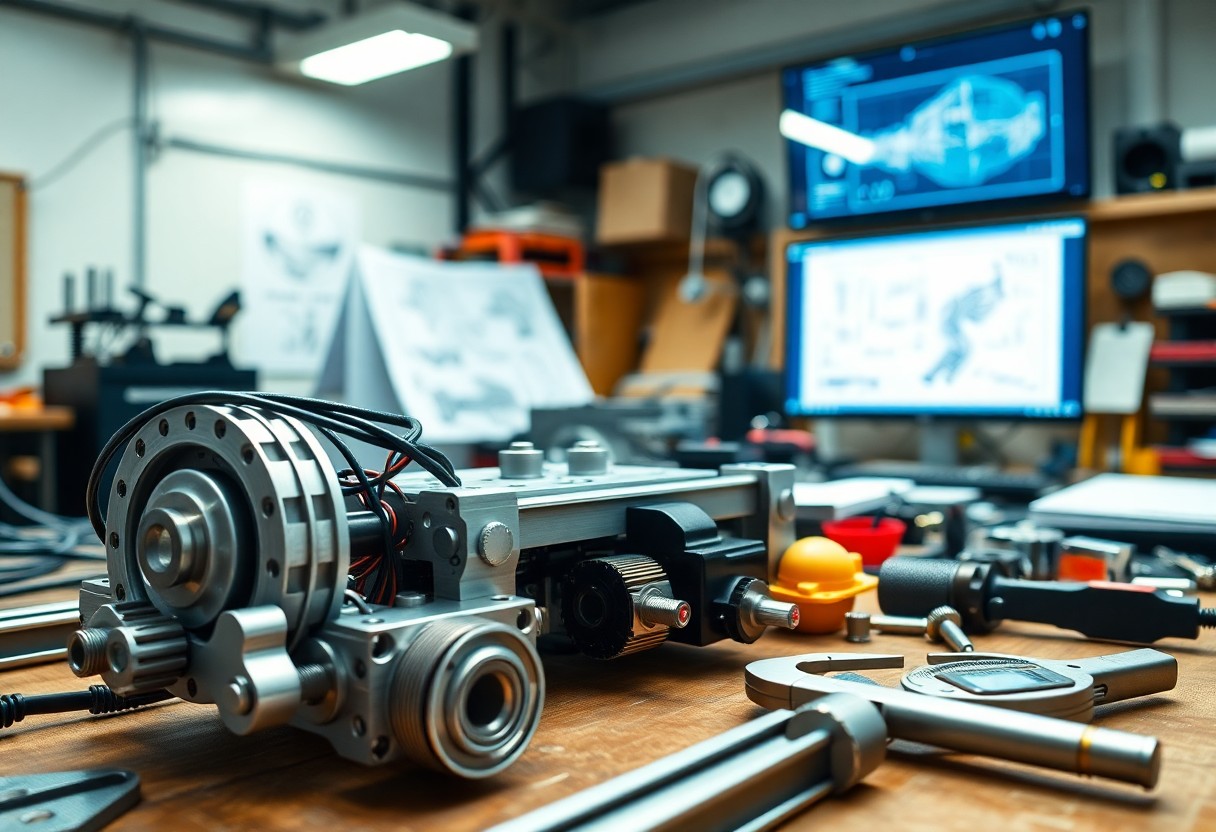
Mechanical Engineering Basics for Robot Construction
Engineering principles guide your design choices, from material selection and structural framing to actuation and kinematics, enabling reliable, efficient robots while ensuring proper tolerances, load paths, and thermal management throughout the build process.
Kinematics and Linkage Design
Kinematics maps joint motions to end-effector trajectories; you assess linkage types, coupler geometry, and joint constraints to shape workspace, load distribution, and achievable precision.
Degrees of Freedom and Coordinate Systems
Degrees of freedom set possible motions; you assign coordinate frames, pick Denavit-Hartenberg or Cartesian conventions, and constrain axes to simplify control and collision avoidance.
Forward and Inverse Kinematics Analysis
Forward kinematics gives pose from joint values, while inverse kinematics computes joint configurations for a target pose; you choose analytical solutions when available or iterative solvers for complex chains.
Analytical methods provide closed-form inverse solutions for simple serial chains, letting you compute joints quickly and deterministically; for redundant or constrained systems you apply Jacobian-based numerical techniques, use damped least squares to handle singularities, enforce joint limits and collision constraints through optimization, and seed solvers with good initial guesses to ensure convergence and smooth motion.
Structural Materials and Fabrication
Choosing structural materials and fabrication methods shapes your robot’s durability, mass distribution, and manufacturability. You should weigh alloys, composites, and plastics for load paths and joining techniques, and factor assembly tolerances and cost so you reduce failures and simplify maintenance.
Material Properties: Strength-to-Weight Ratios
Compare specific strength-to-weight ratios when selecting beams, frames, and links so you meet payload and agility targets. You should also consider stiffness, fatigue life, and environmental resistance to match use cases and extend service intervals.
Precision Machining and Additive Manufacturing
Machining gives you tight tolerances and repeatable fits for bearings and gears, while additive processes let you create complex, lightweight geometries you can’t mill. You should choose methods based on required accuracy, surface finish, and production volume.
Additive manufacturing lets you consolidate assemblies, reduce fasteners, and optimize lattices to cut mass while maintaining stiffness, but you must validate parts for anisotropy, layer adhesion, and post-processing. You should use CNC milling or EDM when micron tolerances, predictable grain structure, and fatigue performance are required for critical components.
Actuation Systems and Power Transmission
Actuators connect your control signals to mechanical motion; select them by force, speed, duty cycle, and efficiency to match payloads and tasks. You must consider power sources, mounting, and control interfaces to ensure reliable robot motion.
Motor Selection and Torque Requirements
Motors must deliver required torque at operating speeds; calculate stall, continuous, and startup torques, then match gear reduction and current limits. You should test predicted loads with safety margins and consider thermal limits for prolonged operation.
Gear Trains, Belts, and Mechanical Advantage
Gears, belts, and pulleys change torque and speed; calculate reduction ratios to deliver required output while minimizing backlash and wear. You must balance efficiency, size, and alignment to preserve accuracy and service life.
Selecting gear types involves trade-offs: spur for simplicity, helical for smoothness, bevel for direction changes, and planetary for compact torque density. You need to size belts for tension and slippage, choose materials for wear and lubrication, and calculate expected efficiency and backlash to meet positional and endurance requirements.
Structural Integrity and Stress Analysis
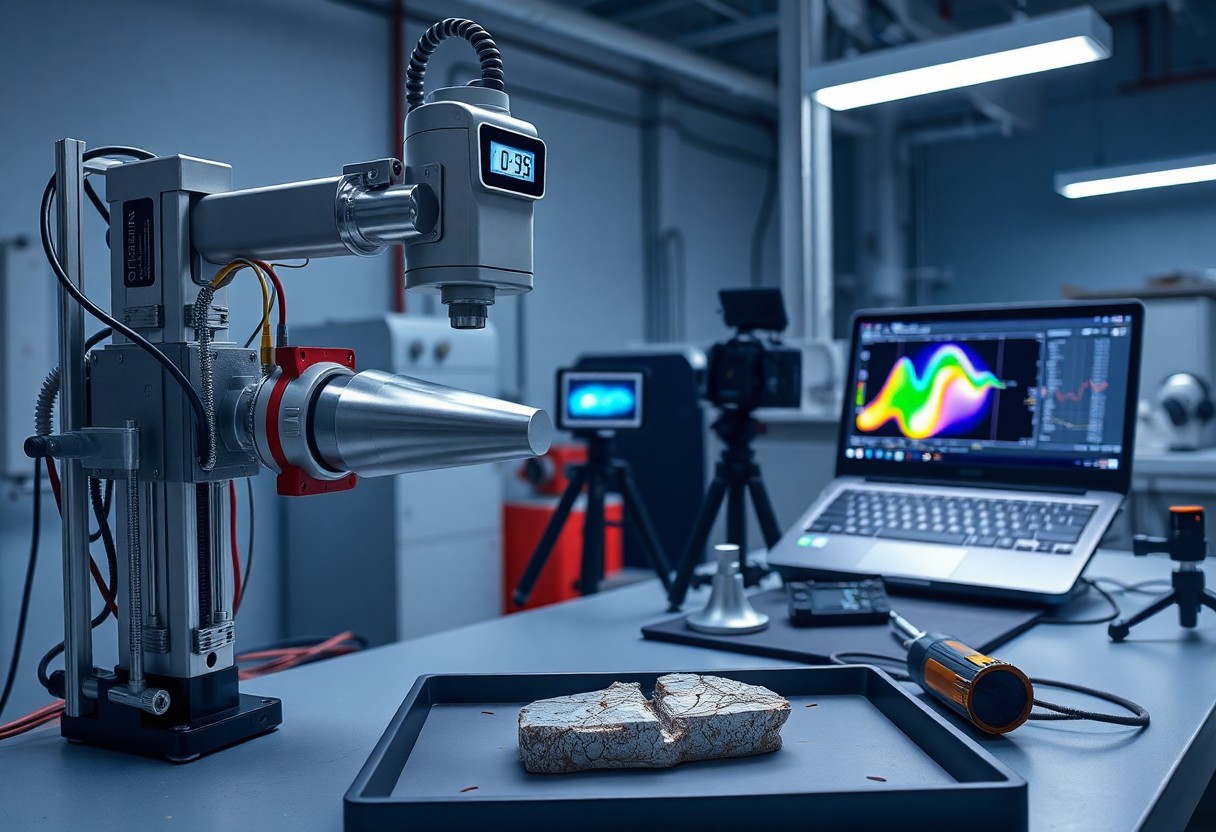
Structure and material selection determine how your robot handles loads; you should apply safety factors, avoid stress risers, and verify designs using finite element analysis to prevent failures under expected operating conditions.
Static and Dynamic Load Distribution
Loads from gravity, actuators, and impacts distribute differently in static and dynamic scenarios, so you must model force paths, joint stiffness, and transient responses to ensure components carry expected stresses without excessive deformation.
Vibration Control and Damping Techniques
Damping and tuned absorbers reduce resonant amplitudes, and you can use material selection, tuned mass dampers, and compliant mounts to limit vibration transmission to sensitive components.
Design your vibration control strategy by first performing modal analysis to find natural frequencies and mode shapes; you should then decide between passive options (viscoelastic layers, tuned mass dampers, isolation mounts) and active control (sensors, actuators, feedback loops). Prototype with shaker tests, iterate stiffness and damping parameters, and validate with time-domain simulations and field testing to keep vibration within acceptable limits.
Sensing and Feedback Integration
Integration of sensors and feedback loops lets you maintain balance and refine motion by fusing encoder, IMU, and force data into controllers for smoother, adaptive robot behavior.
Position and Velocity Feedback Systems
Encoders and resolvers give you accurate joint position and velocity; combining them with IMUs and filtering yields stable closed-loop control and predictable trajectory tracking.
Force, Torque, and Tactile Sensing
Strain gauges, torque sensors, and tactile arrays enable you to sense contact, measure load, and implement overload protection for safer manipulation and compliant behavior.
Tactile arrays map pressure distribution across grippers while joint torque sensors detect unexpected loads, so you must calibrate sensors, apply filtering, and fuse signals into impedance or admittance controllers that let you regulate force, detect slip, adjust grip, and perform delicate assembly tasks.
Design for Assembly and Reliability
Assembly planning reduces fastener types, aligns tolerance stacks, and lowers build time; you should prioritize part accessibility and orientation to simplify assembly while keeping consistent mating features to improve long-term reliability.
Modular Architecture and Component Interfacing
Modules simplify upgrades and diagnostics, so you should standardize mechanical and electrical interfaces to allow drop-in replacements and reduce integration time.
Maintenance Protocols and Failure Analysis
Schedules for preventive checks and clear failure reporting let you detect wear patterns early; you should define inspection intervals, spare parts lists, and diagnostic checkpoints to shorten downtime.
Detailed maintenance records and structured failure analysis processes let you shorten repair cycles and improve designs. You should log timestamps, environmental conditions, sensor traces, and operator actions for each incident, run root-cause analysis with physical testing and simulations, and update your FMEA and spare-part lists based on trends. You should also define rollback procedures, acceptance tests after repair, and metrics for mean time between failures to guide component selection and design changes.
Summing up
The mechanical engineering basics give you the foundation to design durable frames, select actuators, size gears and bearings, calculate loads and thermal limits, and integrate motion control for reliable robot construction.