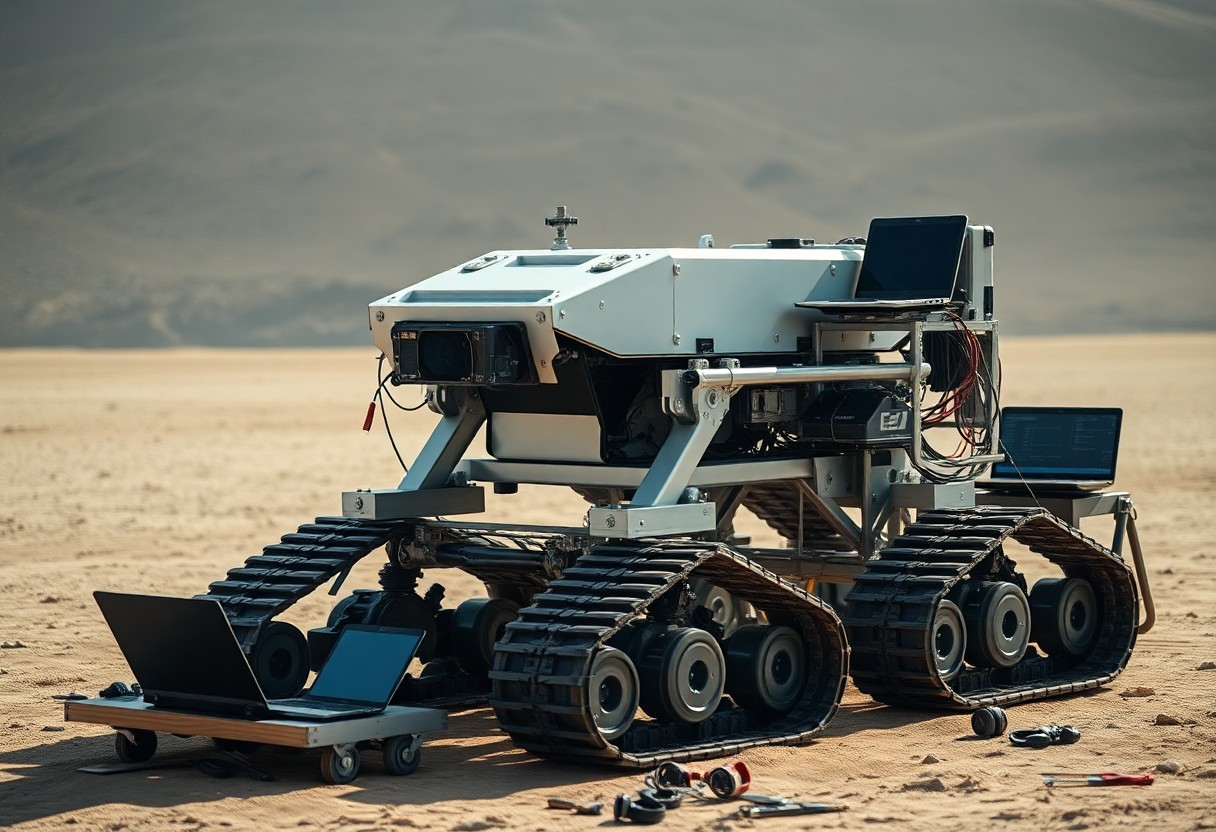
With clear objectives and practical constraints, you design a field-ready robot that balances mobility, power management, sensing, and rugged construction, and you plan components, test systems, and ensure reliable performance in remote environments.
Design Philosophy and Structural Engineering
You prioritize load paths, redundancy, and serviceability in structural engineering so field repairs are straightforward and failure modes are contained; design choices favor accessible fasteners, modular panels, and predictable deformation under overload.
Material Selection for Extreme Environments
Select corrosion-resistant alloys and high-performance composites that tolerate thermal cycling and abrasion while keeping weight manageable; you prioritize materials that simplify in-field repairs and reduce lifecycle maintenance.
Chassis Geometry and Terrain Adaptability
Design chassis geometry with adjustable ground clearance, articulated joints, and a low center of gravity so you maintain stability and traction across uneven ground while protecting critical components with sacrificial skid points.
When you tune wheelbase, track width, and suspension compliance, weigh trade-offs: longer wheelbases improve straight-line stability but limit obstacle clearance, while wider tracks raise roll resistance at the cost of added mass. Place batteries and heavy actuators low and central to lower center of mass, run finite-element analysis to locate stress concentrations, and specify modular mounts for sensors and tool carriers so you can swap payloads quickly during field missions.
Locomotion and Drive-Train Mechanics
Designing your drive-train requires balancing traction, efficiency and payload; integrate torque vectoring, redundant motors and modular gearboxes so you can handle varied terrains. See Developing a safer, more efficient autonomous robot for sensor-aware motion strategies.
Actuation Systems for Variable Topography
Choose actuators with wide torque bands, regenerative braking and programmable compliance so you can adapt drive outputs to slopes, ruts and slippery surfaces with minimal energy loss.
Suspension Dynamics and Stability Control
Optimize suspension geometry and damping rates to keep chassis attitude stable, maintain wheel contact and reduce sensor jitter so you can sustain control during rapid terrain changes.
Modeling suspension response with multibody dynamics and hardware-in-the-loop tests helps you tune spring rates, damper curves and active actuators. Use roll, pitch and yaw coupling metrics to shape control laws that keep wheels loaded, limit body motion and preserve sensor alignment under impacts and abrupt maneuvers.
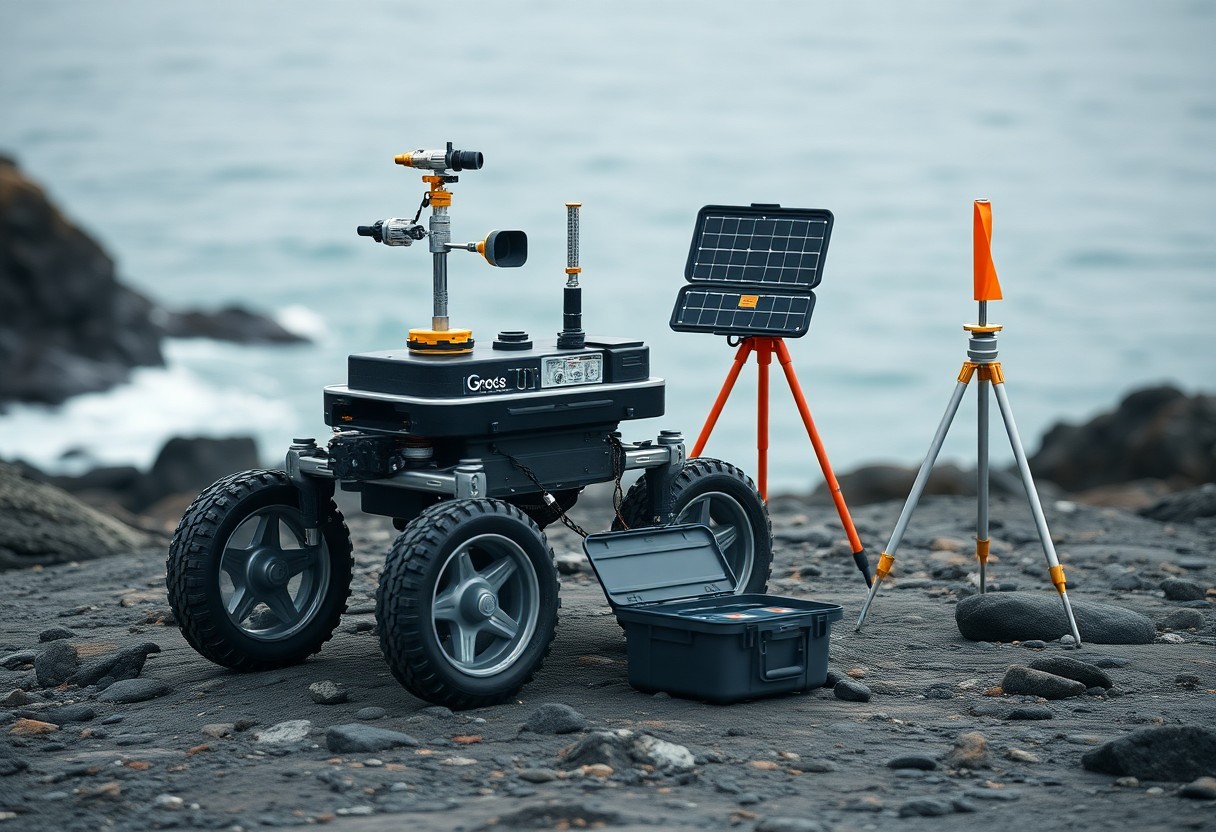
Navigation and Autonomous Systems
Autonomy in field robots gives you onboard decision-making through sensor inputs and control loops, allowing the system to handle obstacle avoidance, localization, and mission execution with minimal intervention.
Sensor Fusion and Environmental Mapping
Sensors fused from IMU, LiDAR, cameras, and GNSS let you build consistent maps, reduce uncertainty, and support reactive behaviors in changing conditions.
Pathfinding Algorithms for Unstructured Terrain
Algorithms such as A*, D*, and sampling-based planners help you plan safe trajectories across uneven ground while adapting to dynamic obstacles and varying traction.
When designing path planners for unstructured terrain, you should combine traversability cost maps, kinodynamic constraints, and terrain classification to bias sampling toward feasible motions. You can integrate belief-space planners or anytime variants to handle sensor uncertainty and moving obstacles while meeting real-time deadlines. Local reactive controllers correct slips, and multimodal planners permit wheel-to-leg transitions where traction changes abruptly.
Payload and Scientific Instrumentation
Payload selection concentrates on instruments you need for mission objectives, balancing mass, power, and data budgets while ensuring mount compatibility and environmental protection for sensitive sensors.
Modular Tool Integration and Sampling Arms
Arms enable you to mount drills, scoops, and manipulators via standardized interfaces, supporting quick swaps, force feedback, and contamination controls to collect repeatable samples.
Data Acquisition and Remote Sensing Arrays
Data acquisition arrays collect, time-stamp, and preprocess sensor streams so you can prioritize telemetry, compress efficiently, and trigger event capture for high-value observations.
You should design sensor suites with complementary modalities-optical, thermal, multispectral, LiDAR, and environmental probes-and synchronize them to a common clock for precise fusion. Calibrate preflight and include in-situ references to track drift; implement onboard filtering, compression, and anomaly detection to reduce downlink load. Budget power, storage, and bandwidth, and include failover modes and graceful degradation to sustain long deployments.
Communication and Telemetry
Communication systems should prioritize bidirectional telemetry, adaptive bandwidth, and low-power links so you can monitor status, receive commands, and log mission data in real time. Design for intermittent connectivity with store-and-forward to prevent data loss.
Long-Range Data Transmission Protocols
Protocols such as LoRaWAN, NB-IoT, and mesh variants let you extend reach while conserving power; select frequency, modulation, and duty cycles to match terrain and regulatory constraints.
Edge Computing and Onboard Processing
Edge processing enables local filtering, compression, and anomaly detection so you reduce telemetry volume, lower latency, and maintain actionable situational awareness without constant uplink.
You should architect onboard stacks to handle sensor fusion, preprocessing, and lightweight inference so only high-value data is sent. Choose processors and accelerators that match your power budget-MCUs for simple filtering, embedded GPUs or NPUs for neural inference. Balance model size with quantization and pruning, and implement priority queues, energy-aware scheduling, watchdogs, and secure boot. Test end-to-end failure modes and provide OTA update paths so you can iterate safely in the field.
Summing up
Drawing together the design, sensors, mobility, and power considerations, you create a durable, adaptable robot for exploration and field work that meets mission goals, handles environmental stresses, and supports remote operation and data collection.