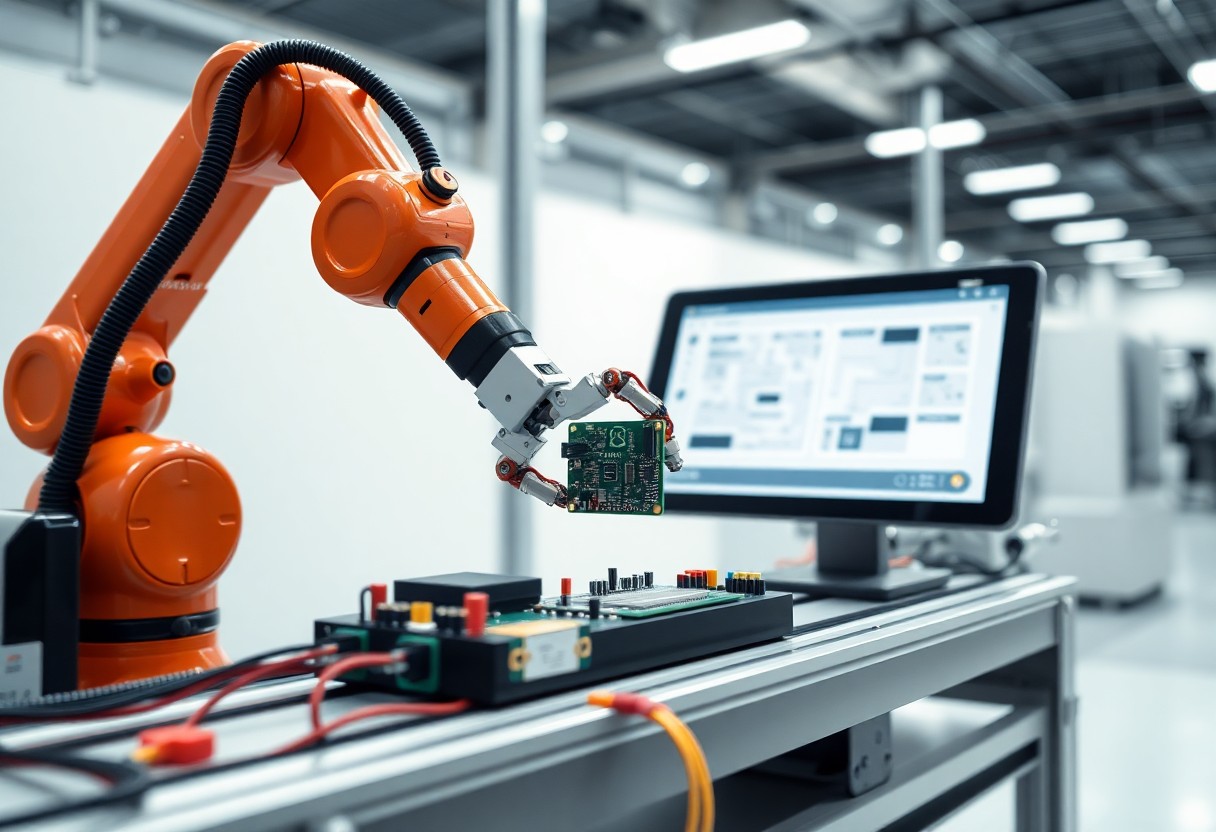
You can deploy and manage robotic systems without writing code by using visual programming, drag-and-drop interfaces, and prebuilt modules; this lets you optimize your workflows, integrate sensors and actuators, and scale solutions rapidly while minimizing technical barriers and time to value.
Understanding Zero-Programming Robotics
Definition and Key Concepts
You build robot behavior through visual tools-drag-and-drop editors, flowcharts, and preconfigured device profiles-that hide low-level code and protocols. Event-driven triggers, sensor templates, and connector libraries (PLC, MQTT, ROS wrappers) let you assemble sequences, error handling, and safety interlocks visually. Modular components enable reuse across cells, and versioned configuration stores make rollback and audit straightforward while reducing bespoke scripting to a minimum.
Benefits of No-Code Solutions
Faster time-to-deployment is immediate: you can prototype and iterate in hours instead of days, lowering skilled-programmer dependency and operational risk. You gain easier maintenance through visual logic that technicians understand, and reduced vendor lock-in via standard connectors. In logistics, life-science labs, and small-scale manufacturing these platforms often shrink commissioning costs and speed ROI.
For example, a mid-size assembly shop converted a manual pick-and-place cell to a no-code orchestrated robot in under two days, cutting setup from roughly 72 hours to about 6 hours and freeing engineers to optimize throughput. You also benefit from predictable scaling-cloning validated workflows to additional lines typically takes minutes, not weeks-while analytics dashboards give you immediate performance metrics for continuous improvement.
Platforms for Zero-Programming Robotics
You can choose platforms that span hobbyist kits to enterprise suites, matching your project needs: educational kits cost under $300, mid-range AMR systems run into the low thousands, and industrial cobot packages often start in the tens of thousands, so you balance ease, hardware, and ROI when picking a platform.
Popular Tools and Software
You’ll find tools like Makeblock mBlock and LEGO Education SPIKE for classroom assembly, VEXcode for competition robots, Universal Robots’ Polyscope for teach-pendant flows, MiR Fleet Manager for AMR mission design, and UiPath StudioX for desktop robotic process automation-each targets different users and use cases.
Tool – Primary use| mBlock (Makeblock) | Educational, Scratch-based blocks; supports Arduino and Makeblock kits |
| LEGO Education SPIKE | Classroom robotics, drag-and-drop coding; used in K-12 curricula |
| VEXcode | Competition-focused visual programming for VEX V5 systems |
| Universal Robots Polyscope | Industrial cobot GUI; visual task sequencing on teach pendant |
| MiR Fleet Manager | No-code AMR mission planning and fleet coordination |
| UiPath StudioX | RPA for software automation with low-code/no-code builders |
Comparison of Features
You should compare platforms across ease-of-use, hardware compatibility, deployment speed, and cost: simple kits often take 1-4 hours to learn, whereas industrial suites can take days to weeks but scale to fleets and integrate with PLCs and ROS via standardized interfaces.
Feature – What to expect| Ease of use | Drag-and-drop UIs vs teach-pendant flows; entry platforms ≈1-4 hour ramp |
| Hardware compatibility | Kit-specific vs broad industrial I/O, ROS, and PLC connectors |
| Scalability | Single-robot classroom projects vs fleet management for 10-100+ AMRs |
| Cost | From <$300 kits to $10k-$100k+ industrial deployments |
| Support | Community tutorials and blocks vs enterprise SLAs and integrator networks |
For example, if you need a fast pilot you can deploy a LEGO or mBlock demo in a day, while Polyscope or MiR often reduces integration time versus custom code but still requires systems integration-expect lower upfront developer time at higher platform cost for production-scale projects.
Applications in Various Industries
Across sectors like logistics, healthcare, agriculture and retail, zero-programming robotics accelerates deployment-you can get a pilot running in days instead of months, with pilots reporting up to 70% faster commissioning. For an in-depth project example see Holon Robotics Brings Zero-Programming Automation to Manufacturing, which replaced manual pick-and-place tasks and cut cycle times significantly.
Manufacturing and Production
In assembly and machining cells you rapidly create flows that coordinate conveyors, cobots and vision systems; manufacturers report up to 30% throughput gains in small-batch lines after deploying visual workflows. When you configure error-handling blocks and camera triggers, quality inspection moves from sampling to 100% inspection on critical parts, and SMEs can iterate recipes in hours without engineering sprints.
Service and Delivery Automation
Field service, hospitality and last-mile delivery use zero-programming stacks to map routes, schedule tasks and hand off items to customers; pilots in urban delivery reduced labor time 25-35% and increased on-time performance. You deploy voice-guided service robots in hotels within a day, and integrate with your order system through prebuilt connectors to automate dispatch and proof-of-delivery workflows.
For larger fleets you scale routing with dynamic replanning, handling 10-50 robots per site while minimizing deadhead miles; trials show SLA compliance improving around 10%. You tie warehouse WMS and TMS data into the robot scheduler, enable teleoperation fallback for exceptions, and use payload sensors and thermal monitoring to maintain perishable goods chains without custom code.
Getting Started with Zero-Programming Robotics
When you begin, focus on a single, measurable task-such as conveyor sorting or bin picking-and break it into inputs, decisions, and actions you can map in a visual editor. Use a simulator or sandbox to validate flows before hardware trials; many users complete a basic pick-and-place prototype in under 2 hours using templates. Keep safety interlocks and emergency stops visible in your flow so you test behavior before powering actuators.
Choosing the Right Tools
Pick tools that match your hardware and skill goals: prioritize platforms with the controllers you own (Raspberry Pi, Arduino, UR cobots), a visual editor (flowcharts or Blockly), and built-in simulation. Evaluate community size, available templates, and vendor support-Node-RED, Makeblock/Arduino-driven kits, and some cobot vendors offer extensive drag-and-drop libraries and tutorials that cut setup time by weeks in institutional pilots.
Setting Up Your First Project
Start by selecting a template closest to your goal, then map sensors and actuators to named nodes in the editor and define success/fail conditions. Calibrate one sensor, run 10 simulated cycles, adjust timing and grip parameters, and finally run a low-speed hardware test in a guarded workspace. Track iterations and save versions so you can revert if a change causes unexpected movement.
For deeper setup, define coordinate frames and waypoints explicitly, assign tolerance bands for position and force, and enable collision detection in the simulator. Use automated calibration wizards where available, log at least 50 trial runs to gather mean and variance for repeatability, and apply offsets or soft limits based on those results before scaling speed or payload. Maintain a rollback snapshot before each major change.
Challenges and Limitations
Common Obstacles
You’ll face sensor calibration drift, vendor lock-in, and legacy PLC integration-protocols like Modbus or OPC-UA often require adapters. Field deployments typically need 4-12 weeks of tuning, while edge cases such as reflective surfaces or variable lighting lead vision systems to misclassify parts. Security and compliance add overhead: patching firmware and managing certificates across tens to hundreds of devices becomes an operational burden that can erode expected ROI.
Solutions and Workarounds
You can mitigate many issues with prebuilt connectors (OPC-UA, MQTT) and drag-and-drop logic that implements retries, timeouts, and human-in-the-loop approvals. Use redundancy-dual cameras or force sensors-and simulation-based testing to reduce tuning from weeks to days. In one deployment, adding a fallback operator step and sensor redundancy cut unplanned stops by about 40% within six months.
Adopt a staging pipeline: validate workflows in a digital twin, run 1,000 simulated cycles to catch edge cases, then do a canary roll-out to 5-10% of cells. Automate telemetry-track cycle time, MTBF, and mispick rates-so you can iterate quickly. Maintain a library of low-code templates and certified drivers to avoid lock-in and often shorten integration time by 30-70%.
Future Trends in Zero-Programming Robotics
Prepare for accelerated adoption as modular hardware and cloud-native orchestration converge: by 2026 many integrators expect per-cell costs to fall below $10k, letting you expand from single-cell pilots to multi-cell deployments without custom code. You’ll see standardized connectors, plug-and-play vision modules, and marketplace-driven skill libraries that let operators swap tasks-sorting, assembly, inspection-in hours instead of weeks, cutting integration cycles and total cost of ownership.
Advances in Technology
You’ll benefit from faster edge compute (NVIDIA Jetson Orin-class devices) enabling sub-20ms inference for common perception models and real-time control. Collaborative 6-axis arms with built-in force sensing and Time-Sensitive Networking (TSN) over Ethernet make safe, synchronized multi-robot cells feasible. Expect vendor-agnostic APIs and universal URDF-style models to reduce vendor lock-in and let you mix components-robot arms, grippers, cameras-into validated, reusable templates.
The Growing Role of AI
AI-driven perception and planning already let you set up tasks with tens instead of thousands of labeled images: foundation models like SAM and compact YOLO variants enable few-shot segmentation and detection, cutting setup time by orders of magnitude. You’ll rely on onboard inference and periodic cloud updates to maintain accuracy, while lightweight policy networks handle dynamic grasps and reactive behaviors that used to require bespoke coding.
You can accelerate deployment further with synthetic data and domain randomization, often reducing required real-world labels by an order of magnitude. Online learning pipelines enable periodic model fine-tuning from operator corrections, and predictive maintenance models fed by telemetry can drop unplanned downtime-industry reports often cite 20-40% reductions-so your fleets stay productive with minimal manual intervention.
Final Words
Presently you can harness zero-programming robotics to streamline workflows, reduce setup time, and scale automation without coding expertise; by adopting visual tools and prebuilt modules you gain control over deployment, monitoring, and iterative improvement, enabling your team to focus on strategy and outcomes while maintaining safety and compliance through configurable constraints and best practices.