
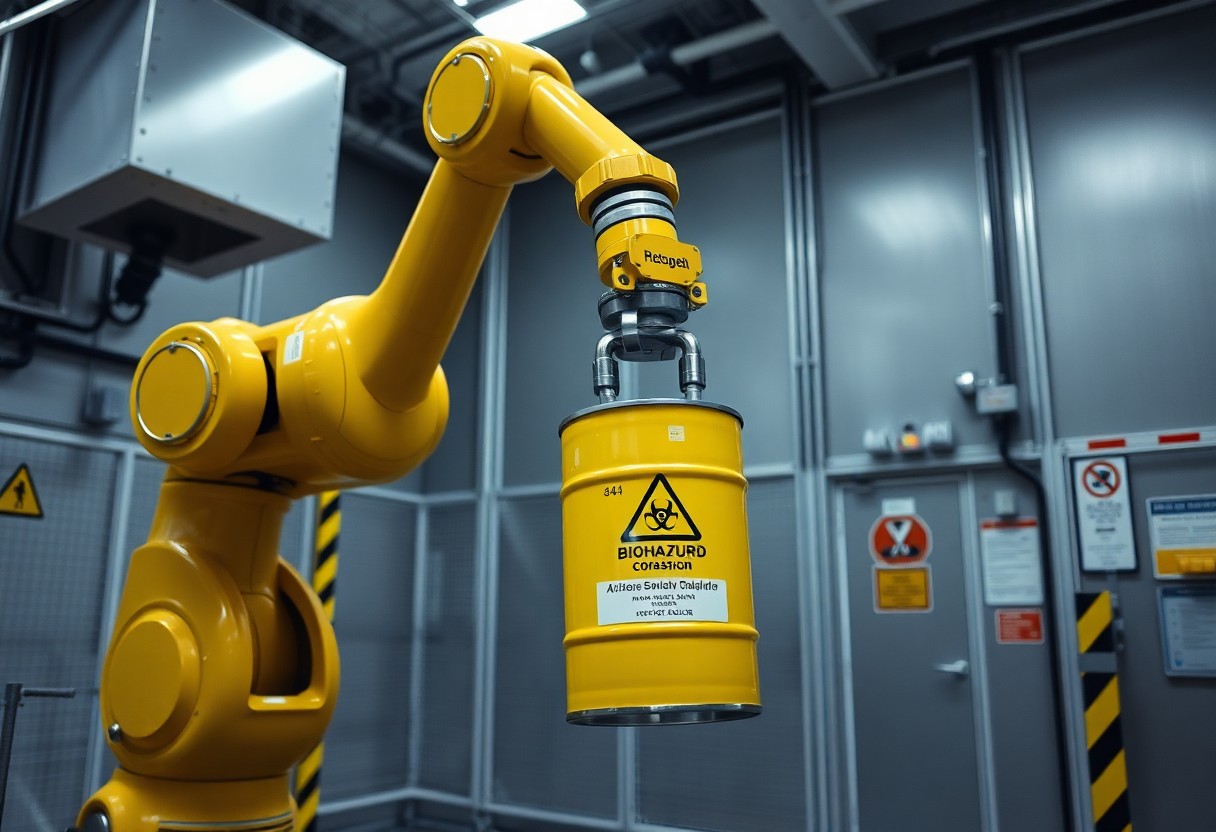
With robotic systems integrated into hazardous materials handling, you can minimize human exposure, improve containment, and enforce consistent safety protocols through precise, repeatable actions. Automated sensing, remote operation, and real-time data feeds let you monitor conditions, respond faster to incidents, and maintain regulatory compliance while reducing operational variability. Deploying robots also helps your team focus on oversight and decision-making rather than direct intervention in dangerous environments.
Overview of Hazardous Materials
You work with substances classified under the UN’s nine classes-explosives, gases, flammable liquids/solids, oxidizers, toxics, radioactive, corrosive and miscellaneous-each demanding distinct containment, PPE and transport controls. Incidents can escalate quickly: a 100‑kg chlorine release forms lethal concentrations within minutes if ventilation fails. Your protocols must align with DOT, OSHA and EPA rules while providing layer‑ed protection through engineering controls, monitoring and emergency response plans.
Types of Hazardous Materials
The common categories you encounter include flammables, toxic gases, corrosives, oxidizers and radioactive sources; each presents unique handling rules and storage separations. Examples range from gasoline and solvents to chlorine cylinders, concentrated sulfuric acid, ammonium nitrate and sealed radioactive sources like Cs‑137. Any misclassification or mixed storage can trigger violent reactions, regulatory penalties and life‑threatening exposures.
- Flammables: liquids and solvents
- Toxic gases: chlorine, ammonia
- Corrosives: strong acids/bases
- Oxidizers: nitrates, peroxides
- Radioactive: sealed sources, medical isotopes
| Flammable liquids | Gasoline, solvents – fire/explosion risk |
| Toxic gases | Chlorine, ammonia – inhalation/asphyxiation |
| Corrosives | Sulfuric acid – chemical burns, metal damage |
| Oxidizers | Ammonium nitrate – accelerates combustion/explosion |
| Radioactive | Cs‑137, Co‑60 – ionizing radiation exposure |
Risks and Challenges in Handling
You face inhalation, dermal contact, thermal and mechanical hazards plus secondary contamination and environmental release; West, Texas (2013) showed how improper fertilizer storage led to a 15‑fatality blast and widespread damage. Shorter response times and precise segregation are key to preventing escalation, and you must ensure continuous monitoring and trained responders on site.
Delving deeper, your main challenges include accurate classification, incompatible storage, and reliable detection of leaks or off‑gassing-nanoparticles and lithium‑ion battery fires complicate suppression and expose responders to novel toxins. Regulatory frameworks such as OSHA HAZWOPER (24-40 hours training) and DOT hazmat rules set baseline controls, but you need layered engineering solutions: remote robotics for transfer and sampling, redundant ventilation and real‑time sensors (PID, electrochemical, gamma spectrometry). Case studies from pharma and battery recycling show robotics reduced operator exposure during transfer and sampling, while thermal imaging and fixed gas detection shortened response times; integrating these technologies into procedures and drills closes gaps that PPE alone cannot address.
Robotics Technology in Hazardous Environments
Types of Robots Used
Your operations commonly employ teleoperated manipulators for remote handling, UGVs for debris removal and sampling, UAVs for aerial surveys and mapping, ATEX/IECEx-rated articulated arms for explosive atmospheres, and collaborative robots for controlled tasks near personnel. Manufacturers specify payloads from 2 kg to 500 kg, arm reaches up to 6 m, and UGV slopes of 30° with IP67 sealing. Knowing how each fits your workflow improves deployment speed and safety.
| Robot Type | Typical Application / Example |
|---|---|
| Teleoperated Manipulator | Precision sampling, cutting, and remote valve operation (EOD/industrial arms) |
| UGV (Unmanned Ground Vehicle) | Debris clearance, sensor payloads, CBRN mapping (tracked/wheeled platforms) |
| UAV (Drone) | Aerial survey, radiation plume mapping, thermal imaging inspections |
| ATEX/IECEx Articulated Arm & Cobot | Work in explosive atmospheres, collaborative tasks with force/torque sensing |
- Teleoperated arms provide sub-millimeter positioning and can deliver up to 500 N grip force for manipulation in confined spaces.
- UGVs such as PackBot/TALON variants carry 20-50 kg payloads and integrate gas, radiation, and LiDAR sensor suites for remote reconnaissance.
- Knowing how these specs map to your scenario lets you prioritize endurance, payload, or autonomous capability when selecting platforms.
Advances in Robotics for Safety
Recent advances let you combine AI autonomy, sensor fusion, and low-latency teleoperation to reduce exposure and operator workload. LIDAR plus stereo vision gives sub-meter localization in GPS-denied settings, while 5G/edge computing can lower control latency below 50 ms. Radiation-hardened controllers and modular quick-change end-effectors extend mission life to 8-12 hours and improve mean time between failures. These upgrades let you perform safer, faster interventions with fewer on-site personnel.
In deployments you’ll notice integrated redundancy and digital tools matter most: at Fukushima Daiichi, teleoperated and tethered robots performed inspections that would have been unsafe for humans, and at Sellafield Spot was trialed for visual surveys to reduce human entry by about 30%. Vendors now offer IECEx/ATEX Zone 1-rated platforms and modular shielding that halved electronics failure rates in lab tests. You can also use digital twins to rehearse missions and trim on-site time by up to 40%, improving both safety margins and project economics.
Automation Solutions in Hazardous Materials Handling
When you deploy automation, you’ll choose systems like ROVs, UGVs, aerial drones, and remotely controlled manipulators tailored to exposure levels. For example, EOD ROVs such as iRobot PackBot and QinetiQ TALON handle ordnance and sampling tasks, while LiDAR-equipped drones map interiors at centimeter resolution. Plants often cut personnel entry by 50-90% with combined systems, and modular end-effectors let you swap tools in minutes for tasks from sampling to decontamination.
Remote Operated Vehicles (ROVs)
ROVs let you keep operators outside hot zones while performing manipulation, sampling, and inspection. Field-proven platforms like PackBot and TALON carry cameras, radiological sensors, and manipulators with reaches around 1-2 meters and payloads of dozens of kilograms. In ordnance removal and chemical spills they provide telemetry and haptic feedback, and you can integrate gas chromatographs or syringe samplers to capture liquid or vapor samples without personnel exposure.
Autonomous Robots and Drones
Autonomous UGVs and drones let you perform routine surveys, source localization, and mapping without direct control. Vehicles like Spot or custom tracked UGVs navigate using LiDAR and RTK GPS; drones equipped with thermal and multispectral sensors detect hot spots and chemical plumes. Organizations report inspection cycles cut from days to hours, and autonomous patrols can trigger alarms when radiation or VOC thresholds exceed preset limits.
For deeper operations you should assess autonomy stack, sensor fusion, and endurance. SLAM with LiDAR gives centimeter-level localization indoors; fusing gamma spectrometers, VOC detectors, and thermal cameras lets algorithms classify hazards in real time. Typical quadcopters run 20-30 minutes, so tethered drones provide continuous monitoring while UGVs operate for hours and carry 10-50 kg payloads for manipulators or pumps. In Fukushima deployments, mixed robotic teams mapped radiation gradients and guided human teams to safer entry points.
Safety Benefits of Automation
You remove personnel from the most dangerous tasks by using robots for inspection, containment, and handling in high-radiation, high-temperature, or corrosive environments; teleoperated platforms provide continuous sensor feeds and event logging, while automated rigs maintain isolation and repeatable procedures so your team can manage incidents from safe control rooms without compromising data integrity or response speed.
Reducing Human Exposure to Hazards
When you deploy teleoperated manipulators and remote vehicles, you keep workers out of radiation zones, toxic atmospheres, and blast perimeters; bomb disposal robots and inspection units at Fukushima Daiichi enabled critical measurements without human entry. This substitution lowers both acute exposure and long-term health risk, lets you limit onsite personnel to necessary oversight, and provides live video and sensor telemetry for safer, faster decision-making.
Improving Handling Efficiency and Accuracy
By automating repetitive transfers and dosing you increase throughput and reduce human error; modern articulated arms and AGVs offer repeatability measured in hundredths to tenths of millimeters, and high-speed cells can perform hundreds of picks per minute in packaging lines. In hazardous chemical blending, automated metering rigs deliver consistent doses within tight tolerances, cutting the need for manual corrections and off-spec containment.
You gain further accuracy from closed-loop control, vision-guided pick-and-place, and force/torque sensing that detect slips and correct trajectories in milliseconds. Integrating robots with PLCs and MES gives barcode-verified transfers, automated batch records, and timestamped traceability so errors are caught before they propagate; robotic filling and sampling lines commonly sustain 24/7 operation with cycle-time variability held to a few percent.
Case Studies of Robotics in Action
You’ll find concrete examples below showing how automation reduced exposure, cut costs, and increased throughput across hazardous-materials environments; each study cites metrics you can use to model ROI and safety gains for your own operations.
- Chemical processing-Automated drum-handling robot reduced operator contact by 92%, increased transfer throughput 40%, handled 50 kg payloads, and delivered payback in 18 months while cutting incident-driven downtime from 24 to 2 days/year.
- Nuclear decommissioning-Radiation-hardened manipulator removed contaminated piping, lowering worker dose by >99%, accelerating schedule from 36 to 22 months and reducing projected remediation cost by 27%.
- Pharmaceutical aseptic filling-Robotic vial transfer lowered contamination events by 85%, boosted line throughput 60% (0.8 s cycle time), ran 24/7 with validated protocols, and reached ROI in ~12 months.
- Oil & gas inspection-Crawling robots and UAVs cut planned shutdowns by 45%, detected corrosion with 95% accuracy, and saved ~1,200 manual inspection hours annually while improving predictive-maintenance scheduling.
- Automotive parts handling-Automated palletizing system from ROBOTIC MATERIAL HANDLING – CNC Solution achieved 60 picks/min, reduced ergonomic injuries 70%, and paid back capital in 9 months through labor and error-cost reductions.
Success Stories in Industry
You can expect similar outcomes: throughput gains of 30-60%, incident reductions up to 92%, and ROI timelines commonly between 9-18 months; projects in pharma, chemical, nuclear, and oil & gas demonstrate reproducible metrics you can benchmark against your facility.
Lessons Learned from Implementations
You should allocate time for systems integration (typically 12-24 weeks), invest ~10-15% of capex in end-of-arm tooling and validation, and plan operator training of ~40 hours per role to hit target uptime and safety KPIs.
You’ll want a staged rollout: start with simulation and offline testing, then pilot one cell for 8-12 weeks while tracking MTTR, incident rate, and throughput; involve operators early to refine ergonomic layouts and SOPs, build a spare-parts kit (3-6 months of critical parts), implement remote monitoring and predictive-maintenance routines to cut unplanned downtime ~30%, and ensure regulatory validation and cybersecurity reviews are completed before scaling.
Future Trends in Automation for Hazardous Materials
Expect tighter convergence of edge AI, 5G-enabled teleoperation, and digital twins so you can run realistic incident simulations and remote interventions with sub-20 ms control latency in many deployments. You will see modular hardware-interchangeable grippers, sealed sensor pods, tethered power for long-duration missions-so field teams swap tools in minutes. Vendors are already piloting swarm UGVs for perimeter mapping and tethered drones for sustained gas monitoring at decommissioning sites like Fukushima.
Emerging Technologies
Edge inference running on ARM/NPU chips now delivers <50 ms perception loops, letting you use real-time LiDAR-hyperspectral fusion for leak detection and isotope-independent gas ID with MEMS e-nose arrays. You can deploy RTK GNSS for centimeter-level positioning outdoors and visual-inertial odometry plus LIDAR for GPS-denied interiors, while soft robotics and force-feedback manipulators provide sub-0.1 mm repeatability for delicate container handling.
Predictions and Implications
Over the next 5-10 years you’ll move beyond inspections into fully automated containment workflows; regulators will demand digital logs, authenticated remote operator credentials, and standardized interoperability. Operationally, expect reduced human exposure and faster incident resolution, but you must invest in retraining for teleoperation, systems integration, and data analytics to manage those gains and evolving compliance requirements.
On the business side you’ll see predictable ROI from predictive maintenance and continuous monitoring: pilots report quicker root-cause identification and fewer escalations. You should plan for integrated asset tracking, automated chain-of-custody records, and insurance models that factor in robotic mitigations-these shifts will change vendor contracts, procurement cycles, and the KPIs you use to measure safety and uptime.
Conclusion
To wrap up, you can rely on robotic systems to remove people from direct contact with hazardous materials, enforce consistent safety procedures, and provide real-time sensing and remote manipulation that reduce incidents and downtime. By integrating automation with proper protocols and training, your operations become more predictable, auditable, and resilient, enabling safer decision-making and regulatory compliance in high-risk environments.
