
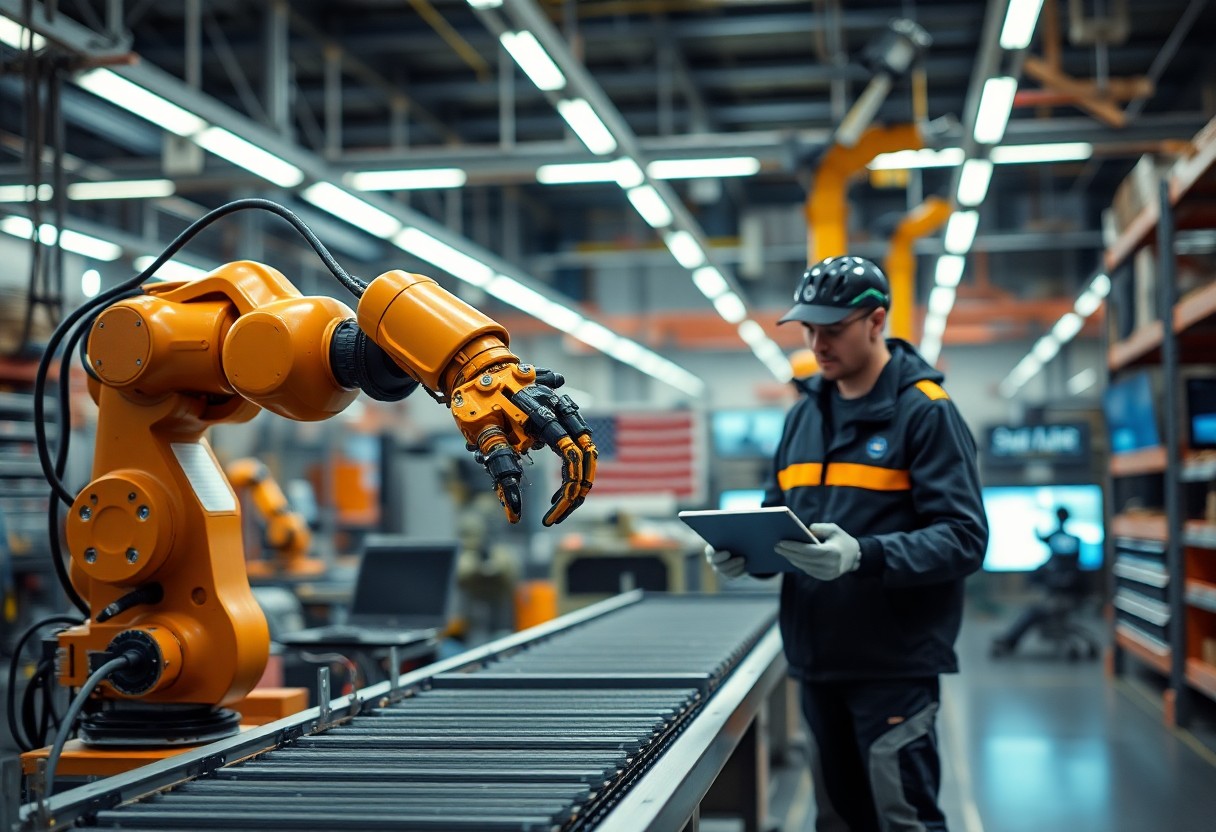
Most robots increasingly learn on the job, and you should know how continuous adaptation uses online learning, sensor-driven feedback, and safety-aware updates to maintain performance in real environments; this post explains methods, evaluation metrics, and operational considerations so you can deploy and monitor adaptive systems effectively in your operations.
The Importance of Continuous Learning
In live deployments, continuous learning prevents model drift and keeps your robot effective as environments change. For instance, Amazon’s 200,000+ mobile robots continually adjust routing and coordination to shifting warehouse layouts and demand, and lessons from the DARPA Robotics Challenge (2013-2015) accelerated online adaptation practices. You benefit because incremental updates-on-device or via the cloud-maintain perception accuracy and operational uptime over weeks and months without full retraining.
Definition of Continuous Learning in Robotics
Continuous learning means your robot updates models from incoming data during operation using methods like online supervised fine-tuning, reinforcement learning, experience replay, or meta-learning. It avoids wholesale retraining by applying incremental weight updates or selective replay buffers, so a vision pipeline can adapt to new lighting in hours while a navigation policy refines obstacle costs after a few traversals.
Benefits of On-the-Job Learning
You gain higher uptime, faster recovery from edge cases, and reduced maintenance because systems respond to distribution shifts without engineer intervention. Field reports commonly cite 10-30% improvements in throughput or recovery times; manufacturing lines cut manual reprogramming, logistics fleets rebalance dynamically during peaks, and service robots personalize routines to users, boosting task success within weeks.
Digging deeper, on-the-job learning reduces failure modes by enabling rapid corrective updates: online safety monitors can block hazardous actions after a handful of missteps, and predictive maintenance models ingest fresh sensor streams to extend mean time between failures. In logistics, incremental policy updates let fleets rebalance workloads during seasonal spikes; in clinical pilots, adaptive controllers shortened calibration from days to hours, lowering setup costs and increasing availability for staff.
Mechanisms of Adaptation
You rely on layered mechanisms-online learning, adaptive control, and model-predictive updates-to keep robots effective as conditions shift. Reinforcement learning fine-tunes policies while adaptive controllers correct unmodeled dynamics at 100-1,000 Hz, and model updates propagate via secure OTA pipelines. In warehouse deployments, combining these approaches has produced measurable uptime and task-success gains in weeks rather than months.
Machine Learning Algorithms
You deploy a mix of algorithms: PPO, SAC and DQN for policy learning, with MAML-style meta-learning to enable few-shot adaptation (often within 5 gradient steps). Continual learning techniques like elastic weight consolidation and prioritized experience replay mitigate forgetting, while domain randomization and sim-to-real pipelines use thousands of randomized simulations to bridge transfer gaps.
Real-Time Data Processing
You must fuse sensors at matching rates-IMU at 200-1,000 Hz, LIDAR at 10-40 Hz, and vision at 30-60 fps-while keeping end-to-end latency within 5-50 ms. Edge inference on platforms like NVIDIA Jetson Xavier NX commonly yields 10-30 ms per ResNet-50 pass, and frameworks such as ROS 2 or DDS handle topic QoS and deterministic delivery.
You implement asynchronous pipelines, time-synchronize sensors via PTP, and apply EKF or particle filters for robust state estimation under jitter. Prioritization and backpressure prevent camera bursts from starving control loops, and batching or model quantization reduces inference time; in field tests, switching to quantized models and ROS 2 QoS cut perception latency by 20-40%, stabilizing closed-loop performance.
Case Studies of Robots in Real Environments
You can see concrete outcomes when robots adapt in place: Amazon Robotics reported throughput gains up to 40% and pick-time reductions near 20% after deploying adaptive fleet orchestration; a Boston Dynamics Spot pilot logged over 1,000 autonomous inspection hours on offshore platforms and cut human-entry tasks by ~85%; Starship Technologies surpassed one million sidewalk deliveries in pilots, showing median trip distances around 0.7 km and low marginal costs per run.
- 1) Amazon Robotics (fulfillment): reported throughput improvements up to 40% and pick-time reductions ≈20% after live adaptive scheduling and dynamic rerouting in >100 centers (internal/press data).
- 2) Boston Dynamics Spot (industrial inspection): field pilots logged 1,000+ autonomous hours, reduced confined-space human entries by ~85%, and increased inspection cadence from monthly to weekly on some rigs.
- 3) Starship Technologies (last-mile delivery): operational pilots exceeded 1M deliveries, median trip ≈0.7 km, with reported per-delivery marginal costs substantially below comparable human couriers in dense campuses.
- 4) Automotive welding cobots (OEM pilots with ABB/FANUC): adaptive control reduced rework rates by ~25% and shortened cycle times 12-18% in targeted lines, yielding payback within 9-14 months in several sites.
- 5) Agricultural robots (see-and-spray demos): row-crop trials reported herbicide usage reductions up to 90% and harvest throughput increases of ~10-20% through targeted actuation and real-time plant detection.
- 6) Hospital service robots (Aethon/TUG, Diligent/Moxi pilots): reported reductions in clinician non‑value walking by up to 30% and faster intra-hospital deliveries, improving throughput for supply logistics and specimen transport.
Industrial Applications
In production you’ll find adaptive robots tuning parameters on the fly: vision-guided pick-and-place systems maintain ≥99% accuracy across lighting and part variation, adaptive welding controllers cut defect incidence ~25%, and predictive-maintenance integration has reduced unplanned downtime in pilots by roughly 30-40%, letting you prioritize interventions based on live sensor drift and learned failure modes.
Service Robots in Dynamic Settings
When you deploy service robots in crowds, learning on the job is what keeps them useful: campus delivery robots navigate mixed pedestrian flows with reactive planners updated from daily logs, hotel concierge bots reduced guest interaction time in pilots by ~40%, and hospital assistants adapted routing to changing shift patterns to sustain timely deliveries.
Technically, you’ll see these systems combine continual learning, human-in-the-loop corrections, and lightweight on-site fine-tuning: online policy updates with minutes-to-hours of local data, domain-randomized pretraining to narrow sim-to-real gaps, and safety envelopes that constrain exploratory actions. This mix lets your deployed robot improve navigation, perception, and task sequencing without full retraining in the cloud.
Challenges in Continuous Adaptation
Operationalizing continual learning exposes trade-offs between fast adaptation and auditability: you must detect data drift, validate updates, and maintain rollback paths while minimizing downtime. Practical pipelines often stage updates on 5-10% of a fleet and use A/B metrics to prevent regressions. For design patterns and feedback-loop examples, see Continual Learning in Robotics: Feedback Loops & HITL ….
Safety and Reliability Concerns
When your robots learn in situ, safety frameworks like ISO 10218 and ISO/TS 15066 require continuous risk assessment and runtime verification; formal checks and watchdog monitors reduce incidents. In practice, teams deploy staged rollouts, human-in-the-loop overrides, and canary tests (1-5% of units) because field updates have produced regressions in 0.5-2% of cases in industry pilots.
Resource Limitations
Your edge hardware often limits on-device training: many warehouse robots run on 2-8 CPU cores, <8 GB RAM, and sporadic uplink, forcing you to compress models or offload heavy training to the cloud. Bandwidth caps and latency (50-200 ms on cellular) push you toward federated updates, selective logging, and prioritized exemplar storage to keep pipelines operational.
For example, a single-site deployment can generate terabytes of sensor data monthly; labeling may cost ~$0.01-$0.10 per sample and full retraining on GPUs can take 4-12 hours. You mitigate costs by using transfer learning, incremental fine-tuning on distilled datasets, and adaptive sampling (store only 1-10% of frames) to cut storage and compute by 50-80% while preserving adaptation quality.
Future Trends in Robot Learning
Deployment-driven research will push your robots toward continuous online learning: model distillation of >100B-parameter foundations for edge inference, latency targets under 50 ms for reactive control, and adaptive maintenance that cuts downtime by 20-40% in pilot deployments; you’ll rely on mixed local/cloud pipelines to balance safety, cost, and responsiveness as fleets scale.
Enhanced Autonomous Capabilities
Your systems will combine multimodal self-supervision and safety-aware planners to extend autonomy windows-allowing minutes-long uninterrupted operation in warehouses and urban delivery pilots; field trials report 10-20% better generalization to novel layouts after in-place adaptation and fewer human interventions per 1,000 task-hours.
- Perception: continuous domain adaptation to lighting and wear.
- Control: online policy refinement for actuator drift.
- Planning: hierarchical task replanning with temporal abstraction.
Enhanced Capabilities – Feature vs Impact
| Feature | Impact |
|---|---|
| Multimodal sensors | Reduce false positives in cluttered scenes |
| On-device adaptation | Lower latency, faster recovery from failures |
| Hierarchical planners | Longer autonomy horizons with fewer resets |
Integration with Advanced AI Systems
You’ll stitch robot controllers to large models and symbolic planners so natural-language goals become adaptive policies; early integrations cut high-level planning time by 30-60% and let operators reprogram tasks verbally between shifts without manual scripting.
When perception embeddings are shared with foundation models, your robot can leverage context-aware retrieval for rare failures and crowd-sourced troubleshooting; vendors like NVIDIA show sensor-to-inference pipelines under ~200 ms, enabling hybrid local/cloud decision loops that keep safety-critical checks on-device.
- LLM-guided task synthesis for ad-hoc workflows.
- Shared representations for few-shot visual reasoning.
- Hybrid inference: local safety, cloud specialization.
Integration – Component vs Benefit
| Component | Benefit |
|---|---|
| Language-to-policy translation | Faster reconfiguration by operators |
| Shared embeddings | Improved generalization on edge cases |
| Local/cloud orchestration | Balanced latency and compute cost |
Ethical Considerations
Ethical trade-offs emerge as your robots adapt in place: privacy, accountability, and labor impacts intersect with technical choices. Regulators already classify adaptive systems as “high-risk” under frameworks like the EU AI Act, so you must balance on-device learning with data minimization and auditable logs. For example, Amazon’s robotics improvements increased throughput but also triggered discussions about worker safety and task redesign, showing you need integrated ethical risk assessments alongside performance metrics.
Job Displacement Issues
Automation projections such as McKinsey’s estimate 400-800 million workers could be affected by 2030, so you should plan reskilling pathways and transition programs. Corporate initiatives like Amazon’s pledge to upskill 100,000 employees by 2025 illustrate one mitigation model you can adopt: combine staged automation, internal mobility, and targeted training tied to measured productivity gains to reduce sudden displacement in your deployments.
Decision-Making Transparency
Opaque adaptation undermines trust and compliance, especially under rules like GDPR’s automated-decision provisions and the EU AI Act’s high-risk requirements, so you must expose decision rationale, provenance, and confidence to operators and auditors. High-profile failures-Amazon’s shelved recruiting model and the Apple Card bias controversy-show you how lack of transparency converts technical errors into legal and reputational crises you will want to avoid.
Operationally, you should implement versioned audit trails, model cards, and runtime provenance that tie each action to the model version, data batch, and confidence estimate. Use explainability tools (SHAP, LIME, counterfactual explanations) for post-hoc justification and integrate uncertainty quantification so operators see prediction intervals, not just point outputs. Keep a human-in-the-loop for escalation thresholds, run periodic third-party audits, and publish standardized safety metrics-companies like Waymo and others demonstrate how logged safety data and disengagement analyses inform both regulators and continuous-improvement cycles you manage.
Summing up
With this in mind, you see how robots that learn on the job continuously refine performance, adapt to unpredictable conditions, and reduce downtime. By integrating online learning, sensor feedback, and safety-aware policies, your systems become resilient, efficient, and progressively autonomous. You will need governance, validation, and human oversight to ensure reliability, but embracing continual adaptation accelerates deployment and improves real-world outcomes.
