
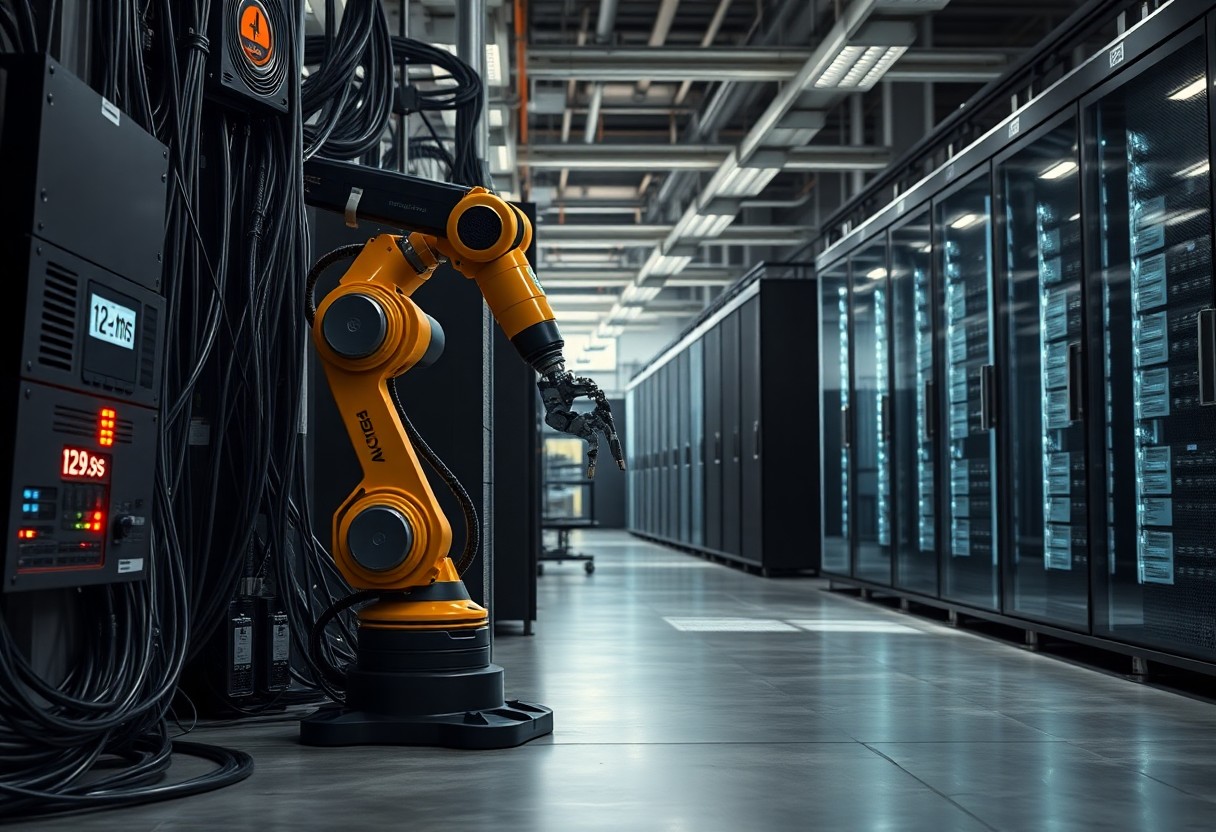
Over the past decade, cloud robotics have shifted the balance between local autonomy and remote intelligence, and you must weigh latency, operational cost, and system control when designing your systems; this post guides you through trade-offs, deployment patterns, and metrics so you can decide when to offload computation, where to place control loops, and how to manage costs without sacrificing performance.
Many modern robotic systems shift computation to the cloud, forcing you to weigh latency against cost and the degree of centralized control you accept; this post guides you through latency-sensitive architectures, edge-cloud hybrids that lower expenses, and governance strategies to preserve autonomy and security, so you can design systems that meet performance, budget, and policy requirements without sacrificing responsiveness or operational resilience.
Overview of Cloud Robotics
In practice, cloud robotics lets you push heavy perception, mapping, or fleet coordination into scalable datacenters while keeping control loops local. Since ROS popularized modular robot software, you can offload model training to cloud GPUs, use services like AWS RoboMaker (launched 2018) for large-scale simulation, and deploy edge nodes to shave round-trip latency from hundreds of milliseconds to tens. That balance directly affects your choices on throughput, cost, and deterministic control.
Definition and Evolution
You define cloud robotics as the split of responsibilities between onboard controllers and remote compute, a shift from teleoperation in the 1990s to distributed ROS-era systems in the 2010s. After 2015, cheaper GPUs and cloud ML services let teams train models in hours instead of days; by 2018 platforms standardized cloud-based simulation and CI/CD, driving many groups to rebalance sensing, planning, and fleet orchestration across robot, edge, and cloud.
Key Technologies
Key technologies you must master include ROS/ROS2 for middleware, DDS or MQTT for messaging, Docker and Kubernetes for deployment, and gRPC or REST for APIs; on the hardware side, NVIDIA Jetson modules or Intel NUCs handle onboard inference while cloud GPUs (V100/A100) accelerate training. You also rely on network tech like 5G and SD-WAN to reduce latency and provide predictable bandwidth for telemetry and model updates.
Digging deeper, ROS2’s DDS gives you QoS controls for reliability and deadlines, enabling tighter real-time guarantees in some deployments, while Kubernetes lets you scale simulation and model-serving from tens to thousands of pods, cutting CI turnaround times. 5G field trials report sub-10 ms round-trip times in ideal conditions, so you can offload non-safety-critical perception to the edge; a common pattern pairs Jetson Xavier NX on-robot inference with cloud A100s for centralized training.
Overview of Cloud Robotics
When you move heavy perception, mapping, or ML workloads to datacenters, you trade onboard autonomy for elastic services: platforms like AWS RoboMaker and RoboEarth-style knowledge bases let fleets share maps and models, 5G can cut round-trip latency into single-digit milliseconds while LTE often sits around 50-100 ms, and cloud GPU instances cost a few dollars to tens per hour-so you balance latency, scale, and operating expense when architecting systems.
Definition and Key Concepts
Cloud robotics means you offload compute and storage to remote servers while combining edge gateways for real-time loops; core concepts include shared model repositories, centralized orchestration, telemetry-driven retraining, and hybrid edge-cloud placement patterns; technologies such as ROS, AWS RoboMaker, federated learning, and containerized inference enable you to coordinate fleets, push OTA updates, and reuse perception assets across deployments.
Benefits of Cloud Robotics
You gain faster feature rollout, simplified maintenance, and fleet-level optimization by centralizing heavy compute: cloud-based orchestration lets you coordinate thousands of units, amortize expensive GPUs across many robots, and deliver continuous model improvements; Fetch Robotics’ cloud fleet management, for example, accelerated warehouse rollouts and remote updates, illustrating operational scale and reduced per-robot integration effort.
Digging deeper, you exchange capital expense for elastic operating cost-rather than fitting every robot with a high-end onboard GPU, you run shared inference and training in the cloud (on-demand GPU pricing ranges from a few to tens of dollars per hour) and autoscale to workload; this enables nightly retraining from fleet telemetry, centralized logging and A/B testing, and rapid OTA fixes. You still must design for network variability by keeping millisecond control loops local, using map and model caching at the edge, and enforcing strong encryption and IAM to protect telemetry and intellectual property, as demonstrated by production fleets that combine edge gateways with cloud-based simulation and analytics.
The Importance of Latency in Cloud Robotics
When milliseconds influence safety and task success, you must treat latency as a design parameter. Typical cloud round-trip times range from ~20-200 ms over the public Internet, while 5G/edge setups can drop to ~10-20 ms; by contrast, motor-level control often requires 1-2 ms loops. That gap forces you to split functionality: keep sub-10 ms closed loops local, move perception or learning tasks to the cloud, and use edge nodes to bridge the divide when you need both low latency and heavy compute.
Real-time Processing Requirements
For motor control you run servo loops at 500-1,000 Hz (1-2 ms periods), so sending those signals to the cloud is infeasible. Conversely, SLAM and object recognition often tolerate 50-200 ms latency, letting you offload mapping or model updates to the cloud. You should profile each pipeline: if a perception module contributes >50 ms variability to a control decision, consider moving it onboard or to an edge node to keep closed-loop stability and deterministic timing.
Impact on User Experience
In teleoperation and telepresence you feel delays above ~100 ms, and delays past ~200 ms produce disorientation and degraded task performance; for example, drone pilots report control difficulty above 150-200 ms R
TT. You need to quantify acceptable latency per task-precision manipulation vs. high-level guidance-and design interfaces and feedback that mask or compensate for the delays your network introduces.
Mitigations you can apply include adding edge compute to shave tens of milliseconds, implementing local autonomy fallbacks for safety-critical loops, and using predictive displays or model-based estimators to reduce perceived lag-studies show prediction-based interfaces can significantly improve operator accura
cy. In high-stakes domains like telesurgery (industry targets often cite sub-200 ms RTT) and industrial robotics, vendors keep balance and force controllers onboard (Boston Dynamics-style local control) while streaming higher-level telemetry to the cloud for analytics and planning.
Latency Considerations
When you measure latency for a cloud-robotics pipeline, aim to quantify RTT, jitter, and tail latency: typical WAN RTTs sit between 30-150 ms, wired LANs below 1 ms, and 5G MEC can push single-digit ms; control loops often need 1-10 ms, while perception and analytics tolerate 50-200 ms. In practice, Amazon-style warehouse fleets keep millisecond-safe motion control local and push fleet optimization, mapping, and heavy vision to the cloud to balance responsiveness and co
st.
Impact on Real-Time Operations
If your control loop runs at 100 Hz (10 ms period), adding 20-50 ms network delay can cause phase lag, oscillation, or missed deadlines; higher-frequency actuators at 1 kHz (1 ms) are impossible to cloud-contr
ol. Latency variability (jitter) forces conservative gains or stability margins, increasing settling times and reducing throughput, and safety-critical functions must remain local to avoid transient network failures turning into hazards.
Strategies to Mitigate Latency
You can partition workloads: keep tight-loop control and collision avoidance onboard, offload perception training and global planning to cloud, and use edge/MEC (AWS Wavelength, Azure Edge Zones) for low-latency inference. Combine model distillation, compressed telemetry, prioritized UDP streams, ROS2/DDS QoS tuning, and local fallback behaviors to shave milliseconds while preserving functionality under degraded links.
For deeper mitigation, deploy an explicit hybrid architecture: run a compact neural policy onboard (20-50 ms inference) and a larger model in the cloud for periodic updates; implement state-prediction horizons (e.g., 100-300 ms) so your controller compensates for expected delay; use asynchronous reconciliation where cloud outputs correct drift rather than command instant maneuvers; and instrument end-to-end SLOs with SLAs and per-packet QoS to route latency-sensitive traffic over MEC or private links when available.
<h2>Cost Considerations in Cloud Robotics
Balancing cost means you must break expenses into predictable capital and variable operational buckets: compute, storage, bandwidth, and people. You’ll see large one-time hardware buys (edge servers, cameras) offset by recurring cloud bills and telemetry fees. For planning, assume GPU inference at $0.5-$3+/hour, object storage around $0.023/GB-month, and egress roughly $0.09/GB as baseline figures to model total cost of ownership for any fleet size.
<h3>Infrastructure Costs
Compute dominates when you offload perception or ML: a single cloud GPU instance can run $12-72/day depending on type and region, so 10 concurrent instances is $3,600-$21,600/mon
th. Network egress scales quickly-50 robots streaming 1 Mbps produce ~16 TB/month, which at $0.09/GB is about $1,440 in egress fees; storing that data in S3-class storage adds roughly $375/month. You should model peak vs average usage and leverage spot or reserved instances to shave 30-70% off compute bills.
Operational Expenses
Ongoing ops include engineering, monitoring, support, and managed services: hiring a cloud engineer or SRE typically costs $120k-$170k/year, while managed services (Kubernetes, ML endpoints) add per-hour or per-request fe
es. You’ll also pay for logging/metrics, CI/CD, and redundancy – multi-region deployments multiply base costs and increase monthly spend by 20-50% depending on tolerance for failure.
Digging deeper, telemetry can be surprisingly expensive: if each robot emits 10 KB/s of logs (≈25 GB/month), 100 robots generate ~2.5 TB/month; at $0.10/GB ingestion that’s $250/month, but at $1/GB for advanced analytics it’s $2,500/mon
th. On-call and incident overhead raise personnel costs by roughly 15-25% when accounting for rotations and overtime. You should quantify SLA penalties, backup retention policies, and analytics tiering when forecasting operational burn.
Cost Analysis
When evaluating total expense, you should split CapEx (edge hardware: ~$5,000-$25,000 per industrial-grade node) and OpEx (cloud compute and bandwidth). For example, inference on a modest GPU instance can range ~$0.20-3.00/hour while training or high-end inference reaches $2-12/hour; storage often runs $0.01-0.03/GB/month. Factoring amortization, bandwidth, and maintenance reveals where cloud-driven savings offset added latency or operational complexity.
Financial Implications of Cloud Robotics
Consider bandwidth: egress typically costs $0.05-0.12/GB, so 100 robots streaming 1GB/day yields ~3TB/month and $150-$360 monthly egress. You also face licensing, data retention (cold storage ~$0.004-0.01/GB/month), and monitoring costs. For fleets, software subscriptions and cross-region transfers can multiply; a 100-robot pilot commonly moves from hundreds to thousands of dollars per month once telemetry and model updates scale.
Cost-Benefit Optimization
Mixing edge for control loops and cloud for heavy perception often yields best ROI: use quantized models at the edge, batch cloud inference, and spot or reserved instances to cut compute by 50-90%. For bandwidth, apply H.265 or point-cloud compression to reduce egress 50-70%. These tactics let you trade latency against predictable monthly spend. For a concrete benchmark, if avoiding a $2,000 edge upgrade per robot means using cloud inference at $0.05 per call, you break even after 40,000 calls-roughly 33 days at 1,200 calls/day. Run sensitivity analysis varying call rate, egress $/GB, and instance-hour costs to find the operational threshold where cloud becomes cheaper than local investment, and pilot with A/B tests to validate modeled savings.
Control Mechanisms in Cloud Robotics
When architecting control, you accept that low-latency loops remain local (typically under 10 ms loop periods) while heavier planning can tolerate 50-200 ms cloud RTTs; the UNC Cloud Robotics work examines these tradeoffs-see cloud-based computation for robot motion planning for experiments and implementations that illustrate where you should offload versus keep local.
Centralized vs. Decentralized Control
You must weigh centralized global schedulers, which simplify coordination and optimality for fleets of 10-50 robots but become single points of failure and bandwidth bottlenecks, against decentralized schemes that scale to hundreds, tolerate intermittent links, and use local consensus or distributed MPC for safety; many warehouses mix central tasking with onboard reactive collision avoidance to get the best of both.
Hybrid Approaches
You should design hybrids that keep 100-1,000 Hz inner control loops on the robot while moving 0.1-1 Hz strategic planning or map fusion to the cloud, so sensors and emergency responses stay local and heavier optimization can leverage pooled GPUs or clusters.
You can implement hybrid stacks by placing deterministic hard-deadline loops (e.g., motor control, braking) on-device and running nonreal-time planners in the cloud; practical measures include edge proxies to cache recent maps, heartbeats that force graceful degradation to local autonomy when RTT exceeds ~150-200 ms, and using local MPC for trajectory tracking while the cloud supplies waypoint updates at 0.1-1 Hz-this pattern reduces onboard CPU load, limits peak cloud costs, and preserves safety under variable networks.
Control Mechanisms
In real deployments you split control by latency sensitivity and failure modes: run millisecond-rate servo loops on local controllers (industrial arms often use 1 kHz loops) while placing high-latency, compute-heavy tasks like fleet-wide optimization or batch learning in the cloud. You should budget edge hardware ($5k-$25k) for deterministic real-time control and use the cloud for non-real-time coordination, logging, and model training to balance cost, safety, and performance.
Centralized vs. Decentralized Control
When you pick centralized cloud control, expect WAN RTTs often in the 50-150 ms range, making it suitable for global planning, telemetry, and batch coordination but not for closed-loop stability. Decentralized or hybrid approaches keep SLAM, collision avoidance, and 10-50 ms reaction loops local, while the cloud handles multi-robot task allocation with horizons of seconds to minutes; ROS 2/DDS and edge containers are common building blocks for these hybrids.
Ensuring Robustness and Reliability
You harden systems by combining deterministic local control with cloud redundancy: deploy watchdog timers (10-100 ms), dual-network paths, and local failover behaviors so safety-critical functions survive cloud outages. Target cloud SLAs explicitly-99.99% uptime means about 52.6 minutes downtime per year-and design your robot to degrade gracefully when connectivity drops, using cached maps, local planners, and prioritized message queues.
Implement additional measures like state-machine shadowing, consensus for critical distributed decisions (Raft or Paxos), and QoS prioritization (ROS 2 QoS, TCP low-latency channels). You can use edge shadow models to continue autonomy with degraded sensing, employ exponential backoff and jitter for reconnection, and run chaos testing (simulated packet loss, 100-500 ms spikes) to validate failover policies before fielding.
Balancing Act: Latency, Cost, and Control
When you design a cloud-enabled robot, you must weigh end-to-end RTT against operational cost and autonomy: offloading perception to the cloud can slash onboard compute needs but spikes latency and egress expenses, while local processing increases hardware cost and power draw. Hybrid frameworks such as FogROS2-PLR: Probabilistic Latency-Reliability for Cloud … show how probabilistic guarantees help you tune where to place functions.
Trade-offs and Prioritization
You should prioritize tasks by safety and timing: put hard real-time control loops locally (≤10-20 ms jitter), push batch perception or map updates to the cloud, and use edge nodes for mid-latency workloads (20-100 ms). Define SLAs and cost thresholds up front, then apply adaptive policies that shift workloads based on current RTT, bandwidth, and budget to meet mission goals without overprovisioning.
Case Studies in Balancing Solutions
You can learn from deployments that quantified trade-offs: hybrid stacks reduce costs and latency variance, while pure-cloud setups simplify software but raise tail-latency and bandwidth bills. The following examples show concrete numbers and operational outcomes that inform placement decisions for your systems.
-
-
- FogROS2-PLR lab demo: median perception latency dropped from 120 ms to 45 ms; 95th-percentile latency fell 200 ms → 85 ms; reliability target reached 99.2% under variable load.
<li>Warehous
-
e picking (edge-assisted): local inference on $300 edge box cut cloud egress by 72%, increased throughput from 40 to 85 picks/hour per robot, and kept RTT ≤35 ms. <l
-
- i>Teleoper
ation for inspection: moving camera encoding to edge reduced operator-perceived latency from 350-500 ms to 70-90 ms, lowering task completion time by ~38% and error rate by 22%. <l
-
- i>Fleet-wi
de mapping (cloud-heavy): centralized SLAM reduced per-robot CPU by 60% but raised monthly cloud cost from $120 to $950 for 50 robots, with occasional 95th-percentile delays >400 ms. </
-
- ul>
You should treat these case studies as templates: adjust thresholds and budgets to your risk profile, replicate measurement setups (latency percentiles, throughput, cost/hour), and run A/B tests under realistic network conditions so your placement strategy is evidence-driven rather than hypothetical.
-
-
- <ul>
- Autonomous delivery demo: hybrid planner split-local short-horizon control (≤15 ms), cloud route optimization-reduced on-robot CPU by 48% and decreased delivery time variance by 31% across 1,000 trips.
<li>Factory
-
QA robots: moved heavy vision scoring to an on-prem edge cluster; average per-inspection compute cost fell from $0.08 to $0.02, latency stabilized at 28±6 ms, throughput rose 2.3×. <l
-
- i>Search-a
nd-rescue prototype: fully local autonomy achieved sub-20 ms control latency but required 4× the power budget; hybrid mode used cloud for map fusion, cutting battery drain by 35% during extended missions. </
-
- ul>
Use Cases
Across deployments you’ll see cloud robotics solve coordination, analytics, and fleet learning where local control handles safety-critical timing. You can push heavy vision inference, map fusion, and policy training to the cloud while keeping sub-10 ms control loops on-device, yielding faster feature rollout, centralized monitoring, and measurable OpEx reductions without compromising latency-sensitive tasks.
Applications in Various Industries
You’ll find cloud-enabled robots in warehouses (order fulfillment fleets of 50-1,000+ units), manufacturing (cobots with centralized scheduling reducing idle time by 20-40%), agriculture (drone swarms for crop mapping covering 100-500 ha/day), healthcare (remote imaging and asset tracking with HIPAA-aware clouds), and inspection (pipeline/bridge inspections reducing field time by 30-60%).
Case Studies Demonstrating Effectiveness
You can evaluate impact via throughput, downtime, and cost-per-task: typical results show 30-60% throughput gains in logistics, 15-35% labor or FTE reductions in mixed-automation sites, and cloud-driven model convergence times 3-5× faster versus siloed training, often delivering payback within 6-18 months depending on scale.
- Retail warehouse (fleet 200 AMRs): cloud route optimization cut average pick time from 14s to 6s (57% improvement); labor FTEs down 18%; monthly OpEx savings ≈ $48k.
- Discrete manufacturing (20 cobots): centralized scheduling reduced cycle wait time 32%; overall throughput +28%; CapEx per node ~$12k, ROI in 11 months.
- Agricultural mapping drones (fleet 30): cloud mosaicking trimmed processing from 8 hr to 45 min; actionable field maps delivered next-day; per-hectare imaging cost fell 42%. <l
- Infrastructure inspection (10 robots): shared defect model lowered manual review rate from 22% to 6%; inspection throughput +60%; remediation lead time cut 40%.
Future Trends in Cloud Robotics
You’ll see hybrid stacks where low-latency perception runs on-device while the cloud handles fleet learning, map aggregation, and heavy planning; 5G URLLC (target ~1 ms) and private LTE push round-trip times from typical 20-80 ms toward single-digit milliseconds for many sites, letting you centralize coordination and analytics without killing responsiveness.
Emerging Technologies
You’ll adopt edge accelerators like Google Coral Edge TPU and NVIDIA Jetson for on-board inference, pair them with cloud GPUs for periodic retraining, and use federated learning to merge updates from thousands of units while sending only model deltas; ROS 2, NVIDIA Isaac Sim and serverless robotics platforms (AWS RoboMaker, Azure IoT Edge) will accelerate deployment and cut live testing effort substantially.
Predictions for Industry Growth
You’ll see logistics, inspection, and last-mile delivery fleets scale fastest-deployments in those verticals are likely to double within 3-5 years-as RaaS pricing, cheaper edge compute, and unified cloud APIs let you manage hundreds of robots from a single pane.
You should expect concrete operational changes: RaaS models will shift your budget from CAPEX to OPEX so you can expand fleets faster; hybrid rollouts in warehouses (examples from Amazon Robotics and Ocado-style automation) show time-to-deploy falling from months to weeks and operational downtime dropping 15-30%; continuous cloud-driven retraining will shorten update cycles from quarterly to hourly or daily, while regulations like the EU AI Act will push you to keep auditable decision logs and some decision logic on-device.
Future Trends
Emerging architectures are shifting how you balance latency, cost, and control: edge‑native accelerators and 5G sub‑10 ms links let you offload perception while keeping control loops local, cloud services like AWS RoboMaker and NVIDIA Isaac Sim scale training and simulation, and spot GPUs can cut batch‑training cost by up to 90% at the expense of preemption risk.
Innovations in Cloud Robotics
You’ll see broader adoption of on‑device accelerators (NVIDIA Jetson, Google Edge TPU), ROS2 and Kubernetes at the edge, and model compression (quantization/pruning) to fit 1-5 W devices; digital twins and Isaac Sim are shrinking sim‑to‑real cycles, while federated and split learning reduce raw data transfer and privacy exposure for fleet learning.Potential Developments and Challenges
You must contend with regulatory frameworks, heterogeneous hardware, and network variability: 5G slicing and MEC help, but jitter beyond tens of milliseconds still disrupts tight control loops, and safety certification for cloud‑assisted behaviors (e.g., automotive or medical) lags behind deployment pace.
Mitigation requires hybrid designs: keep safety‑critical control local and certified, offload perception and fleet learning to the cloud, and implement multi‑tier caching, multi‑path connectivity (cellular + private LTE/Wi‑Fi), and clear SLOs targeting millisecond RTTs; industry pilots show that graceful degradation and local fallbacks prevent unsafe states when spot instances are preempted or cellular links degrade.
Summing up
Taking this into account, you should weigh latency, cost, and control against your application’s real-time demands, choosing hybrid and edge strategies to reduce delays while containing expenses and retaining autonomy; define clear SLAs and monitoring to validate performance and guide trade-offs.
Summing up
To wrap up, you must weigh latency, cost, and control when designing cloud-enabled robotic systems: push time-sensitive processing to the edge to keep your robots responsive, leverage cloud resources for heavy learning and storage to reduce expenses, and define clear control boundaries and fail-safes so your operational policies and safety con
straints are preserved. Strategic hybrid architectures give you the best trade-offs.
