
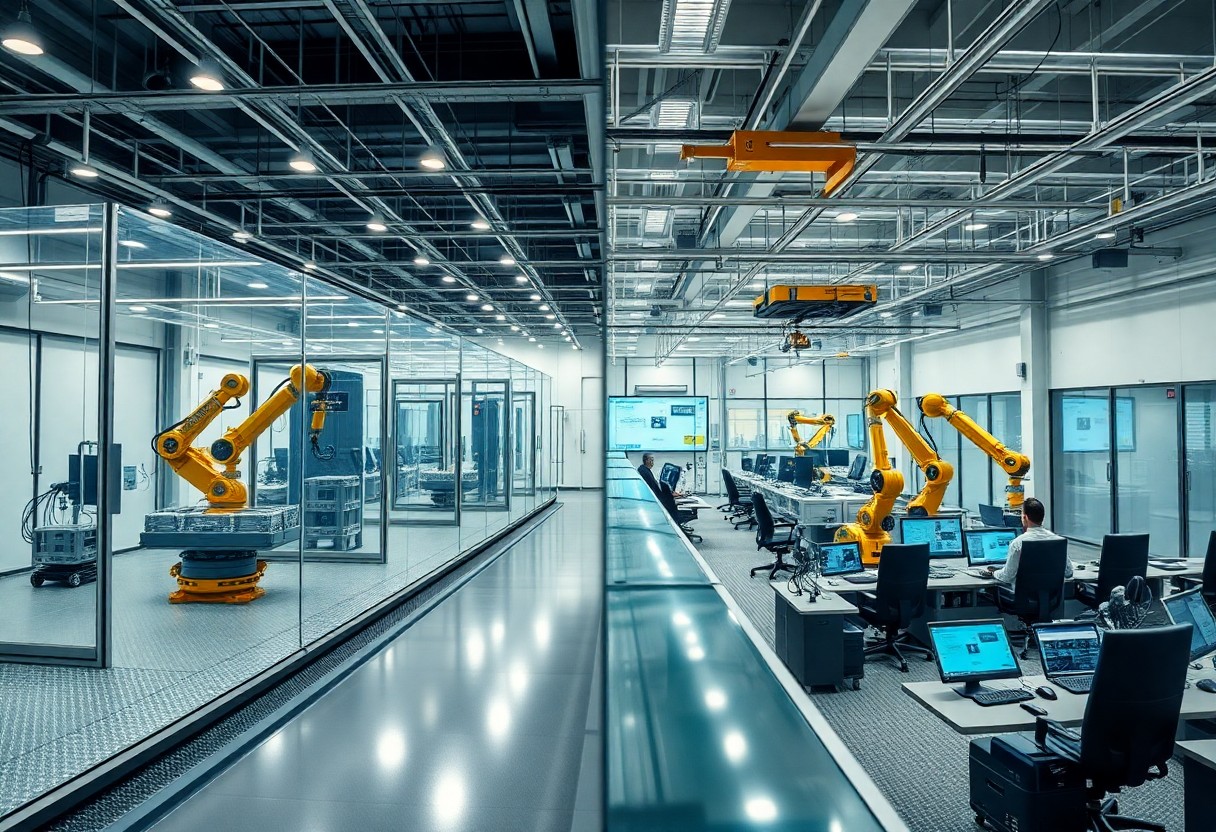
There’s a shift in manufacturing as isolated automated cells evolve into fully orchestrated autonomous factories, and you need to understand how integration, real-time data, and adaptive control transform productivity and resilience. This post explains the technology stack, system architectures, workforce impacts, and implementation pathways so you can evaluate readiness, prioritize investments, and lead deployment of interoperable, self-optimizing production systems.
Evolution of Factory Automation
Historical Overview
You can trace modern automation to Unimate’s 1961 robot at GM and the late‑1960s Modicon PLC that replaced hardwired relays; CNC and early SCADA in the 1970s-90s scaled repeatability, MES connected shop floor to ERP in the 1990s, and Ethernet plus sensors in the 2000s enabled data flows-Industry 4.0 (coined around 2011) then pushed strategy toward connected, software‑defined plants.
Technological Advancements
You’ve moved from isolated controllers to AI vision, cobots, AMRs and digital twins that co‑orchestrate production; Siemens Amberg’s plant, for example, reached 99.998% quality using closed‑loop automation and digital twin workflows, while OPC UA, 5G and cloud/edge architectures let you optimize cycles in near real‑time and automotive lines now exceed 1,000 robots per 10,000 workers.
You can deploy edge AI for anomaly detection to shift maintenance to condition‑based care-pilots often report 10-40% downtime reduction-while vision plus deep learning catches micron‑scale defects, cutting scrap; digital twins let you virtually commission changes (reducing ramp‑up by weeks in auto stamping), and containerized, open‑protocol stacks let you iterate software without stopping lines.
The Concept of Autonomous Factories
You see autonomous factories as integrated ecosystems where cells, AGVs, robots, and MES communicate and self-orchestrate to meet changing orders without manual reprogramming; examples include FANUC’s lights-out production and Siemens Amberg’s highly traceable lines. By combining digital twins, edge AI, and standardized interfaces like OPC UA, your plant shifts from manual choreography to adaptive, continuous flow, improving responsiveness to demand spikes and enabling 24/7 operation with far fewer human interventions.
Definition and Characteristics
An autonomous factory lets systems observe, decide, and act with minimal human input: decentralized control, closed-loop feedback, digital twins, edge inference on sensor streams, and modular cells that auto-configure. You rely on real-time telemetry, model-based optimization, and interoperable APIs so robots, conveyors, and planning software autonomously reschedule, reroute, and rebalance production when faults or order changes occur.
Benefits of Autonomous Operations
Autonomy delivers higher uptime, tighter quality control, faster changeovers, and lower operating cost: pilots report up to 40% downtime reduction and 20-30% productivity gains. When you enable autonomous scheduling and predictive maintenance, throughput rises while defect rates fall, and your factory can sustainably run 24/7 with predictable lead times and smaller safety stocks.
In practice, you’ll see predictive maintenance extend MTBF and cut spare-part inventory, autonomous AGVs shorten internal transport times by ~30%, and digital twins accelerate commissioning-some OEM pilots reduced ramp-up from months to weeks. Combining these tactics, your supply-chain alignment improves, lead times shrink, and overall equipment effectiveness (OEE) moves measurably upward.
Isolated Cells in Manufacturing
Inside many plants, isolated cells group machines and robots to execute narrowly defined operations-welding, machining, or inspection-without broader factory coordination. You’ll commonly find 1-5 robots per cell, local PLCs or embedded controllers, and cycle times ranging from 5 to 30 seconds per part. Cells often optimize a single KPI (throughput or yield) but operate as islands, relying on manual or conveyor handoffs that limit visibility into downstream effects.
Structure and Functionality
Typically, a cell contains fixed tooling, safety cages, part feeders, vision systems, and a cell controller communicating via OPC-UA or Ethernet/IP. You might see a 6-axis robot handling 300-800 parts/day, a camera inspecting tolerances to ±0.01 mm, and local SCADA logging alarms. Integration focuses on deterministic repeatability: repeatable cycle times, automatic fault shutdowns, and local recipe management for quick changeovers within 5-20 minutes.
Limitations of Isolated Systems
When cells remain isolated, you face disconnected KPIs, hidden bottlenecks, and excess WIP-often 20-60% higher than in orchestrated lines. You’ll encounter manual transfers that add 1-5 minutes per part, unpredictable idle times, and difficulty reallocating capacity during demand shifts. Faults are localized but propagate lead-time variance across your schedule because there’s no global rescheduling or AGV-driven buffering.
For example, a mid-sized electronics OEM tracked a 40% lead-time reduction and a 60% drop in WIP after linking 12 separate SMT and assembly cells with an MES and three AGVs; previously, manual handoffs caused average 3-minute delays per lot and 15% throughput loss during shift changes. You can mitigate these limits by adding standard data models, event-driven alarms, and lightweight orchestration to enable dynamic routing and real-time load balancing across cells.
Transitioning to Integrated Systems
You accelerate integration by aligning PLCs, MES, edge gateways and cloud orchestration so data flows bidirectionally; pragmatic architectures-OPC UA, event buses and API layers-shrink handoffs and support phased rollouts. See concrete frameworks in From Industrial Automation to Autonomous Production, and plan pilots (3-6 months), scaling (12-24 months) with KPIs like OEE, cycle time and first-pass yield.
Importance of Connectivity
You must provision deterministic networks, edge compute and secure VPN/DTLS tunnels so control loops stay under 10 ms while OT/IT synchronization feeds analytics; deployments that standardized on time-sensitive networking and edge gateways reported 40-60% reductions in unplanned downtime and 20-35% faster troubleshooting.
Case Studies of Successful Integration
You’ll find reproducible patterns: combining AGVs, machine vision and MES often yields 25-70% cycle-time improvements and payback within 12-18 months; the following case summaries show the metrics and timelines you can target.
- Automotive OEM (Europe): Integrated 200 industrial robots, MES and digital twin; OEE +15%, cycle time -30%, deployment 18 months, annual savings €5M.
- Electronics contract manufacturer: End-to-end traceability and inline AOI; throughput +60%, defect rate -45%, ROI 12 months, reduced rework by 70%.
- Food & beverage line: Modular conveyors and recipe-driven PLCs; SKU changeover 60→5 minutes, waste -25%, throughput +22% after 9-month rollout.
- 3PL warehouse (FMCG): AMR fleet and WMS integration; picks/hour 60→180, labor cost -40%, lead time variability halved in 6 months.
- Semiconductor assembly: MES + predictive maintenance; equipment uptime +8-12%, throughput +20%, yield uplift ~2% across a 2-year program.
You can adapt elements from these pilots: standardize communication (OPC UA), instrument assets for condition monitoring, and phase automation to lock early wins-each case shows shorter ROI when you pair clear KPIs with cross-functional teams and vendor-managed integration sprints.
- Tier‑1 supplier (machinery): PLM + ERP + shop-floor digital twin reduced design-to-production lead time by 35%, commissioning time cut from 14 to 6 weeks.
- SME furniture manufacturer: CNC automation and smart conveyors; labor headcount -50%, throughput x3, payback 10 months, flexible batch sizes enabled.
- Pharmaceutical packaging line: Vision-guided pick-and-place + track-and-trace; compliance reporting automated, rejects -60%, OEE +12% within 9 months.
- Consumer electronics pilot: Cloud analytics on edge telemetry; predictive alarms reduced mean time to repair (MTTR) by 45% and increased overall throughput by 28% in a 15-month program.
The Role of AI and Robotics
AI models and collaborative robots turn siloed cells into adaptive assets, using sensor fusion, real‑time optimization and closed‑loop control to make decisions at the edge. You can deploy vision systems and anomaly detection that spot defects at micron scales, while predictive maintenance models commonly cut unplanned downtime by 20-50%. Integrators like Siemens and ABB now combine MES telemetry with robot controllers so your cells adjust speed, grip and routing dynamically to throughput and quality targets.
Enhancing Efficiency and Precision
Through adaptive path planning, force‑torque control and in‑line machine vision you can shave cycle times and scrap rates: documented deployments report 20-40% faster cycles and sub‑millimeter placement for assembly tasks. Real examples include automated deburring and fastening stations where real‑time feedback reduces rework, and AGV-robot handoffs orchestrated by edge controllers that cut material handling delays by predictable margins.
Future Trends in AI Applications
Edge AI, digital twins, federated learning and multi‑agent coordination are converging so you’ll run models locally for latency‑sensitive control while aggregating improvements centrally. Expect reinforcement learning for dynamic scheduling, self‑supervised vision models that reduce labeling effort, and explainable AI layers so operators can trust automated decisions. Vendors are packaging these into platforms you can trial within weeks rather than years.
More specifically, digital twins let you prototype line changes offline and accelerate commissioning by simulating thousands of scenarios; federated learning enables model improvements across dozens or hundreds of plants without sharing raw data; and energy/thermal optimization techniques-similar to DeepMind’s 40% cooling savings in data centers-are being adapted to cut factory energy usage. You should plan governance for model updates, validation datasets and rollback paths as these capabilities scale.
Challenges and Considerations
Many obstacles surface as you stitch cells into a single autonomous fabric: legacy PLCs speaking Modbus, scattered OPC UA and MQTT endpoints, and the need for deterministic networking like TSN to meet sub‑10 ms control loops. You must also weigh data integrity, maintenance windows, and the fact that unplanned downtime can cost manufacturers anywhere from $10,000 to $250,000 per hour depending on the sector, so architectural choices have direct financial impact.
Technical and Operational Hurdles
Integration often forces you to implement OPC UA companion specs, map hundreds of PLC tags, and reconcile differing time bases with PTP/TSN while protecting OT from cyber threats under ISA/IEC 62443 guidelines. You will face months of testing for edge-to-cloud pipelines, digital‑twin validation, and firmware management; in many projects that validation phase alone can consume a six‑figure budget and dictate phased rollouts rather than big bangs.
Workforce Implications
As autonomy grows, you need blended teams combining OT know‑how and IT skills: robotics technicians, data engineers, AIops specialists, and OT security analysts. The World Economic Forum estimates roughly 50% of workers will need reskilling by 2025, so hiring alone won’t suffice – you must build internal pathways to transition operators into roles that manage models, label data, and troubleshoot integrated systems.
Practical steps you can take include 8-16 week bootcamps, vendor certification programs (Siemens, ABB), ISA security training, and shop-floor rotations that pair veteran technicians with data analysts. You should prioritize hands-on labs for digital‑twin commissioning, short sprints to validate KPIs like OEE, and micro-credentialing so your staff can incrementally acquire skills without long absences from production.
Summing up
Upon reflecting, you see that autonomous factories evolve from isolated cells into harmonized, data-driven ecosystems where interconnected machines, AI orchestration, and real-time analytics let you scale production, reduce downtime, and adapt to demand. To realize this, you need interoperable standards, secure networks, skilled personnel, and iterative deployment strategies that balance autonomy with human oversight to protect quality and ensure return on investment.
