
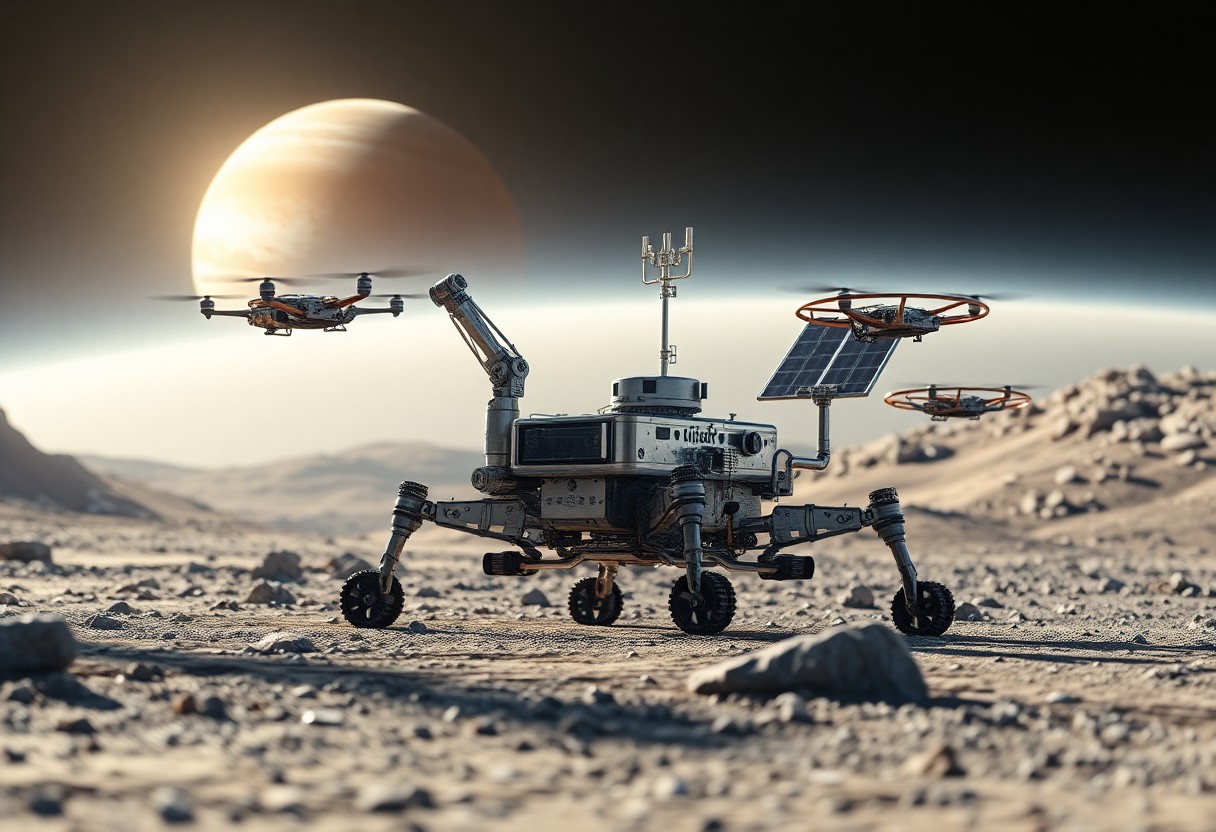
Many autonomous space robots now operate beyond Earth orbit, allowing exploration of distant worlds, conducting experiments, and responding to unexpected hazards when real-time control is impossible. These systems rely on advanced perception, navigation, onboard decision-making, fault tolerance, and long-duration energy management. Understanding their capabilities helps plan resilient and efficient exploration in environments with communication delays, radiation, and limited resources.
The Evolution of Space Robotics
Space robotics has evolved from tethered manipulators to fully autonomous explorers. Early arm servicers handled assembly tasks, mobile rovers expanded surface science capabilities, and now self-guided servicers and aerial scouts perform complex, independent tasks. Key missions include ISS robotics in the 2000s, Mars rovers since 1997, and recent on-orbit servicing demonstrations. Mixed teleoperation and autonomy extend reach and reduce risk for long-duration missions.
Historical Overview of Space Robotics
Significant milestones include:
-
1980s: Shuttle-era manipulators for assembly.
-
1997: Sojourner rover proves mobile surface science.
-
2001: Canadarm2 installed on the ISS.
-
2004: Spirit and Opportunity demonstrate multi-year endurance.
-
2012: Curiosity lands on Mars.
-
2021: Perseverance lands on Feb 18; Ingenuity flies Apr 19.
Incremental successes built confidence in autonomous long-duration missions.
Key Technological Advancements
Advances reshaping capability include:
-
Visual odometry and SLAM for rover navigation.
-
AI-enabled hazard avoidance, e.g., Perseverance.
-
Precision landing with Terrain-Relative Navigation (TRN).
-
In-space docking, e.g., MEV-1 with Intelsat-901 (2020).
Notable examples:
-
Perseverance carries 23 cameras and uses TRN for accurate landing.
-
Ingenuity achieved Mars’ first powered flight (Apr 19, 2021).
-
Sample return missions: Hayabusa (2010), Hayabusa2 (2020), OSIRIS‑REx (2023).
On-orbit autonomy now combines machine vision, LiDAR, and model-predictive control for dexterous manipulation and autonomous rendezvous.
Types of Autonomous Space Systems
Rovers & Landers: Surface exploration and sample caching (Perseverance, Chang’e 5)
Orbiters & Satellites: Reconnaissance, relay, and mapping (MRO, Juno)
Hoppers & Aerial Drones: Short-range mobility and scouting (Ingenuity, Dragonfly)
Free-flyers / Interplanetary Probes: Flyby and long-range science (New Horizons, Voyager)
Servicers & On-orbit Robots: Inspection, refueling, and assembly (Restore-L concept, Canadarm2)
Rovers and Landers
Rovers and landers access terrain directly. Perseverance uses Terrain-Relative Navigation and autonomous hazard avoidance to drive tens to hundreds of meters per sol while caching samples. Chang’e 5 executed robotic sampling and returned 1.73 kg from the Moon. Autonomy sequences sampling, drilling, and imaging without constant ground control.
Orbiters and Satellites
Orbiters provide high-resolution context and communication relay. MRO’s HiRISE images at ~25 cm/pixel for targeted science. Autonomous experiments like EO-1’s Autonomous Sciencecraft prioritize events and downlink, enabling faster reactions to ephemeral phenomena. Orbiters perform onboard fault detection, trajectory correction, and opportunistic science, increasing return while lowering operational cost.
Current Missions Utilizing Robots
Robots operate across Mars and small bodies:
-
Mars: Perseverance (2021) and Ingenuity (2021) extend surface exploration.
-
Asteroid Mining: OSIRIS‑REx (Bennu, 2023) and Hayabusa2 (Ryugu, 2020) return samples.
-
Planetary Defense: DART (2022) demonstrates autonomous impact.
-
Deep-Space Reconnaissance: Lucy and Psyche map Trojan asteroids and metal-rich worlds.
These missions validate autonomous navigation, hazard avoidance, and sample collection for future operations.
Mars Exploration
Perseverance (2021) caches samples for a future Mars Sample Return campaign. Ingenuity provides aerial scouting beyond rover tracks. Curiosity (2012) supplies geological context, while orbiters like MRO provide imagery to guide robotic teams to promising outcrops.
Asteroid Mining
Robotic sample returns demonstrate asteroid resource potential. Hayabusa2 delivered Ryugu samples (2020), OSIRIS‑REx returned Bennu material (2023). DART (2022) demonstrated autonomous target engagement. Returned samples revealed organics on Bennu and hydrated minerals on Ryugu, informing future extraction concepts like in-situ water recovery.
Challenges in Autonomous Space Systems
Communication Delays
One-way light time ranges from ~1.3 seconds (Moon) to 22 minutes (Mars), preventing real-time control. Autonomy must handle hazard detection, trajectory correction, and fault recovery locally.
Environmental Hazards
Radiation, micrometeoroids, abrasive regolith, and extreme temperatures impose constant risk. Systems must anticipate degraded sensors and maintain operations across sudden environmental changes. Radiation-hardened processors, ECC memory, and shielding are standard.
Operational Constraints
Long mission durations, limited compute, and the need for provable safety force designs that handle hardware degradation and software updates without constant human oversight.
Future Prospects for Space Robotics
Expect expansion of on-orbit servicing, lunar infrastructure, and deep-space precursors. NASA’s OSAM-1 demonstrates routine refueling and assembly in orbit, reducing risk and mission costs. Task-specific robots alongside generalist platforms will handle time-critical operations autonomously.
Human-Robot Collaboration
Shared-autonomy models allow humans to define goals while robots execute precise motions. Teleoperation with supervised autonomy is used for cis-lunar tasks, while planetary operations rely on local autonomy. Canadarm2 on the ISS (2001) and Artemis/Gateway telerobotics support remote maintenance.
AI and Machine Learning in Space
Onboard ML supports perception, planning, and fault detection. Techniques include sim-to-real transfer, domain randomization, and continual on-orbit learning. Applications like Terrain-Relative Navigation and AutoNav enable autonomous hazard avoidance and navigation within compute and radiation constraints.
Ethical Considerations
Robots operating millions of kilometers away raise planetary protection, data ownership, and liability issues. Autonomy shifts decision-making from mission control to onboard systems, requiring careful ethical and regulatory planning.
Decision-Making in Autonomous Robots
Decision stacks combine rule-based fault protection, model-predictive control, and reinforcement learning. Human operators act as backup for critical tasks, e.g., Progress spacecraft automated Kurs docking. Metrics to monitor include false-positive rates, latency budgets, and mission-level success rates.
Impact on Future Space Exploration
Autonomous robots extend mission reach, reduce risk for crewed follow-ups, and enable sustained operations. They can scout resources, test ISRU concepts, and perform routine maintenance, accelerating timelines for lunar gateways and Mars exploration while minimizing crew exposure.
Conclusion
Autonomous space robots are essential for modern exploration beyond Earth orbit. They perform navigation, inspection, sample collection, and maintenance while reducing mission risk and cost. Adaptive learning, fault tolerance, and interoperable systems will support human exploration and sustained off-world infrastructure in the coming decades.
