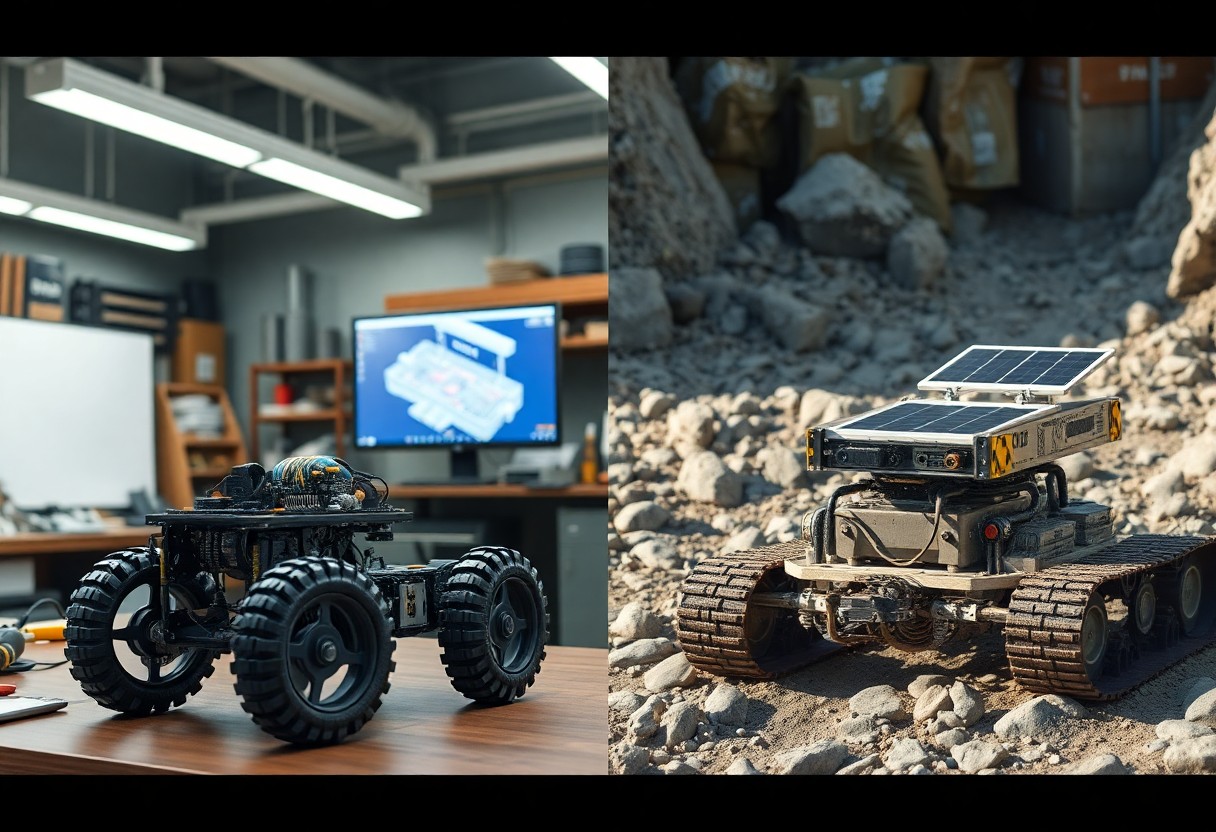
Most projects you build for indoor environments prioritize precision and safety while outdoor designs demand weatherproofing and guard against hazards such as terrain and exposure, so you adjust sensors, mobility and power.
Structural Design and Locomotion
Structure dictates trade-offs: for indoor robots you favor compact frames, quiet actuators, and precision, while outdoor systems require greater ground clearance, weatherproofing, and impact resistance.
Maneuverability and Precision in Confined Spaces
Tight corridors force you to prioritize omnidirectional wheels, low-inertia arms, and high-rate feedback loops so you keep precision and avoid collisions.
Suspension and Traction for Unstructured Terrain
Outdoor robots depend on suspension geometry, tire choice, and weight distribution to maintain traction and reduce tipping; you must balance compliance with control to handle unstructured ground.
Selecting dampers, adjustable spring rates, and active damping lets you tune response for mud, sand, or rock; prioritize reliability and easy field repairs to avoid mission failure in harsh conditions.
Navigation and Localization Strategies
Strategies force you to balance sensor choices: indoor SLAM and beacons vs GNSS and long-range planning outdoors; plan for GPS outages, multipath interference, and differing update rates when designing systems.
SLAM and Beacon-Based Indoor Positioning
SLAM pushes you to fuse LiDAR or vision with odometry, while beacons give absolute fixes; tune filters to limit drift and deploy redundant sensors where signal occlusion is common.
GNSS Integration and Long-Range Path Planning
GNSS lets you plan long routes and maintain global frames, but you must mitigate signal loss under canopy or in canyons and blend IMU data for steady tracks.
Hybrid GNSS/IMU solutions give you centimeter-to-meter accuracy depending on correction services; use RTK or PPP for centimeter-level fixes, but prepare for outages by precomputing alternate waypoints, employing map-matching, and implementing sensor-fusion timeouts to avoid false confidence when signals degrade.
Sensor Modalities and Perception
Sensors combine cameras, lidar, radar, and inertial units to give you layered awareness for indoor and outdoor tasks; prioritize precise localization, mitigate blind spots, and monitor hazardous conditions so your system maintains reliable, mission-focused perception across environments.
High-Resolution Lidar for Obstacle Avoidance
Lidar maps detailed geometry so you can avoid obstacles with centimeter-level accuracy, detect small hazards, and plan safe paths; high-resolution scans reduce false negatives while supporting dynamic obstacle tracking in cluttered indoor and unstructured outdoor scenes.
Multispectral Imaging and All-Weather Vision Systems
Multispectral sensors combine visible, near-infrared, and thermal bands so you can detect targets through smoke, darkness, or foliage; prioritize thermal contrast for people detection and all-weather resilience to maintain perception when cameras fail.
You should integrate multispectral cameras with lidar and radar to fuse spectral cues (visible, NIR, SWIR, thermal) and geometric returns for reliable detection in fog, rain, or night; enforce precise calibration, synchronization, and ML models tuned to spectral signatures to lower false positives, and validate performance across temperatures, precipitation, and occlusion before field deployment to ensure consistent all-weather performance.
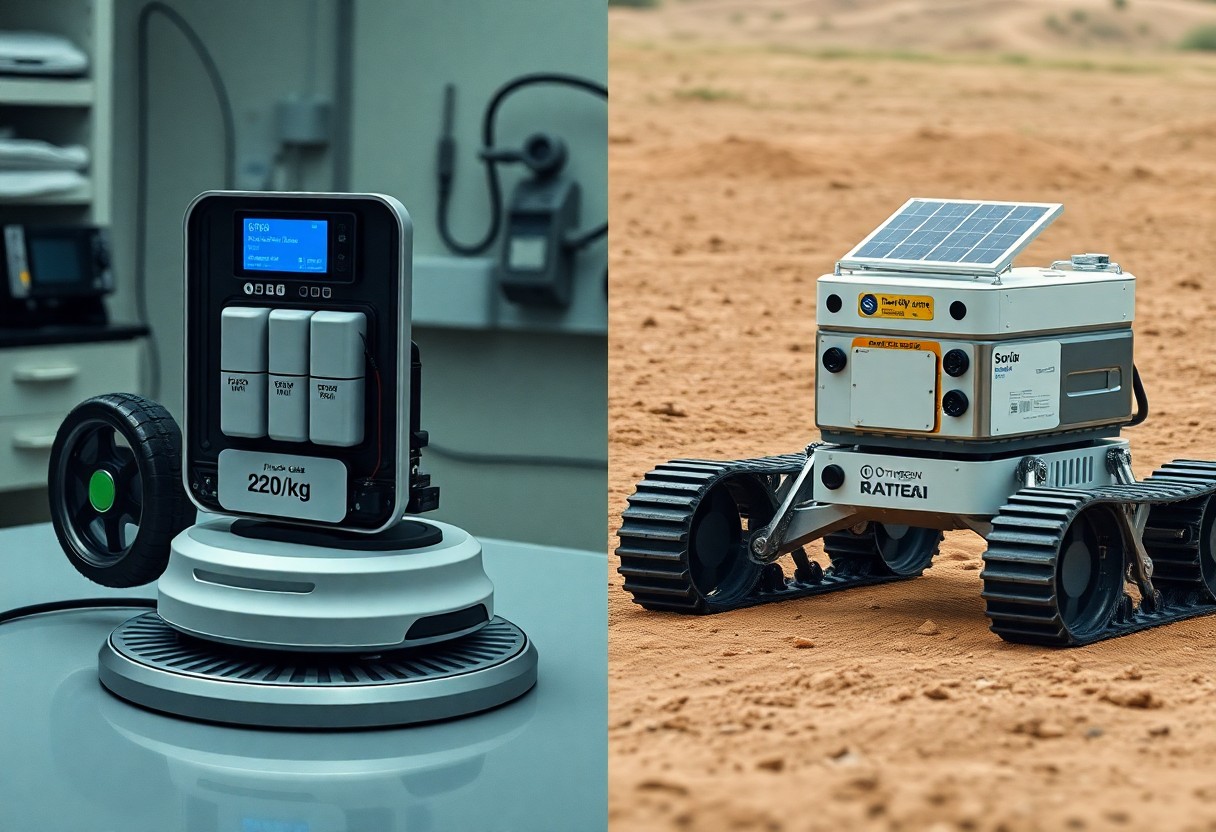
Power Management and Energy Density
Batteries and fuel systems determine run time and weight; you must balance energy density against size and heat. For comparisons see Autonomous Mobile Robotics – Indoor vs. Outdoor to plan for indoor constraints and outdoor range.
Duty Cycles and Automated Charging Stations
Duty cycles shape mission length; you should schedule tasks to match charging windows and use automated stations to reduce downtime and thermal stress on cells.
High-Capacity Storage for Extended Field Operations
High-capacity packs extend autonomy but increase mass; you must evaluate payload limits and safety risks like thermal runaway in remote deployments.
Packs with higher amp-hour ratings give you multi-day operation, but you must plan for charging logistics, battery management systems, and environmental effects on capacity; cold, vibration, and dust can cut usable energy, so provision redundancies to avoid mission failure.
Connectivity and Communication Protocols
Connectivity shapes how your robot stays responsive indoors or reaches distant sites; choose protocols to match latency, range, and interference tolerance.
Low-Latency Wi-Fi and Local Network Integration
Wi-Fi lets you achieve low latency control for indoor navigation, but you must manage channel congestion, AP placement, and local network integration to maintain reliable links.
Satellite Links and Long-Range Cellular Telemetry
Satellite connectivity gives you global reach where cellular fails, at the expense of higher latency and more complex power and antenna requirements.
You must assess link options: GEO satellites deliver broad coverage but very high latency, while LEO constellations reduce delay and improve throughput. Cellular telemetry (LTE-M, NB-IoT) provides efficient long-range uplink with lower power draw and operator security; however, coverage gaps, roaming costs, antenna gain, and susceptibility to jamming require fallback routing, buffering, and strict power budgeting.
Final Words
Presently you should weigh sensor choice, enclosure sealing, locomotion, and power for indoor versus outdoor robots; indoor machines favor compact form, quiet actuators, and precise localization, while outdoor machines require weatherproofing, terrain clearance, and extended energy reserves.