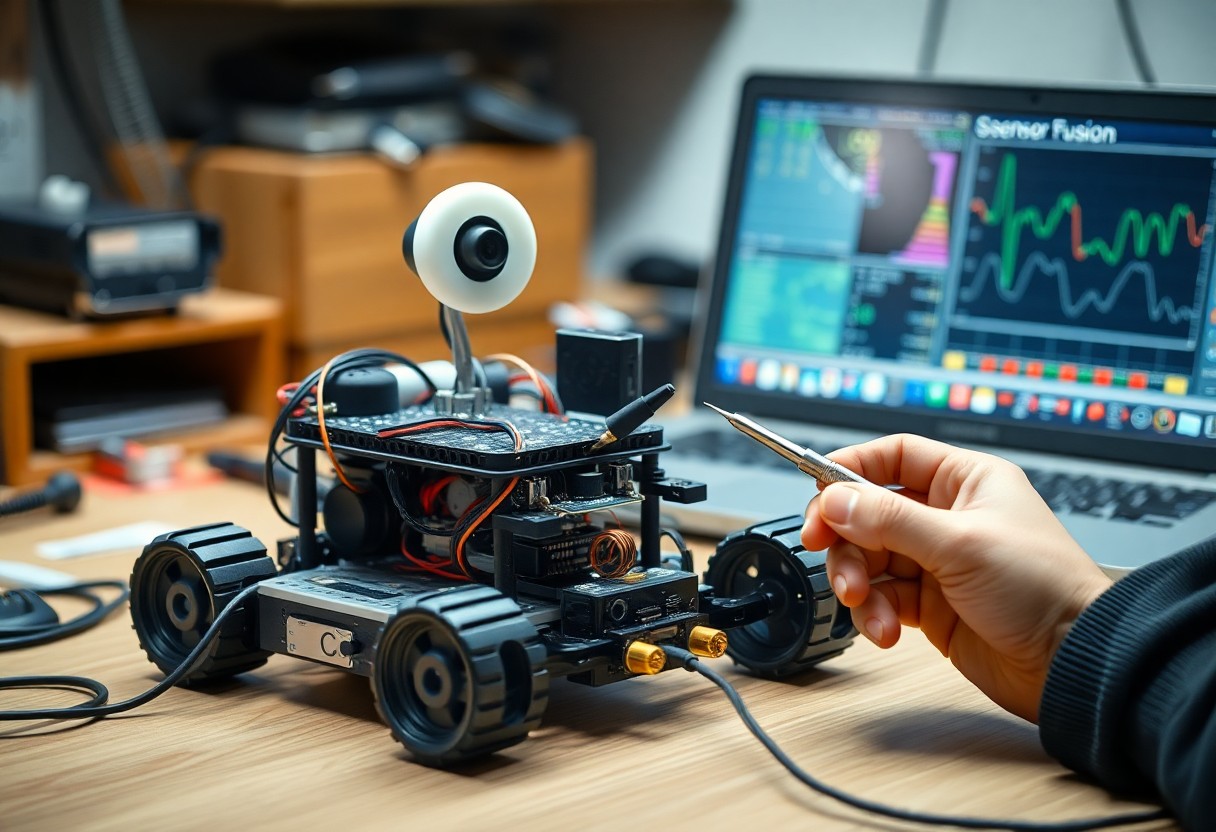
Building a DIY Robot with Advanced Sensor Fusion
Most hobbyists underestimate how accessible advanced robotics has become. You can now build a DIY robot that combines multiple sensors to perceive its environment intelligently. This guide walks you through selecting components, integrating sensor data, and programming autonomous behavior-all with affordable, off-the-shelf parts.
The Mechanical Foundation
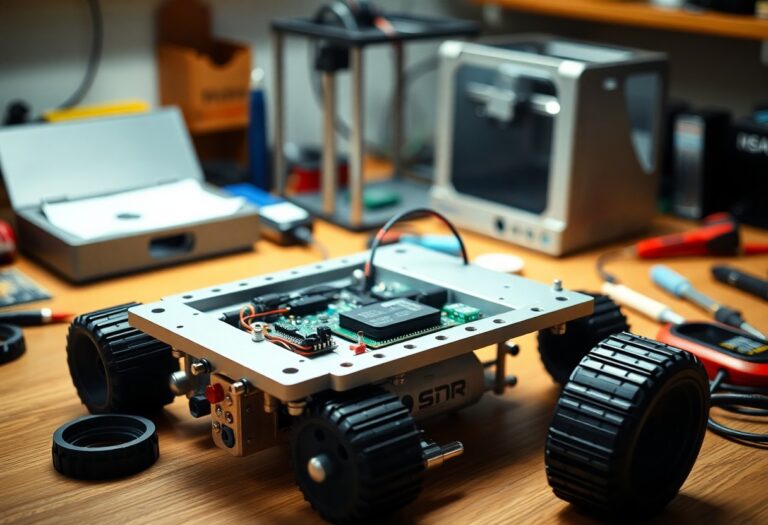
Your robot’s performance begins with a well-designed mechanical base. Every sensor reading and control decision depends on how reliably the physical structure supports motion and load. A stable foundation ensures consistent behavior, especially when integrating complex sensor data.
Chassis Structural Integrity
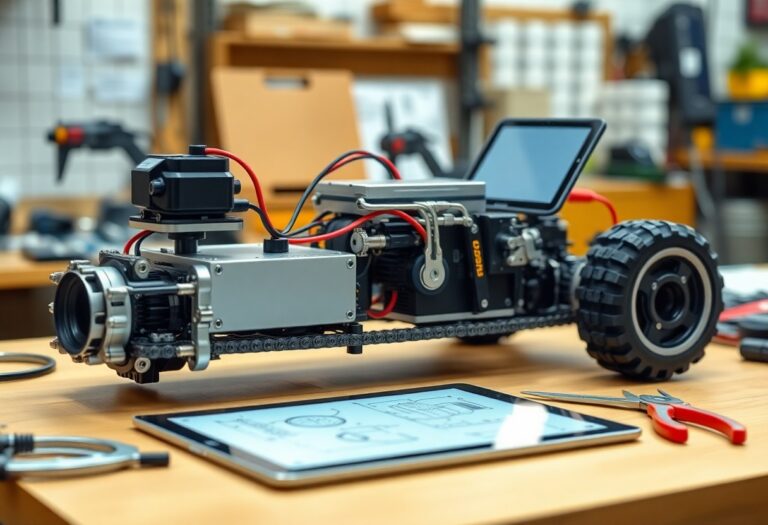
Strength in your chassis prevents flex under stress, which could misalign sensors and degrade fusion accuracy. You need rigid materials like aluminum or reinforced plastic to maintain alignment across uneven terrain. Even minor deformation affects how data streams correlate.
Actuator Precision
Each motor must respond predictably to control signals, ensuring synchronized movement. Inaccurate actuation introduces noise into sensor feedback loops, undermining the reliability of fused outputs. Consistent speed and torque are non-negotiable.
When your actuators lack precision, odometry drifts and sensor timestamps misalign, creating confusion in the fusion algorithm. High-resolution encoders and closed-loop control help maintain exact wheel rotation, directly improving how well your IMU, lidar, and vision data align over time. Small errors compound quickly without tight actuator control.
The Sensory Array
Your robot’s perception hinges on a well-integrated sensory array. By combining inputs from multiple detectors, you enable real-time environmental awareness. Each sensor contributes a unique data stream, and together they form a cohesive picture of the robot’s surroundings. This fusion allows for precise decision-making in dynamic spaces.
Laser Rangefinding Modules
Laser rangefinders give your robot accurate distance measurements up to several meters. You’ll use time-of-flight calculations to detect obstacles with centimeter precision. Mounting these modules at key angles ensures 360-degree coverage, letting your system map its environment and adjust paths instantly based on incoming spatial data.
Gyroscopic Stabilization
Gyroscopes track angular velocity across three axes, helping maintain balance during motion. You’ll rely on this data to correct tilt and prevent falls, especially on uneven terrain. When fused with accelerometer readings, the gyroscope sharpens orientation accuracy for smoother navigation.
Integrating gyroscopic stabilization means your robot can respond instantly to shifts in posture. The sensor detects even slight rotational changes, feeding data to the control loop at high frequency. Over time, filtering algorithms like a complementary or Kalman filter reduce drift, ensuring your robot maintains reliable orientation without overcorrecting or wobbling during operation.
Data Integration Logic
You streamline sensor inputs by combining data streams into a unified framework using precise timing and priority rules. This ensures your robot responds accurately to dynamic environments. For reliable results, consider the Robotics & Sensor Fusion Kit – Build Intelligent Arduino Robots, which simplifies implementation with pre-tested code and hardware compatibility.
Kalman Filtering Protocols
Each sensor’s noise profile is addressed through predictive state estimation that balances real-time measurements with prior predictions. You apply this recursive algorithm to smooth erratic readings from accelerometers and gyroscopes, enabling stable orientation tracking even during rapid movement.
Bayesian Probability Models
Your robot assesses uncertainty by updating beliefs as new sensor data arrives. This statistical approach lets you weigh conflicting inputs based on likelihood, improving decision accuracy in ambiguous scenarios like obstacle detection in low light.
Bayesian models allow you to encode prior knowledge-such as expected object distances or motion patterns-into the decision pipeline. As your robot gathers data, it recalculates probabilities dynamically, making choices more context-aware. This method excels when fusing sparse or unreliable inputs, turning partial information into actionable insights without over-relying on any single sensor.
The Central Processing Unit
Your robot’s brain lives in the central processing unit, where raw sensor data transforms into actionable decisions. This chip doesn’t just compute-it coordinates timing, prioritizes inputs, and maintains system stability under dynamic conditions. Choosing the right processor determines how smoothly perception and action align in real-world environments.
Logic Gate Architecture
Logic gates form the foundation of digital decision-making within your CPU. You rely on combinations of AND, OR, and NOT gates to process binary signals from sensors and control circuits. These simple structures scale into complex pathways that execute instructions with nanosecond precision, enabling accurate responses to environmental changes.
Real-Time Execution
Timing defines success in robotic control, and real-time execution ensures your system responds predictably to sensor input. You can’t afford delays when balancing or avoiding obstacles-every instruction must finish within a guaranteed window. This requires tight integration between hardware and software.
Real-time execution means your robot processes data and acts on it within strict time constraints, not just as fast as possible. You configure the operating system to prioritize critical tasks, using preemptive scheduling so motor adjustments or collision alerts never wait. Determinism-knowing exactly when a task runs-is what separates reactive robots from sluggish prototypes. With proper setup, your CPU handles concurrency without missing a beat.
Energy Management
Efficient energy management keeps your robot running longer and performing reliably. You must balance power delivery with consumption across sensors, processors, and actuators. Smart voltage regulation and real-time monitoring prevent unexpected shutdowns and extend operational cycles without sacrificing performance.
Lithium-Ion Regulation
Li-ion batteries offer high energy density but demand precise voltage control. You need a dedicated protection circuit to prevent overcharging, deep discharge, and thermal stress. A quality charge management IC ensures stable input and prolongs battery lifespan under dynamic loads.
Power Consumption Efficiency
Every milliamp counts when sensors and microcontrollers run continuously. You can reduce draw by scheduling components into low-power sleep modes between readings. Synchronizing wake cycles across devices minimizes idle drain while maintaining real-time responsiveness.
Optimizing power consumption efficiency means understanding the active and standby profiles of each subsystem. You should profile current draw using a multimeter or current sensor during different operation states. Many microcontrollers support dynamic clock scaling-use it to lower CPU speed when full power isn’t needed. Sensor fusion algorithms can also be tuned to process data in bursts rather than constant polling, cutting energy use without losing accuracy. By aligning hardware capabilities with task timing, you create a leaner, longer-lasting robot.
Operational Calibration
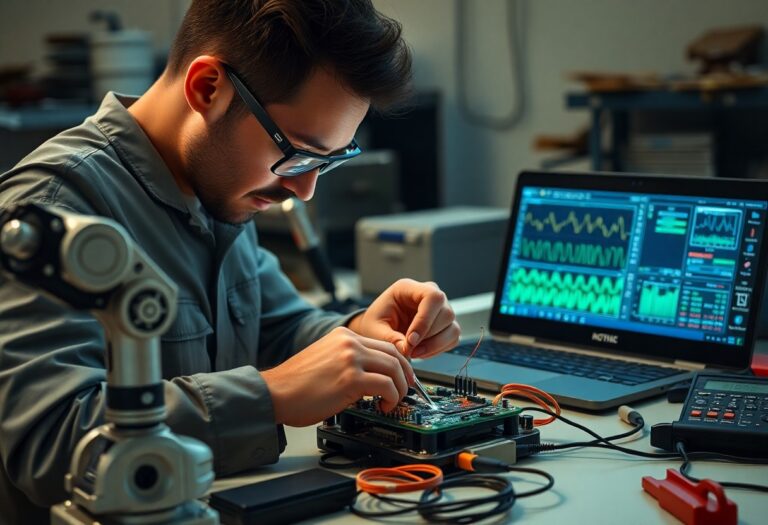
To ensure your robot performs reliably, you must calibrate all sensors relative to one another. This step aligns data streams so inputs from accelerometers, gyroscopes, and distance sensors agree on the robot’s state. Without proper calibration, sensor fusion algorithms produce erratic behavior, undermining navigation and decision-making.
Spatial Mapping
Your robot builds an understanding of its environment by fusing LiDAR, ultrasonic, and IMU data into a coherent spatial model. You’ll rely on SLAM algorithms to generate real-time maps, allowing the robot to track its position and identify obstacles. Accurate mapping starts with synchronized sensor timestamps and consistent frame alignment.
Noise Reduction
Sensor readings often contain distortions from electrical interference or environmental factors. You can minimize these errors using digital filtering techniques like Kalman or complementary filters. Clean data improves decision accuracy and ensures smoother motion control during autonomous operation.
Filtering out noise isn’t just about smoothing values-it’s about preserving signal integrity while discarding artifacts. You’ll notice that raw IMU data, for instance, drifts over time due to temperature shifts and bias. By applying a well-tuned Kalman filter, you combine accelerometer and gyroscope inputs intelligently, reducing drift without sacrificing responsiveness. This balance keeps your robot’s orientation estimates stable during dynamic movements.
Summing up
You now have the knowledge to build a DIY robot capable of interpreting its environment through advanced sensor fusion. Combining data from accelerometers, gyroscopes, and environmental sensors allows your robot to make accurate, real-time decisions. With careful calibration and code optimization, your creation achieves reliable autonomy, demonstrating what’s possible with accessible tools and applied understanding.