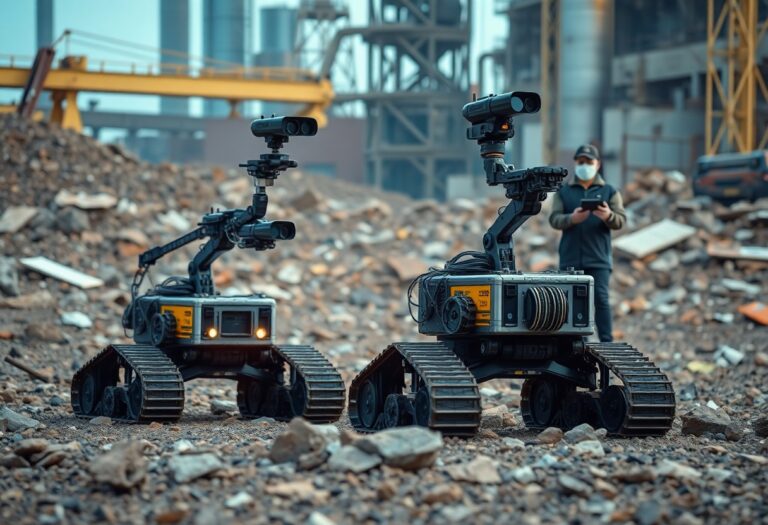
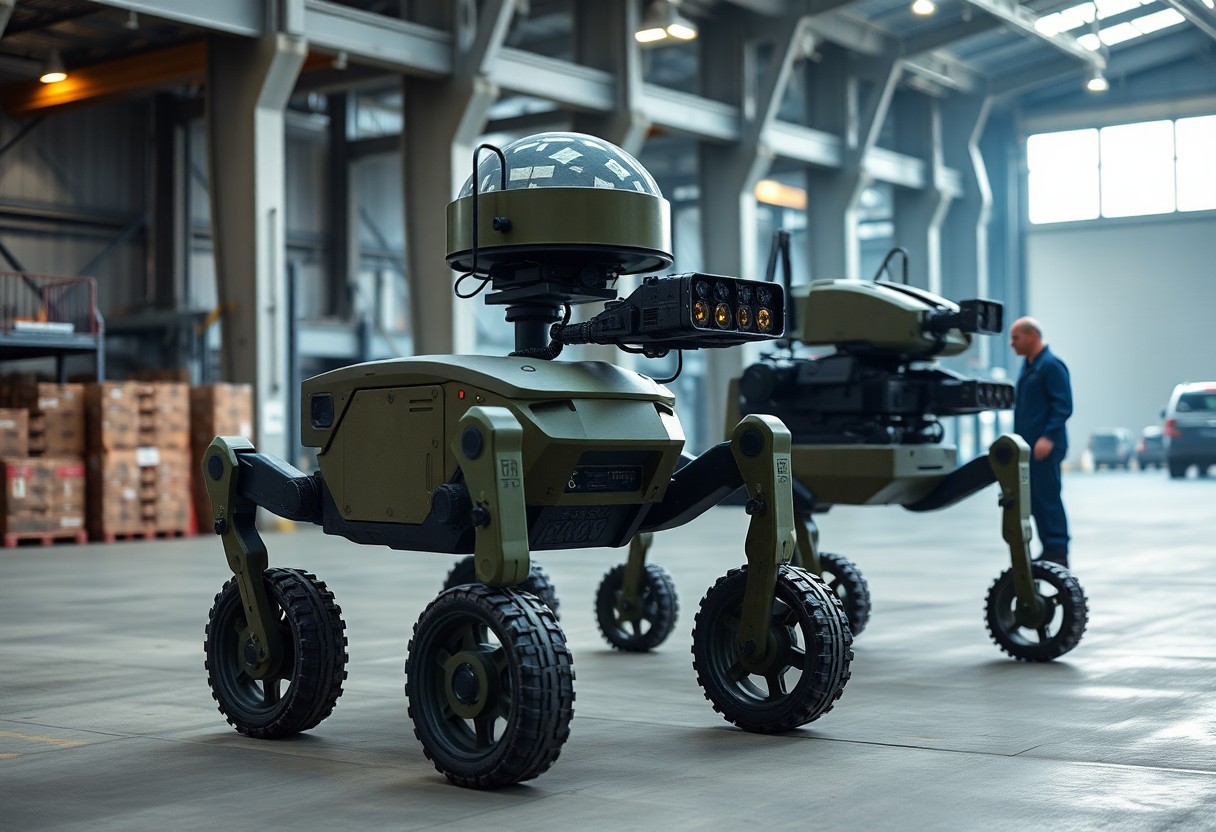
Engineering Next-Generation Military Ground Robots
With modern battlefields demanding faster decisions and greater operational reach, you are now designing ground robots that integrate advanced mobility, real-time sensing, and autonomous decision-making to operate alongside human forces in high-threat environments. These systems must endure extreme terrain, respond to dynamic threats, and maintain secure communication under electronic attack, setting new benchmarks in durability and intelligence.
The Steel and the Bone
Plates of Hard Metal
Your robot’s outer shell must resist small arms fire and shrapnel without adding crippling weight. Composite titanium alloys, layered over ceramic inserts, provide high strength-to-density ratios seen in the latest MRAP vehicle designs. A mid-sized SaaS firm developing autonomous logistics bots adopted a similar sandwich armor layout, surviving repeated 7.62mm rounds during field trials in Fort Bragg.
Motors for the Long Haul
Electric actuators powering legged locomotion demand sustained torque under load. Permanent magnet synchronous motors, cooled by embedded channels, maintain efficiency during multi-hour patrols across uneven terrain. Thermal throttling remains a concern during ascent phases, particularly on inclines exceeding 30 degrees.
You rely on motor redundancy to prevent single-point failure during extended missions. Dual-wound stators in each drive unit allow continued operation at reduced capacity if one winding fails. The Legged Squad Support System prototype demonstrated this capability during a 48-hour DARPA endurance test, completing its route despite losing two actuators in the final stretch.
Seeing the Ground
Your robot must interpret terrain like a seasoned scout, distinguishing mud from metal, slope from solid footing. Modern systems fuse multiple sensor streams to build real-time maps, allowing autonomous traversal of rubble, sand, and urban debris. Success hinges on more than vision-it demands context-aware perception that adapts to shifting environments without human input.
Light from the Lasers
Lidar systems project thousands of laser pulses per second, measuring return times to generate precise 3D point clouds. You rely on this data to detect curbs, craters, and obstacles invisible to standard cameras. In low-visibility conditions, lidar maintains accuracy, enabling navigation when dust or darkness obscures the battlefield.
Heat from the Men
Infrared sensors detect thermal signatures, helping you identify personnel even behind partial cover. Human bodies emit consistent heat patterns, allowing your robot to distinguish combatants from animals or machinery. This capability proves decisive during reconnaissance in built-up or wooded areas where visual line of sight is limited.
Thermal imaging excels not only in darkness but also through smoke, fog, and light foliage. You can spot a soldier crouched behind a concrete barrier by the heat rising from their body and equipment. A mid-sized SaaS firm developing autonomy stacks integrates FLIR feeds directly into pathfinding algorithms, letting robots adjust routes based on living presence, not just static geometry.
The Logic and the Wire
Processing power defines modern ground robots as much as armor or mobility. You rely on embedded systems to translate sensor input into split-second decisions under fire. These machines are not remotely piloted toys but autonomous platforms built on tightly integrated circuitry and real-time computation. Their effectiveness hinges on the balance between computational density and power efficiency in harsh field conditions.
Boards for the Math
Custom FPGA and System-on-Module (SoM) designs handle terrain prediction and threat classification in microseconds. You deploy these boards to run parallel processing tasks such as obstacle mapping and weapon stabilization simultaneously. A mid-sized SaaS firm might prioritize cloud scalability, but in combat robotics, board-level performance determines mission viability.
Code for the Field
Your robot’s autonomy stack processes lidar, GPS, and inertial data to maintain course across broken terrain. This code operates without internet access, relying on preloaded decision trees and adaptive routing algorithms. Updates are rare, so initial programming must anticipate diverse operational edge cases.
Field code must persist through electromagnetic interference, temperature swings, and physical shock. You use bare-metal firmware and real-time operating systems like FreeRTOS to minimize latency and eliminate unpredictable delays. One dismounted infantry unit reported sustained operations in mountainous regions using only waypoint-based autonomy when comms degraded, proving the resilience of well-structured embedded logic.
Tools for the Kill
Modern combat robots are no longer limited to reconnaissance; they now carry integrated weapon systems capable of precise engagement in high-threat zones. You deploy these platforms to reduce human exposure during direct firefights, especially in urban chokepoints or ambush scenarios where split-second responses determine survival.
Mounts for the Guns
Weaponized variants rely on stabilized, remotely operated turrets that support everything from 7.62mm machine guns to 40mm grenade launchers. You select the mount based on mission profile, balancing recoil management, traverse speed, and integration with targeting sensors already onboard.
Jamming the Waves
Electronic warfare capabilities are embedded directly into the robot’s communication stack, allowing you to disrupt enemy radio signals within line-of-sight ranges. These systems target command links used by insurgents to trigger IEDs or coordinate attacks.
Operating in contested spectrum environments demands selective jamming to avoid degrading your own drone or squad comms. You configure emission profiles to pulse only during threat windows, preserving battery and minimizing detection risk. A mid-sized SaaS firm managing drone fleets might use similar logic for bandwidth allocation, but here the stakes involve immediate physical danger.
The Voice in the Air
Communication systems now enable real-time coordination between soldiers and autonomous units, transforming how missions unfold. You rely on secure, low-latency links to issue commands and receive sensor data from the Unmanned Ground Vehicles to be used in future combat operations, as detailed in The Unmanned Ground Vehicles to be used in future scenarios.
Talking to the Birds
Satellite relays allow your robot units to maintain contact beyond line-of-sight, especially in mountainous or urban terrain. These uplinks function like digital tethers, ensuring commands reach their target even when direct radio paths are blocked by terrain or enemy jamming.
Radio for the Squad
Your squad’s handheld radios now integrate with robot control interfaces, enabling voice and data exchange without additional hardware. This interoperability reduces cognitive load during high-stress operations where split-second decisions determine mission success.
Embedded waveforms like SRW and TSM allow your ground robots to operate within existing tactical networks without overloading bandwidth. A mid-sized SaaS firm supporting defense contracts recently demonstrated how adaptive frequency hopping preserves connectivity in contested RF environments, maintaining robot responsiveness under electronic warfare pressure.
Hard Use in the Rain
Operating in persistent downpours demands more than water-resistant coatings. Your robot’s joints, sensors, and power distribution units must maintain integrity when submerged in standing water or crossing flooded terrain. A single compromised seal can cascade into system-wide failure during extended wet missions.
Pumping out the Heat
Heat buildup intensifies when raincooled surfaces are unavailable. You rely on sealed internal cooling loops that transfer thermal loads away from processors and motors. Some models use phase-change materials to absorb spikes during high-torque operations in humid conditions.
Wheels for the Mud
Mud-choked terrain tests traction and self-cleaning geometry. You need wide, angled treads that shed viscous soil instead of packing it. Rubber compounds with moderate hardness preserve grip without trapping debris in critical suspension points.
Consider a mid-sized SaaS firm’s delivery robot repurposed for reconnaissance-it failed in clay-rich soil due to narrow, closely spaced treads. Military-grade variants now use staggered, aggressive lug patterns inspired by high-clearance agricultural machinery, reducing clogging and improving forward momentum in saturated fields.
To wrap up
Your work shaping next-generation military ground robots demands precision, adaptability, and a clear focus on real battlefield performance. A mid-sized SaaS firm developing control algorithms, for example, must prioritize low-latency responses over theoretical complexity. Relying on modular architectures allows rapid iteration when mission parameters shift. You build not for novelty but for endurance under fire, where milliseconds and millimeters determine success. Field-tested autonomy in rainy forest terrain recently proved more reliable than remote operation in certain scenarios, underscoring the value of embedded decision-making. You advance not by chasing breakthroughs but by refining reliability, one rugged component at a time.