Building a Robot That Can Operate in Extreme Conditions
Most extreme environments demand robots built beyond standard limits. You face intense heat, freezing cold, radiation, or crushing pressure. Success means selecting materials, power sources, and sensors engineered to endure. Every component must perform reliably where humans cannot survive. This is how you build a robot for the planet’s harshest places.
The Architecture of Endurance
Your robot’s survival in extreme environments begins with structural intelligence. Every joint, circuit, and housing unit must work as a unified system under duress. You design not for optimal conditions, but for the breaking point-anticipating pressure, temperature swings, and corrosive exposure from the outset.
Metallurgy for the Absolute Zero
At cryogenic temperatures, standard alloys turn brittle and fail. You select nickel-titanium composites and specialized cryo-steels that retain ductility near absolute zero. These materials endure thermal contraction without fracturing, ensuring mechanical integrity in the coldest reaches of space or polar exploration.
Synthetic Skins for Acidic Seas
Submersion in sulfuric or hydrochloric-rich oceans demands a barrier that resists ion penetration. You coat your robot in fluoropolymer-laced synthetic epidermises that repel acid while maintaining sensor sensitivity. These skins prevent corrosion without sacrificing mobility or feedback precision.
Acid-resistant synthetic skins go beyond passive shielding. You integrate self-healing microcapsules within the polymer matrix that activate upon pH-triggered damage. When the outer layer degrades, embedded compounds polymerize to seal microfractures instantly. This dynamic response extends operational life in environments like Venusian cloud probes or deep-sea volcanic vents, where constant chemical assault would destroy conventional materials within hours.
Energy for the Long Night
Surviving extended periods without sunlight demands a rethinking of power. You need energy systems that persist when solar input vanishes, especially in polar regions or during planetary dust storms. Relying on intermittent sources isn’t an option when mission continuity is on the line.
Subatomic Power Sources
Radioisotope thermoelectric generators convert heat from decaying isotopes into electricity. You gain steady output over decades, ideal for missions where solar fails. These systems have powered deep-space probes and Martian rovers, proving reliability in darkness and cold.
Efficiency in Vacuum States
Heat doesn’t dissipate through convection in a vacuum, altering thermal management. You must design radiative cooling pathways that prevent overheating without ambient air. Passive heat spreaders and selective surface coatings become vital tools in your engineering toolkit.
Operating in a vacuum means traditional cooling methods fail. You rely entirely on radiation to shed excess heat, which is far less efficient than convection. Components like RTGs produce constant thermal output, so your robot needs precisely engineered radiator panels with high emissivity surfaces. Thermal zoning ensures sensitive electronics stay within operational ranges while power systems remain stable across lunar nights or deep-space transits. Your design can’t afford guesswork-every watt and degree must be accounted for.
Vision Beyond the Human Spectrum
You operate where human eyes fail. By integrating sensors that detect wavelengths beyond visible light, your robot perceives environments obscured by darkness, haze, or alien atmospheres. These systems translate infrared, ultraviolet, and acoustic data into actionable spatial awareness, enabling reliable function in conditions that would blind conventional optics.
Infrared Guidance in Dust Storms
Heat signatures guide your robot when visibility drops to zero. During Martian dust storms, visible light sensors become useless, but infrared imaging detects thermal contrasts in terrain and structures. You rely on this persistent sensing mode to maintain course, avoid obstacles, and complete missions without waiting for skies to clear.
Sonar Navigation in Liquid Methane
Sound travels differently in cryogenic liquids, but your robot adapts. In the frigid lakes of Titan, where liquid methane replaces water, traditional GPS and vision fail. You use low-frequency sonar pulses to map surroundings, measuring echo timing and distortion to navigate safely through submerged terrain.
Temperature drastically affects sound propagation, and liquid methane at -179°C alters speed and attenuation in unpredictable ways. Your sonar system compensates using real-time environmental feedback, adjusting pulse frequency and receiver sensitivity. This allows precise distance measurement and obstacle detection, even in murky, ultra-cold hydrocarbon fluids where no human-made vehicle has operated long-term.
Mechanics of the Alien Surface
Operating on extraterrestrial terrain demands a deep understanding of surface dynamics. You face materials unlike anything on Earth-fine dust, jagged rocks, and unpredictable slopes. Each step your robot takes must account for shifting regolith and unknown load-bearing capacity. Success depends on real-time adaptation to these alien mechanical conditions.
Kinetic Stability in Low Gravity
Low gravity alters how your robot moves and balances. Without Earth-level downforce, standard locomotion fails. You must adjust stride length and foot placement to prevent bouncing or tipping. Active suspension systems and gyroscopic feedback help maintain posture during motion across uneven, low-traction terrain.
Tread Design for Volcanic Regolith
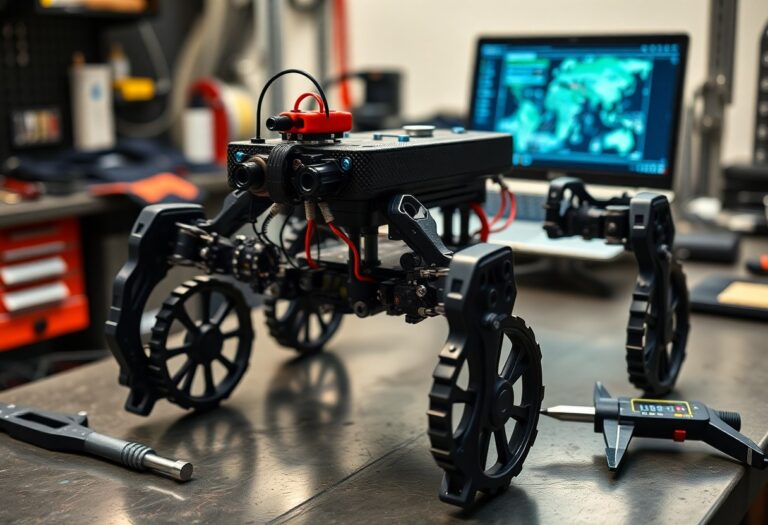
Sharp, abrasive volcanic soil tears through conventional treads. Your robot’s mobility hinges on materials that resist erosion while maintaining grip. A carefully engineered lug pattern prevents clogging and enhances traction on loose, uneven surfaces.
Volcanic regolith isn’t just rough-it’s chemically reactive and thermally unstable. You need treads made from high-temperature elastomers or sintered metal composites that won’t degrade under heat and friction. The tread’s angle and depth are tuned to shed debris efficiently, ensuring consistent contact without sacrificing structural integrity over long missions.
The Logic of Autonomy
You operate with purpose when your robot must make decisions without human input. Autonomy isn’t just about independence-it’s about structured reasoning under pressure. Your system relies on layered decision trees that weigh environmental data, mission priorities, and energy constraints in real time, ensuring intelligent action even in isolation.
Heuristic Processing for Unforeseen Obstacles
You encounter unexpected terrain or debris where pre-programmed responses fall short. Heuristic processing allows your robot to assess novel situations using rule-of-thumb logic derived from past experiences. This adaptive reasoning enables rapid, context-aware decisions that keep operations moving without waiting for remote instructions.
Self-Repairing Circuitry Logic
You design circuits that detect and reroute around damaged pathways autonomously. By embedding redundant micro-relays and diagnostic loops, your system identifies faults in real time and activates alternate connections, preserving functionality even after physical or thermal stress compromises original components.
Self-repairing circuitry goes beyond simple redundancy. Your robot’s electrical architecture includes conductive materials that respond to temperature or current anomalies by triggering micro-switches or isolating compromised nodes. This logic operates at the firmware level, continuously monitoring signal integrity and initiating recalibration sequences before failure cascades through critical subsystems. You ensure sustained operation by making recovery an intrinsic feature, not an afterthought.
The Rigors of the Proving Ground
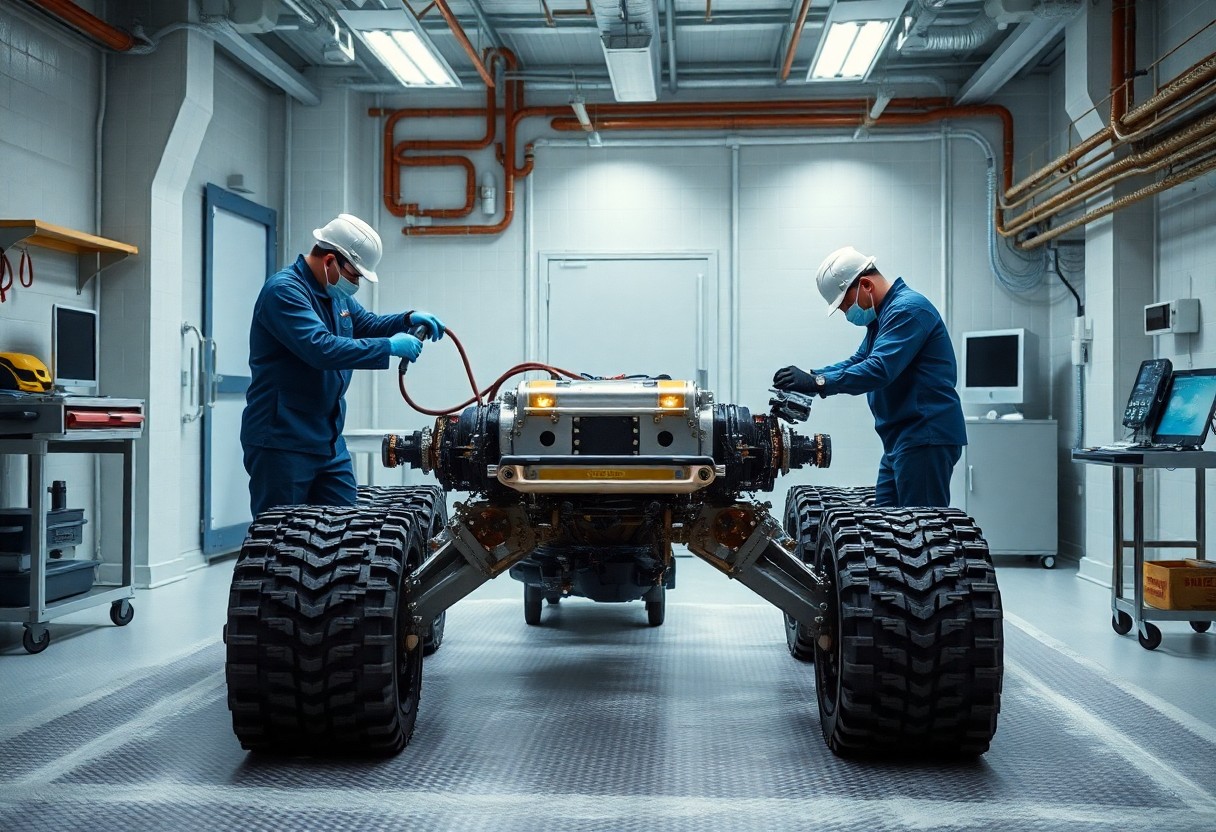
Every robot built for extreme environments faces relentless testing before deployment. You subject your machine to conditions far beyond normal operation to ensure survival in the harshest scenarios. From thermal extremes to radiation exposure, each variable is controlled and monitored. Learn more about engineering resilience in the field with this guide on Protecting Robots In Extreme Environments.
Simulated Pressure Chamber Trials
Pressure fluctuations can cripple untested systems. You place the robot inside a chamber that mimics deep-sea or high-altitude conditions, cycling through extremes to expose structural weaknesses. Seals, joints, and internal components are monitored for failure points, ensuring integrity when real missions begin.
Signal Integrity Across Light Minutes
Distance introduces delays that challenge real-time control. You design communication protocols to maintain data accuracy despite multi-minute signal lags between Earth and distant targets. Error correction and autonomous decision-making become important when immediate feedback isn’t possible.
When operating across light minutes, every command travels through vast emptiness with no room for retransmission. You rely on predictive algorithms and onboard processing to interpret delayed signals and respond appropriately. Redundant data paths and low-latency encoding preserve mission continuity, even when the robot is effectively out of reach.
Final Words
With these considerations, you design a robot capable of enduring extreme conditions. Your choices in materials, power efficiency, and autonomous decision-making define its resilience. You test repeatedly under harsh environments to ensure reliability. Success lies not in complexity, but in thoughtful, precise engineering that anticipates real-world demands.