
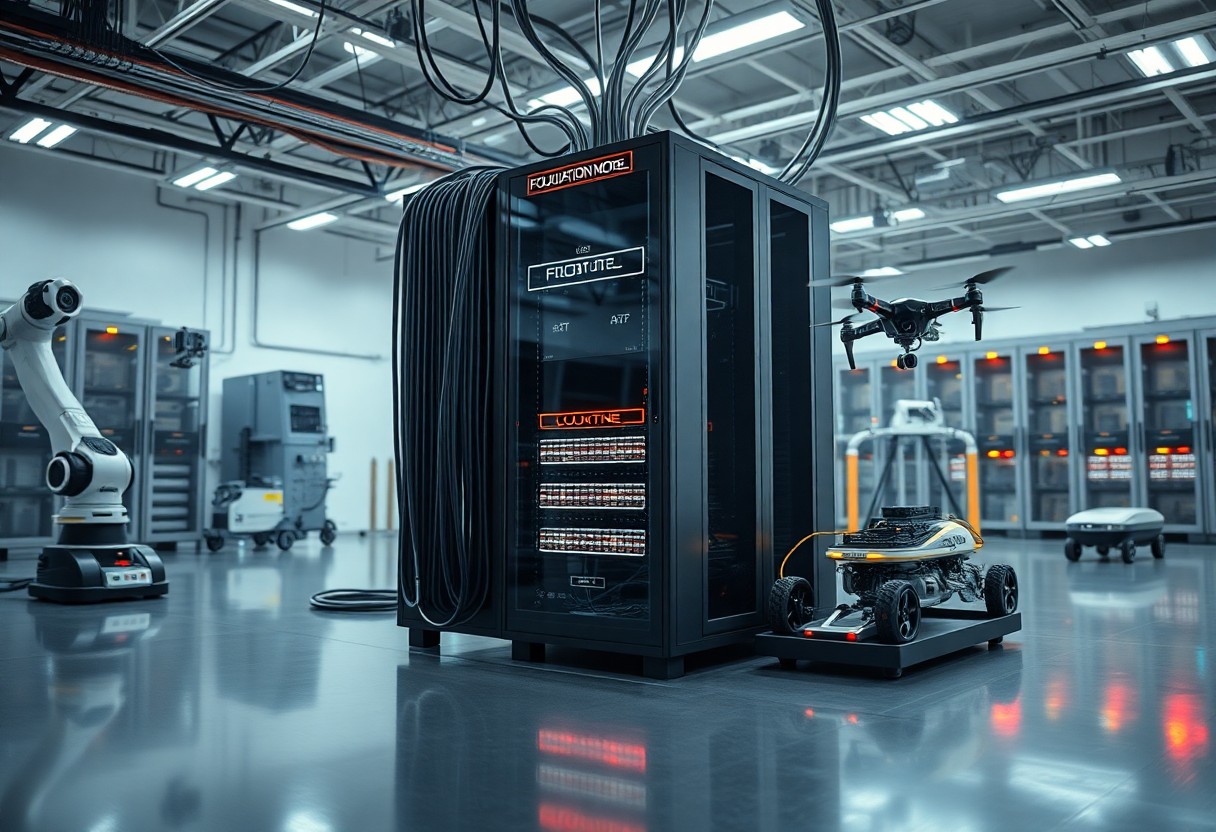
With foundation models, you can unify perception, planning, and control across diverse robots by leveraging shared representations and transfer learning; this single “brain” accelerates adaptation, reduces engineering overhead, and enables scalable coordination so your fleet learns faster, generalizes better, and executes complex tasks with greater consistency and safety.
Overview of Foundation Models
You can now see foundation models acting as a shared backbone that collapses separate perception, planning, and control stacks into one adaptable system; by using billion-parameter, multimodal backbones (language, vision, proprioception) you reduce per-robot engineering and accelerate transfer across platforms, as demonstrated by systems like Gato and RT-1 that repurpose a single model across manipulators, mobile bases, and cameras.
Definition and Characteristics
You should treat foundation models as large, pretrained networks that encode broad priors from heterogeneous datasets, offer multimodal embeddings, and reveal emergent capabilities; they often span millions-to-billions of parameters (e.g., GPT-3 at 175B for language) and support few-shot adaptation, prompt-based control, and fine-tuning so your robot gains cross-task generalization without rebuilding task-specific controllers from scratch.
Definition at a glance
| Characteristic | What it means for your robot |
|---|---|
| Pretrained on diverse data | Your system inherits broad priors, reducing labeled data needs |
| Multimodal | Your robot can fuse vision, language, and state in one model |
| Large parameter count | Your tasks benefit from richer representations but need more compute |
| Fine-tunable/few-shot | Your team can adapt with tens-to-thousands rather than millions of examples |
Comparison with Traditional Models
You’ll find traditional robotics pipelines-separate perception, planning, and hand-tuned controllers-require per-task engineering and often tens of thousands of labeled examples, whereas foundation models trade higher upfront compute for broad reuse: they enable few-shot or fine-tuning workflows, let you reuse a single policy across platforms, and cut integration time even if inference optimization and safety validation remain more involved.
You can point to RT-1 as a concrete case: trained on roughly 130,000 real-world demonstrations, RT-1 generalized across hundreds of manipulation tasks, while a classical pipeline would need bespoke perception modules, object-specific grasp planners, and per-task control heuristics, multiplying engineering effort per new task or robot platform.
Traditional vs Foundation
| Traditional models | Foundation models |
|---|---|
| Task-specific pipelines, manual tuning | Single pretrained backbone, reused across tasks |
| Per-task labeled datasets (10k-100k+) | Pretrain on massive unlabeled/heterogeneous data; adapt with fewer examples |
| Lower inference compute, higher engineering cost | Higher compute footprint, lower per-task engineering |
| Limited cross-task transfer | Better zero/few-shot transfer across robots and domains |
Applications in Robotics
You can apply foundation models across manufacturing, service robots, and research platforms to unify perception, planning, and control; for example, the MIT News piece on Multiple AI models help robots execute complex plans … highlights how model ensembles improve transparency in multi-step tasks, and field deployments show fewer manual interventions in assembly, inspection, and logistics when you share a single backbone across agents.
Manipulation Tasks
You can use one foundation model to handle diverse manipulation chores-bin picking, cable routing, and in-hand regrasp-by conditioning a shared vision-action backbone on task descriptors and tactile streams; studies show that fine-tuning on a few dozen demonstrations often generalizes to new objects, letting your system achieve consistent grasp stability and reduce per-task engineering.
Navigation and Mapping
You can merge learned semantic representations with classical SLAM pipelines so your agents build metric-topological maps that support long-horizon planning; by fusing RGB, depth, and occasional LiDAR, the foundation model provides persistent place embeddings useful for loop closure, multi-robot coordination, and warehouse-scale route optimization.
In practice, you should run a transformer-based encoder to compress local observations into 256-1024D place vectors, index them into a global graph, and use a learned costmap for fast re-planning; this approach has enabled fleets to share maps with submeter consistency and reduced manual map maintenance in trials across logistic centers and campus robots.
Advantages of Foundation Models
You gain a unified backbone that scales across modalities and platforms: models with billions of parameters provide shared representations so you can reuse perception, planning, and control primitives across manipulation, navigation, and inspection. In practice this shortens integration timelines from months to weeks, simplifies software stacks for fleets of tens to hundreds of robots, and reduces the number of bespoke models you must maintain.
Efficiency and Scalability
By pretraining on large, diverse datasets you cut downstream data needs dramatically: fine-tuning or adapter tuning often requires hundreds rather than thousands of labeled trajectories, and compute amortizes as the same backbone serves many endpoints. For example, deploying one foundation model to a warehouse fleet lets you push updates centrally, avoiding per-robot retraining and lowering operational overhead.
Generalization Across Tasks
When you train a model on multi-task, multimodal data it learns transferrable priors that enable zero-shot and few-shot performance across dozens of downstream tasks-pick-and-place, tool usage, and simple assembly among them. Language-conditioned policies let you instruct behavior directly, so you can adapt to new objects or goals with minimal additional demonstrations.
Mechanistically, shared latent spaces and task-conditioning (prompts, adapters, or lightweight heads) let you swap or fine-tune small modules instead of retraining the whole network. You can combine simulation and real logs to cover edge cases; in practice, adapter-based updates after tens to a few hundred demonstrations often recover performance on new object classes, keeping backbone inference stable while accelerating iteration.
Challenges and Limitations
Scaling one brain across many machines forces trade-offs: you face massive data and compute needs (often thousands of GPU-days), brittle sim-to-real transfer, safety and certification hurdles, and evaluation gaps where standard benchmarks miss rare edge cases. Performance can vary dramatically between platforms, so you must budget for per-robot fine-tuning, long-tail testing, and governance processes that can add months to deployment timelines.
Data Requirements
Your models demand multimodal, diverse datasets-typically hundreds of thousands to millions of trajectories or 10^2-10^3 terabytes of sensor logs for robust generalization. Public datasets like RoboNet (≈15M frames) or Dex‑Net (≈6.7M synthetic grasps) illustrate scale, yet you still need targeted real-world data for new morphologies and tasks, plus annotated edge cases that are expensive to collect and label.
Interpretability Issues
Opaque decision-making is a major blocker when you need traceability for safety or debugging: attention heatmaps and saliency scores often give noisy signals, and correlational probes rarely expose causal levers that produced a motion failure. Regulators and operators expect human-understandable rationales, so you’ll struggle to certify black-box policies without extra tooling and extensive testing.
To mitigate this, you should adopt causal probing, counterfactual rollouts, and activation patching to link internal activations to behaviors, and run large stress suites (1,000-10,000 targeted scenarios) to surface rare faults. Instrument sensors and latent representations with linear probes, keep interpretable supervisory layers, and log deterministic replays so you can reproduce and attribute failures across runs and platforms.
Future Directions
Emerging directions will push foundation models toward continual learning, low-latency edge inference, and richer multimodal grounding so you can deploy one brain across diverse robots. Expect pretraining to remain expensive-often millions of dollars for billion‑parameter backbones-so you’ll lean on distillation, adapter tuning, and federated updates to economize. Trials will target sim‑to‑real pipelines that shorten deployment from years to months and support fleets of hundreds to thousands with shared policies and safety monitors.
Integration with Other AI Technologies
You’ll increasingly fuse foundation models with classical control, model‑based planners, and symbolic reasoning: for example, combining a vision‑language backbone with an MPC controller or a reinforcement‑learned policy. Real deployments already pair LLM-style planners for task decomposition with visual Transformers for perception, while simulators like NVIDIA Isaac or MuJoCo provide scalable data generation. This hybrid approach lowers sample needs and lets you mix precise low-level control with high‑level generalization.
Potential Impact on the Robotics Industry
You can expect foundation models to drive platform consolidation and new business models: shared backbones reduce per‑robot software engineering, speed integration, and enable robot-as-a-service offerings at scale. Early adopters in logistics and manufacturing will see faster task retargeting across hardware, and startups can leverage pretrained backbones to enter markets with less domain-specific data and engineering overhead.
Digging deeper, you’ll find concrete levers that change economics and operations: pretrain once (costing millions) then fine‑tune adapters for specific fleets, use quantized models and edge accelerators (e.g., Jetson/TPU) to hit latency targets under 100 ms, and apply continual learning to reduce periodic full retrains. In warehouses, that translates to fewer bespoke integrations, reduced downtime through shared diagnostics, and rollout of new capabilities across thousands of units with incremental adapter updates. Regulatory scrutiny and workforce transition will follow, creating demand for explainability tools, auditing pipelines, and retraining programs as part of large‑scale adoption.
Summing up
Ultimately you should view foundation models for robotics as a unifying brain that, when paired with task-specific modules and robust safety measures, lets your fleet of machines share learning, adapt faster, and scale efficiently while reducing development overhead; adopting this approach requires rigorous validation, clear interfaces, and governance to ensure reliable, ethical deployment across diverse hardware and environments.
