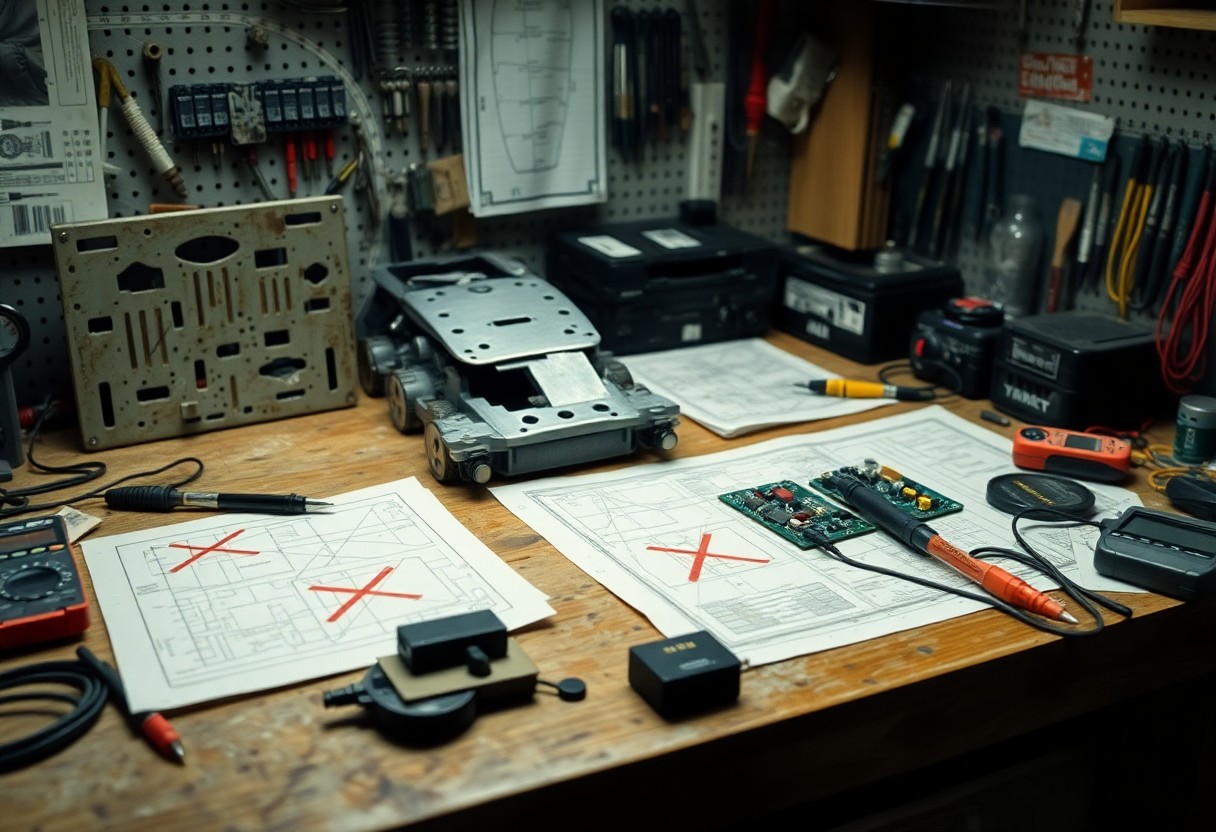
Robotics failures teach you practical debugging, design trade-offs, and testing discipline so you can refine prototypes faster and avoid repeated mistakes.
Mechanical Integrity and Structural Design
Structural design failures teach you to prioritize joint strength, correct load paths, and redundant supports so your robot survives impacts and sustained operation.
Material Stress and Fatigue Limits
Testing components under realistic cycles reveals fatigue points, letting you choose appropriate alloys or redesign stress concentrators before the robot fails in the field.
Center of Gravity and Dynamic Stability
Balancing the center of gravity prevents tipping during acceleration and turns, so you must position heavy components low and toward anticipated motion vectors.
Analyze how inertial forces from actuators and payload shifts alter stability during maneuvers; you should simulate dynamics, validate with tilt-table and push tests, lower bulky modules, distribute mass, and implement active control or a wider stance to regain balance quickly.
Lessons Learned from Failed Robot Builds
Power distribution failures often came from undersized traces and poor grounding; you learned to map loads, fuse appropriately, and separate high-current paths to reduce heat and mysterious resets.
Voltage Regulation and Current Spikes
You saw regulators collapse when spikes hit; add decoupling close to ICs, use transient voltage suppressors, and allow regulator headroom so motors don’t induce brownouts.
Wire Management and Signal Interference
Tidy harnesses cut interference; you must separate power and signal bundles, twist differential pairs, and secure connectors to avoid intermittent faults.
Route power lines away from analog traces, implement a single-point or low-impedance ground strategy, and use ferrite beads on noisy supplies. You should label and anchor bundles, test under representative loads with an oscilloscope, and iteratively reroute or add filtering until emissions and cross-talk fall to acceptable levels.
Control Logic and Software Reliability
Control logic often hides brittle assumptions, so you must add layered checks, versioned rollouts, and conservative defaults to keep your robot predictable when environments shift.
Latency in Sensor Feedback Loops
Latency in feedback loops can make you react to stale data; quantify end-to-end delay, prioritize sensor fusion, and simulate delays to tune control gains before field tests.
Edge Case Handling and Fail-Safe Protocols
Edge cases expose assumptions you missed; design clear fail-states, watchdog timers, and graceful degradation so the robot halts or hands control safely when behavior diverges.
When you confront rare sensor dropouts, hardware faults, or unexpected inputs, build explicit handlers that map failures to deterministic outcomes and measurable metrics. Implement layered protections: sanity checks, timeout-triggered safe modes, and redundant sensing. Exercise these scenarios in simulation and shadow deployments while logging rich context for post-mortem analysis. Define clear operator actions and automated rollbacks so failures become manageable, not catastrophic.

Sensor Calibration and Environmental Factors
Sensors require frequent calibration in changing environments; you should schedule recalibration, verify baselines, and test across temperature and humidity ranges.
- Verify sensor baselines before each run and log offsets for trend analysis.
- Use automated routines to recalibrate after temperature swings or mechanical shocks.
- Any extensive testing should include repeated measurements in real-world conditions to reveal hidden biases.
Ambient Noise and Interference Patterns
Noise often masks weak signals, so you must apply directional sensing, adaptive filtering, and controlled tests to isolate interference before deployment.
Adapting to Unpredictable Terrain and Lighting
Terrain and lighting swings alter sensor outputs quickly, so you should collect diverse samples, tune thresholds dynamically, and fuse multiple sensors to reduce blind spots.
Adaptation requires you to combine sensor fusion (IMU, LiDAR, camera), dynamic exposure and gain control, and active illumination for low-light scenes; add wheel-slip detection and suspension feedback to stabilize readings. You should use domain-randomized training, synthetic augmentation, extensive field trials, and online recalibration so models adjust in operation and safe fallback behaviors engage when confidence falls.
Prototyping and Iteration Cycles
Prototypes show you where your design breaks early, so you can prioritize fixes and reduce wasted time.
Pitfalls of Premature Optimization
Rushing to optimize hardware or code forces you to lock designs before testing, increasing rework and limiting learning.
The Necessity of Modular Testing
Modularity lets you isolate faults so you can test subsystems independently, shortening debug cycles and clarifying responsibility.
Testing modules individually lets you run focused experiments, compare component versions, and measure performance without cross-system noise. You can create automated unit checks for motors, sensors, and control loops, catching regressions early and documenting expected behavior. This approach reduces integration surprises and speeds iteration because fixes are localized and validated before full-system assembly.
Final Words
Conclusively you learn to prototype early, test incrementally, document failures, analyze root causes, and adapt designs to improve reliability and reduce waste.