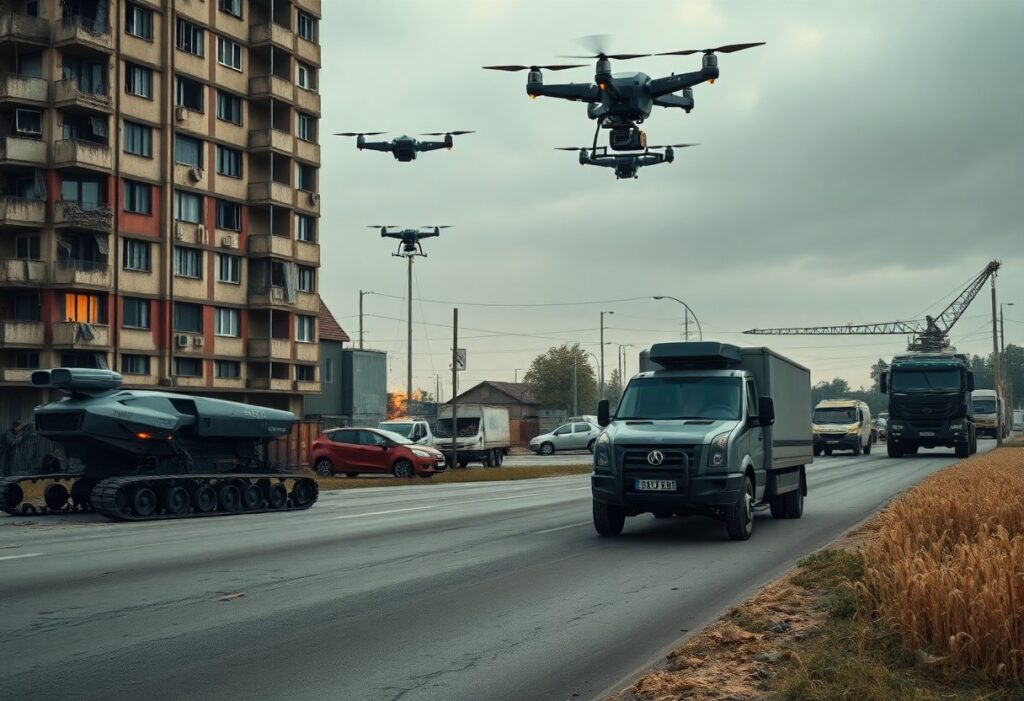
There’s growing evidence that drones, ground robots, and automated systems are reshaping battlefield dynamics in Ukraine. You’re now seeing machines perform reconnaissance, deliver supplies, and even engage targets with increasing frequency. These tools are no longer futuristic concepts but operational assets used by both sides in real-time combat scenarios.
The Sky Above
Robots in the war in Ukraine increasingly operate in the airspace, transforming reconnaissance and strike capabilities. Drones now routinely identify troop positions, assess damage, and deliver munitions with precision once reserved for manned aircraft. Your understanding of modern combat must include these unmanned systems as standard tools of battlefield awareness and engagement.
Aerial surveillance
Small, commercially available drones provide real-time video feeds from beyond the front lines. You rely on this constant stream to track enemy movements and adjust positions without exposing personnel. Units deploy quadcopters daily, turning smartphones and hobbyist hardware into imperative eyes in the sky.
Tactical strikes
Attack drones armed with grenades or explosives target armored vehicles and artillery positions. You coordinate these strikes using encrypted signals and GPS coordinates relayed from forward observers. Systems like the Turkish-made Bayraktar TB2 have destroyed convoys and command centers, shifting momentum in key engagements.
One widely documented incident involved a drone striking a Russian armored column near Kyiv, disabling multiple vehicles in a single mission. You assess such operations not as isolated events but as part of a broader shift toward decentralized, drone-led warfare where response times shrink and battlefield initiative favors the side with superior aerial autonomy.
Ground Movement
Robots now routinely transport supplies across contested terrain, reducing risk to human personnel. Ukrainian forces have deployed unmanned ground vehicles to deliver ammunition and medical kits to front-line positions, particularly in areas under constant artillery surveillance. These systems operate day or night, often using pre-programmed routes or remote guidance, maintaining logistical flow even when roads are impassable or dangerous.
Supply robots
A UGV known as the Voron Mark-2 has been adapted to carry over 100 kilograms of gear across rough fields and damaged urban zones. You can deploy it via tablet interface, allowing small units to resupply without exposing soldiers to direct fire. Its modular design supports rapid reconfiguration for medical evacuation or ammunition delivery, depending on mission needs.
Mine removal
Clearing explosive hazards has become a primary role for robotic platforms, with systems like the Ukrainian-made Vopak deployed to detonate mines remotely. You operate these from a safe distance, minimizing exposure during demining operations in heavily contaminated zones such as southern Kherson or eastern Donetsk.
Demining robots often use flails, plows, or explosive charges to neutralize ordnance, and some are paired with drones for initial surveying. You rely on real-time video feeds and terrain mapping to guide them through fields where even a single misstep can be fatal. In one documented deployment near Lyman, a robot cleared a path through a cluster of anti-tank mines, enabling infantry to advance without casualties.
Naval Action
Autonomous systems are redefining naval operations in the Black Sea, where unmanned surface vessels play an increasing role in surveillance and strike missions. You can read more about this shift in The Use of AI and Autonomous Technologies in the War in Ukraine, a comprehensive analysis of emerging battlefield technologies.
Sea drones
Ukrainian forces have deployed custom-built sea drones to target Russian naval assets, using low-cost, remotely operated vessels packed with explosives. These drones have damaged or disabled several ships near Sevastopol, demonstrating how small, agile platforms can challenge traditional maritime dominance in confined waters.
Port defense
Fixed and mobile radar systems, combined with thermal imaging and AI-assisted tracking, now guard key Ukrainian ports against drone and boat attacks. Operators monitor real-time feeds to intercept threats before they reach critical infrastructure along the coast.
Harbors like Odesa rely on layered electronic surveillance and rapid-response patrol boats to counter incoming drones. Acoustic sensors and radio-frequency jammers form part of a decentralized shield, disrupting enemy navigation and detonation signals seconds before impact, minimizing damage to port facilities and shipping lanes.
Signal Combat
Electronic warfare has become a decisive factor in modern battlefield operations, with robots and autonomous systems playing a central role in detecting, intercepting, and disrupting enemy communications. Your ability to maintain secure data links directly influences mission success, as adversaries deploy increasingly sophisticated countermeasures across the electromagnetic spectrum.
Radio jamming
Enemy forces use automated jamming systems to block command signals sent to drones and ground robots, creating deliberate interference on common frequencies. Your drone operations must account for sudden signal loss, particularly in contested zones near Russian positions where high-powered jammers are routinely deployed.
Target tracking
Autonomous sensors now assist in maintaining continuous surveillance of mobile missile launchers and armored units by fusing radar, thermal, and RF signatures. Your situational awareness improves when these systems operate in coordination with electronic support measures that identify active emitters in real time.
One mid-sized SaaS firm providing battlefield analytics reported that their tracking algorithms reduced false positives by correlating drone footage with signal pings from enemy radios, allowing frontline units to anticipate movements within a 15-kilometer corridor along the front line.
To wrap up
You observe a conflict where robots and autonomous systems are no longer experimental tools but integral elements of battlefield operations. Drone swarms disrupt supply lines, automated sentry guns patrol trenches, and AI-guided artillery locates targets with cold precision. A mid-sized SaaS firm in Kyiv now supplies mission-critical navigation algorithms to frontline units. You see this evolution not as a glimpse into future warfare but as the current reality on the ground in Ukraine.