
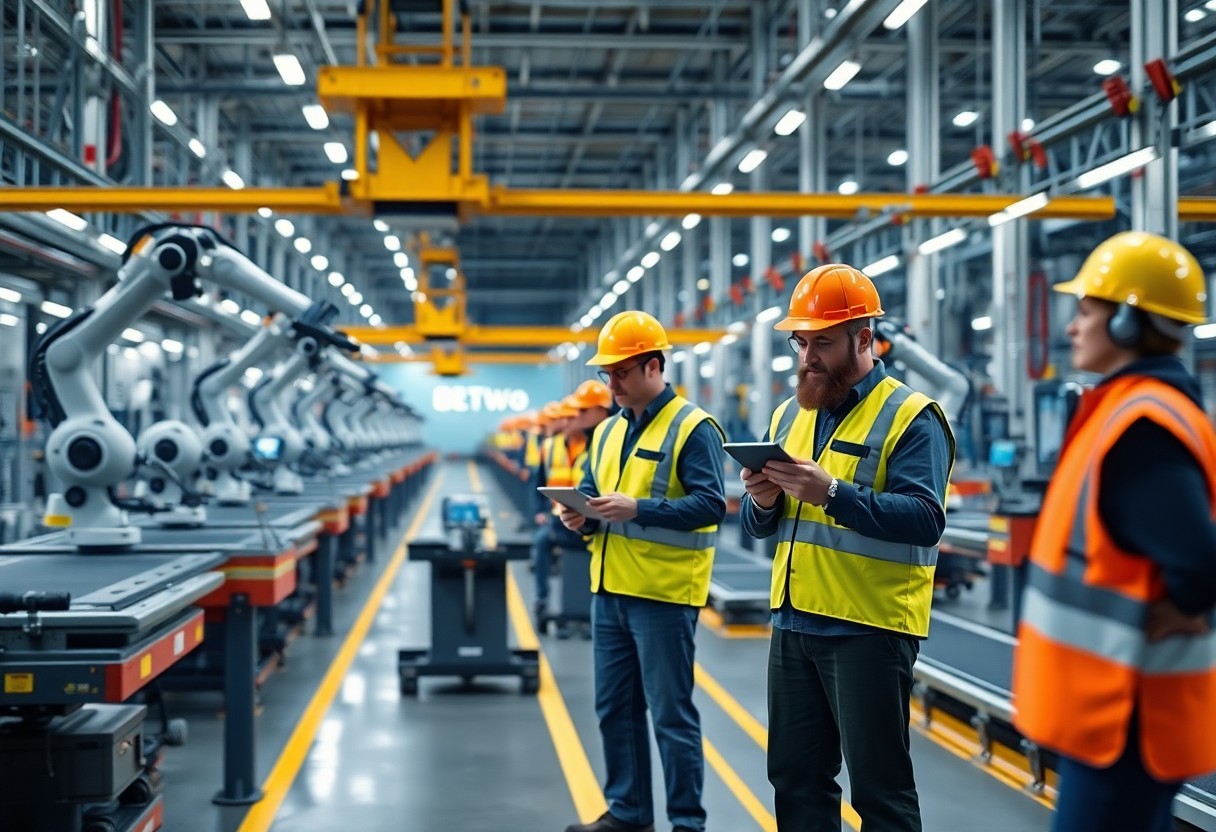
With robots integrated into modern production lines, you gain collaborators that enhance precision and productivity while shifting your role toward oversight, programming and continuous improvement; this transition demands updated skills, safety protocols and organizational design so you can harness automation to increase flexibility, reduce repetitive strain, and focus on higher-value tasks that drive innovation and competitiveness.
The Evolution of Robotics in Manufacturing
Historical Overview
You can trace factory robotics to 1961 when Unimate performed the first industrial welding at General Motors; by the 1970s robots handled repetitive spot welding and painting across assembly lines. Throughout the 1980s and 1990s integration with CNC and PLC systems accelerated throughput, and by the 2000s lightweight, affordable cobots began shifting automation into electronics, plastics, and small-batch operations.
Technological Advancements
Advances in vision, force sensing, and machine learning now let you deploy robots that adapt to part variation and human presence; modern 6-axis arms achieve higher speeds and sub-millimeter repeatability while cobots offer safe, force-limited interaction. Edge computing and 5G cut latency for real-time control, and frameworks like ROS shorten development cycles so you can field complex inspection or bin-picking tasks far faster than a decade ago.
Standards such as ISO 10218 and ISO/TS 15066 shape safe collaboration, and examples like ABB’s YuMi and Universal Robots’ UR series made bench-level cooperation common; you’ll still see KUKA and FANUC handling high-payload automotive tasks while cobots serve electronics and lab assembly. With unit costs lower and modular software stacks available, you can pilot automation with smaller investments and scale incrementally.
Collaborative Robots and Their Functions
Types of Collaborative Robots
You’ll encounter cobot classes tailored to specific shop-floor roles: lightweight articulated arms for fast pick-and-place, dual‑arm manipulators for intricate assembly, mobile cobots that combine AMR transport with a manipulator, force‑sensing units for polishing/finishing, and larger collaborative cells for higher‑payload tasks.
- Lightweight 6‑axis arms (payload 3-10 kg)
- Dual‑arm systems (precision assembly, e.g., ABB YuMi)
- Mobile AMR+arm combos (parts delivery + manipulation)
- Force/torque‑sensing cobots (sanding, deburring)
After assessing payload, reach (typically 500-1,400 mm) and integration needs, you match the class to your cycle times and floor layout.
| Lightweight articulated arm | Payload 3-10 kg; fast cycles; common for bin picking (e.g., Universal Robots UR series) |
| Dual‑arm manipulator | Two coordinated arms for assembly and hand‑to‑hand tasks (example: ABB YuMi) |
| Mobile cobot (AMR+arm) | Autonomous transport plus manipulation; reduces operator walking time and speeds parts flow |
| Force/torque‑sensing cobot | Compliant control for polishing, deburring and human touch‑interaction; used in finishing stations |
| High‑payload collaborative cell | Protected collaborative zones for heavier parts (payloads up to ~20 kg) with speed/reduced force modes |
Benefits of Human-Robot Collaboration
You gain higher throughput and better ergonomics by reallocating repetitive chores to cobots while keeping humans on inspection and complex assembly; many operations report 15-30% cycle‑time improvements and measurable reductions in musculoskeletal strain when cobots handle lifting and repetitive motions.
Extending that, cobots shorten changeover time through flexible programming-UR-style teach pendants and hand‑guiding let your operators redeploy robots within hours. Safety features like power/force limiting and real‑time force feedback reduce injury risk and allow closer human proximity, improving handoffs in mixed teams. Financially, manufacturers often see payback from increased uptime, fewer quality defects, and labor reallocation-your plant can scale capacity without linear headcount growth while keeping skilled technicians on higher‑value work.
Impact on Workforce Dynamics
When cobots join your line, team dynamics shift quickly: human operators move from repetitive assembly to oversight, QA, and exception handling. You’ll see cases where small teams pair one senior operator with two to four cobots, boosting throughput without headcount increases. For industry context, read Rise of Cobots: The New Hybrid Workforce, which documents adoption trends and hybrid staffing models across sectors.
Job Redefinition
Tasks that once consumed your shop-floor hours-part feeding, part inspection-get redistributed as you focus on orchestration, quality decision-making, and collaborative problem-solving. Technicians increasingly configure end-effectors and safety zones while assemblers handle exceptions and finishing work. In several mid-sized plants, roles shifted from 90% manual execution to a mix where humans perform 60-70% of cognitive tasks and robots handle repetitive motion and lifting.
Skill Development and Training Needs
You must invest in new learning pathways: programming teach pendants, basic PLC integration, and vision-system calibration. Entry-level operators often complete 16-80 hours of targeted training, while technicians add troubleshooting and network diagnostics. Manufacturers that deploy structured bootcamps report faster ramp-up, and you’ll need competency assessments tied to safety certifications before solo operation of integrated cobot cells.
Beyond basic courses, you’ll train on ROS-based simulation, Python scripting for vision pipelines, and PLC ladder logic for cell integration; familiarizing yourself with ISO 10218 and ISO/TS 15066 safety criteria is vital. Many programs combine 20-100 hours of classroom, simulation, and on-the-job mentorship; OEM modules from Universal Robots or Fanuc plus vendor-led certifications accelerate deployment and provide measurable ROI through reduced downtime and faster fault resolution.
Safety and Ethical Considerations
Alongside throughput and flexibility, you must embed safety and ethics into every deployment: follow ISO 12100 for risk assessment, ISO 10218 for industrial robot safety, and ISO/TS 15066 (2016) for collaborative power-and-force limits; combine technical measures with governance so your teams know who decides on acceptable risk, what data is collected, and how productivity gains are shared.
Ensuring Safety on the Floor
When you design work cells, implement layered protections – safety-rated monitored stop, speed-and-separation monitoring, and power-and-force limiting – complemented by light curtains, torque sensors, and redundant E-stops; validate designs with worst-case scenario tests, maintain daily checklists, and train operators on lockout/tagout and cobot hand-guiding procedures to meet both ISO standards and real-world operational durability.
Ethical Implications of Robot Integration
As you deploy robots, anticipate workforce reshaping: McKinsey estimates 400-800 million workers globally could be displaced by automation by 2030, so you should pair rollouts with clear reskilling plans, transparent performance metrics, and strict limits on worker surveillance and productivity-based penalties to protect dignity and fairness.
Start by defining measurable transition goals (for example, target reskilling 15-25% of at‑risk roles within 12 months), create joint labor-management committees for procurement decisions, enforce data-minimization and access controls on sensor streams, and audit outcomes annually so your integration delivers shared value rather than simply shifting risk onto workers.
Case Studies of Successful Implementation
You can draw actionable lessons from deployments that paired clear KPIs with operator upskilling; measured outcomes typically include fast ROI and measurable safety gains. Below are concrete examples showing robots as co-workers delivering quantified benefits across different shop-floor contexts.
- 1) Automotive OEM (Europe): You deployed 150 cobots across final-assembly cells in 2021, yielding a 38% cycle-time reduction, 22% increase in line throughput, and payback in 14 months; recordable ergonomic incidents fell 58% year-over-year.
- 2) Electronics contract manufacturer (Asia): You integrated 120 SCARA and delta robots for PCB handling in 2020, cutting pick-and-place takt by 42%, reducing micro-defects by 68%, and increasing output by 1.8 million units annually.
- 3) Food & beverage plant (North America): You automated packaging with 24 collaborative palletizers in 2019, achieving a 30% labor cost drop, 20% packaging speed increase, and zero contamination incidents attributable to manual handling over two years.
- 4) Small metal fabrication shop (Europe): You added 3 collaborative welding cells in 2022, lifting weld throughput 45%, lowering rework rates from 12% to 3%, and realizing ROI inside 10 months while retaining skilled welders for value-added tasks.
- 5) E‑commerce logistics center (Global): You deployed 400 mobile robots for sortation and goods-to-person in 2020-2022, increasing order throughput 55%, cutting average fulfillment time from 7.2 to 3.6 hours, and reducing damaged-goods rates by 27%.
Leading Industries Adopting Robotics
You’ll see the heaviest penetration in automotive and electronics, but logistics, food & beverage, and pharmaceuticals are accelerating fastest; many automotive lines record 20-50% automation on repetitive cells, while logistics centers commonly report 40-60% throughput uplift after mobile-robot rollouts.
Outcomes of Robot Integration
You should expect mixed but measurable outcomes: typical deployments deliver 15-60% throughput gains, defect-rate reductions often between 30-70%, and workplace injury metrics improving by 25-60% when ergonomics are targeted.
You’ll also need to plan for workforce transitions: reskilling programs usually run 3-6 months, total-cost-of-ownership breaks even in 12-24 months for well-scoped projects, and ongoing uptime targets of 95%+ are achievable with predictive maintenance and operator-led daily checks.
Future Trends in Robotics and Manufacturing
Adoption metrics show accelerating change: IFR reported 517,385 industrial robot shipments in 2021 and global robot stock now exceeds three million units, and you can expect that scale to push advanced automation into mid-sized plants. Edge AI, 5G private networks, and digital twins will converge to cut downtime and speed changeovers, while suppliers like Universal Robots and FANUC keep lowering integration cost for your production lines.
Innovations on the Horizon
Soft robotics and tactile sensor arrays will let you automate delicate assembly-handling food or thin PCBs-while multimodal vision with reinforcement learning enables adaptive pickup and in-process correction. Digital twins are already cutting commissioning time in Siemens case studies by up to 50%, and 5G-enabled AMRs with LiDAR will scale internal logistics, reducing your inventory movement bottlenecks.
Predictions for Workforce Transformation
By 2025 the World Economic Forum projected automation will create 97 million new roles even as it displaces others, so you’ll move from repetitive tasks into hybrid roles focused on robot supervision, data analysis, and preventative maintenance. Employers will prioritize candidates who can program cobots, read sensor data, and run continuous-improvement cycles, shifting headcount toward oversight and optimization functions.
You should plan structured reskilling: short modules, vendor certifications (Universal Robots Academy, FANUC training, Siemens SITRAIN), and apprenticeships with local colleges to teach PLCs, ROS, and predictive-maintenance analytics. Case studies from OEMs show faster ramp-up when on-the-job training pairs with simulation labs; anticipate certifications becoming hiring filters and internal career ladders rewarding cross-disciplinary experience.
Summing up
Hence you should view robots as collaborative partners that transfer repetitive and hazardous tasks to automated systems while enabling your workforce to focus on oversight, problem-solving, and upskilling; you must redesign workflows, training, and safety protocols so your team and machines operate together efficiently, boosting productivity and innovation without sacrificing the human judgment that guides complex decisions.
