
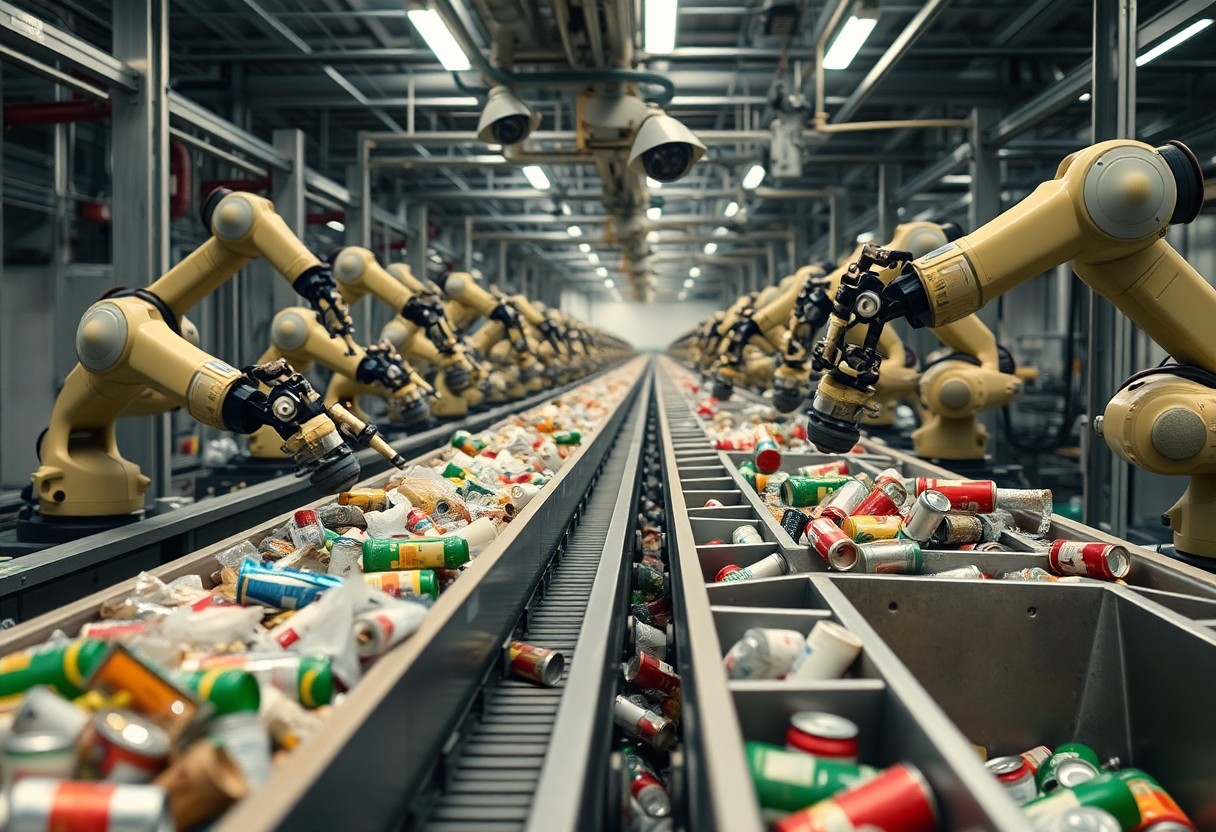
Robotics is transforming modern recycling facilities. Automated sorting allows you to scale operations while improving material recovery. It also reduces contamination and lowers labor risk. Throughput increases without sacrificing quality.
By combining machine vision, AI-based classifiers, and adaptive grippers, facilities gain better control over material identification. Plastics, paper, and metals are detected with higher precision. This leads to consistent output and lower operational costs as volumes increase.
Successful deployment depends on alignment. Sensors, software, and workflow design must work together. When integrated properly, robotics delivers clear environmental and economic benefits.
The Importance of Robot in Recycling
As automation scales, the impact of recycling becomes easier to measure. Recycling aluminum uses up to 95% less energy than producing new aluminum. Despite this, only about 9% of plastic ever made has been recycled. In the United States, overall municipal recycling remains near 32%.
Some cities show what is possible. San Francisco reached an estimated 80% diversion rate. Higher recovery and cleaner streams reduce emissions. They also strengthen recycling markets and local infrastructure.
Environmental Benefits of Robotics in Recycling
Improved sorting delivers immediate environmental gains. Recycling aluminum drastically reduces energy use. Recycling one ton of paper saves roughly 17 trees and large amounts of water.
Diverting organic waste lowers methane emissions from landfills. Methane is around 28 times more potent than CO₂ over a 100-year period. Cleaner material bales also reduce downstream contamination. This improves end-market acceptance and lowers total greenhouse gas emissions.
Economic Impact of AI-Powered Recycling
Recycling is a major economic sector. In the U.S., recycling and reuse support about 681,000 jobs. These activities generate nearly $38 billion in wages and $5.5 billion in tax revenue.
Policy changes reshaped the industry. China’s 2018 National Sword policy forced stricter contamination standards. Many facilities turned to automation to stay profitable. Robotics now helps recover higher-value materials and stabilize revenue.
Tipping fees often range from $30 to $80 per ton. Small improvements matter. A 5–15% gain in recovery or purity can significantly raise bale prices. Many operators report payback periods of two to five years. Savings come from labor reduction, higher yields, and avoided disposal costs.
Challenges in Waste Sorting and Robotics Deployment
Waste streams are becoming more complex. Packaging formats change often. Seasonal volume spikes strain capacity. End markets demand lower contamination, often below 1%.
Facilities processing 50 to 500 tons per day face added pressure. Labor shortages increase costs. Inconsistent feedstock reduces efficiency. These challenges push operators toward smarter automation strategies.
Overcoming Manual Sorting Limitations with Robotics
Manual sorting has clear limits. Workers struggle with repetitive tasks over long shifts. Injury risk and turnover increase operating costs.
Sorting accuracy also varies. Many facilities see yield swings between 5% and 20%. These fluctuations make it hard to meet quality targets. Downstream processors demand consistency that manual lines cannot guarantee.
Contamination Reduction through Automated Recycling
Contamination remains a major problem. Food residue, plastic bags, and mixed polymers reduce material value. Dirty loads can be rejected or require reprocessing.
Some contamination is less visible. PVC in PET streams and battery residue cause serious quality loss. These issues lower prices and raise rejection rates. Without targeted automation, recovery rates decline and processing costs rise.
Robotics Technology Overview for Recycling Facilities
Modern recycling robots rely on sensor fusion. Systems combine RGB cameras, NIR or hyperspectral imaging, and weight sensors. These tools identify materials at conveyor speeds.
Edge computing reduces decision time. Inference often occurs in under 50 milliseconds. This allows robots to keep pace with high-throughput lines. Modular designs let facilities scale by adding more robotic cells.
Types of Robots Used
Facilities typically deploy several robot types.
Six-axis articulated robots handle bulky or irregular items.
Delta and SCARA robots manage lightweight materials at high speed.
Collaborative robots support hybrid human-robot lines.
Autonomous mobile robots move materials internally and reduce fixed conveyors.
Each robot type should match the feedstock, throughput goals, and maintenance capacity of the facility.
Machine Learning and AI in Sorting
AI models drive robotic accuracy. Vision systems use trained classifiers to identify materials in real time. Most systems operate at 30 to 60 frames per second.
Object detection and segmentation help with overlapping items. Active learning improves performance over time. Operators label edge cases, and models retrain regularly. This reduces errors as waste streams change.
Automation in Waste Sorting Facilities
Robotic sorting works best in hybrid systems. Optical and air classifiers pre-sort materials. Robots then target high-value fractions such as PET, HDPE, and OCC.
Facilities often reduce manual picking by 60–80%. Residual contamination drops by double-digit percentages. Throughput increases without expanding floor space.
Proven Implementations
Real-world deployments show consistent results. Many pilots report payback within two years. Purity improves, and throughput remains stable during peak shifts.
Robots perform best when assigned clear pick tasks. Human operators handle exceptions and oversight. This balance delivers repeatable performance across different facilities.
Efficiency and Accuracy Gains
Robots achieve high pick rates. Many systems reach 20 to 40 picks per minute. Accuracy for targeted materials often exceeds 90%.
Continuous retraining is critical. Facilities that use feedback loops reduce misclassification quickly. Predictive maintenance keeps uptime above 95%. These gains translate into lower per-ton processing costs.
The Future of Robotics in Recycling
Future systems will handle more variability. Hyperspectral sensing will improve material identification. Adaptive grippers will manage irregular items more effectively.
Global waste volumes continue to rise. Projections reach 3.4 billion tonnes by 2050. Scalable automation will be essential to meet this demand.
Industry Expansion Potential
Robotics is expanding beyond municipal recycling. Growth areas include e-waste, construction debris, organics, and industrial scrap. These streams offer higher material value.
Service models such as Robotics-as-a-Service reduce upfront costs. Facilities can deploy automation without full plant rebuilds. Payback often occurs within two to four years.
Final Thoughts
Robotics is reshaping recycling operations. Accuracy improves. Throughput increases. Worker safety rises.
AI-driven automation helps facilities adapt to changing waste streams. It supports regulatory compliance and sustainability goals. For operators focused on long-term performance, robotics provides a clear path forward.
