
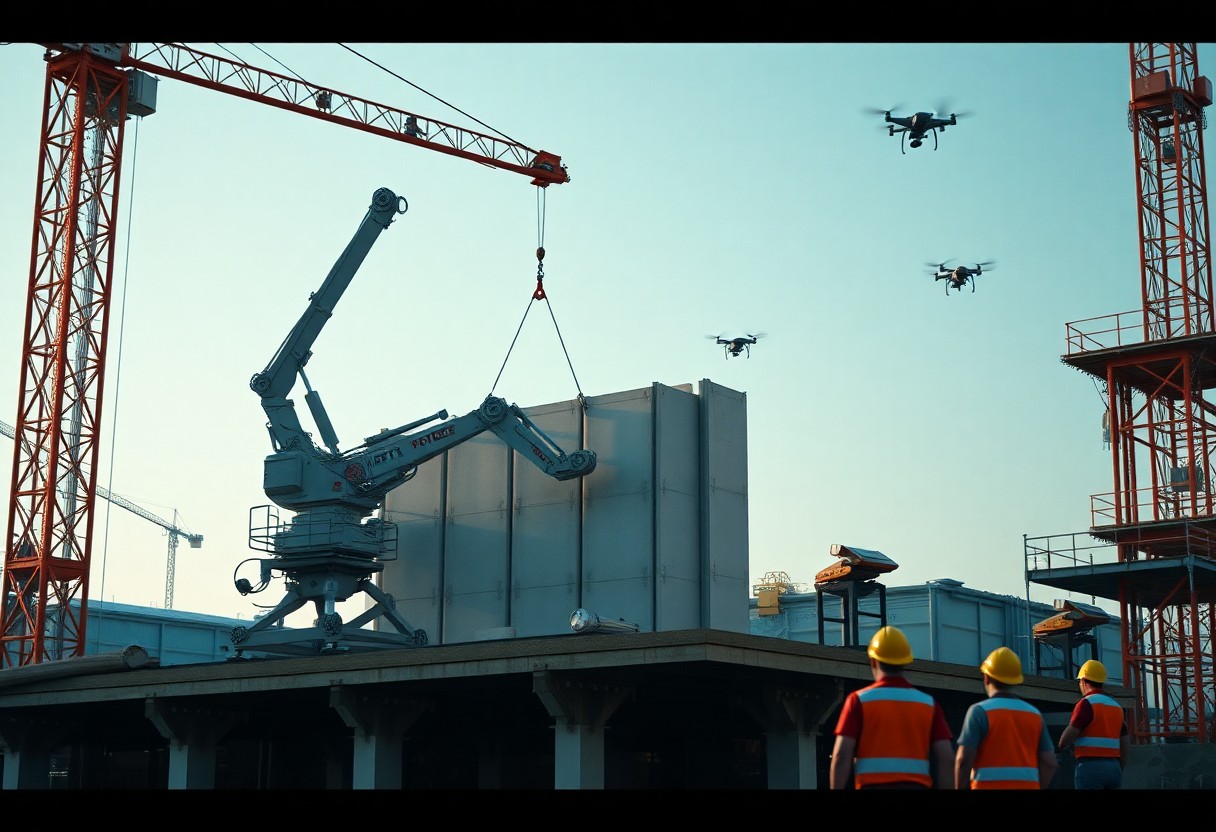
With robotics transforming tasks from heavy lifting to precision assembly, you can deploy autonomous equipment, drones, modular fabrication, and AI-driven planning to boost productivity, improve safety, and reduce cost variability; this post explains key technologies, implementation challenges, and practical steps for integrating robotics into your projects so you can plan, manage, and scale automation in the built environment.
The Evolution of Robotics in Construction
As automation moved from factory floors onto sites, you now see machines handling tasks once done by crews: robotic bricklayers, autonomous earthmovers, and drone mapping. By the 2020s, retrofit autonomy and factory robotics scaled modular prefabrication, cutting onsite labor and rework. Examples include Hadrian X laying ~1,000 bricks/hour and Built Robotics converting Cat excavators for continuous digging, showing how industrial techniques are reshaping your project timelines and cost models.
Historical Development
1960s industrial arms set the stage, but construction robotics accelerated in the 2000s as CAD, GPS and lightweight sensors matured. You saw early prefab robotics in factories, then field robots like TyBot for rebar tying and SAM for masonry in the 2010s. Retrofit companies such as Built Robotics and autonomous equipment from Komatsu pushed site automation, turning prototypes into paid deployments on highway and earthworks projects.
Key Technological Advances
Perception and positioning-LiDAR, RTK GNSS with centimeter accuracy, and computer vision-gave robots reliable site awareness, while BIM integration and ROS-Industrial bridged design-to-robot workflows. You can point to 3D printing (Apis Cor, ICON), collaborative cobots for finishing, and AI planners that optimize sequences; together these advances let robots deliver speed and repeatability across masonry, earthmoving, and prefab assembly.
Sensor fusion combines LiDAR, IMU, and photogrammetry to create dense site models; drones typically achieve 2-5 cm resolution in surveys you can use for as-built comparisons. Edge computing and ROS enable low-latency control, and BIM-to-field links (IFC exports, Autodesk/Bentley integrations) let you translate design geometry into robot paths. Standards like ISO 10218 and ISO/TS 15066 frame safe human-robot collaboration, so you can deploy cobots alongside crews under regulated limits.
Types of Robots Used in Construction
You encounter a spectrum of machines: autonomous haul trucks and AGVs for material flow, robotic arms for prefabrication and welding, drones for surveying and inspection, teleoperated demolition bots for confined work, and wearable exoskeletons that reduce strain. Autonomous retrofits like Built Robotics convert excavators for repetitive digging, while drone surveys reach sub-centimeter accuracy with RTK. Perceiving site geometry and condition, these platforms coordinate to shorten schedules and improve safety.
- Autonomous vehicles: site haul, AGVs, and retrofitted heavy equipment
- Robotic arms: panel assembly, 3D concrete printing, and welding
- Drones: photogrammetry, LiDAR scanning, and aerial inspection
- Teleoperated demolition and compact robots for hazardous access
- Exoskeletons and wearable robots to augment worker endurance
| Autonomous Vehicles | AGVs for just-in-time delivery; Built Robotics retrofits excavators for autonomous digging |
| Robotic Arms | ABB/KUKA/FANUC units in prefabrication lines assembling curtain walls and timber panels |
| Drones | DJI/senseFly platforms for RTK-enabled photogrammetry and LiDAR surveys with cm-level positioning |
| Demolition Robots | Brokk-type teleoperated machines for confined-space concrete removal and hazardous cleanup |
| Wearables | Passive and powered exoskeletons that reduce lifting loads and fatigue on repetitive tasks |
Autonomous Vehicles
You can deploy autonomous vehicles to move bulk materials, run repetitive earthworks, or shuttle supplies across complex sites. Built Robotics retrofits excavators and dozers to operate autonomously for continuous digging, while AGVs handle palletized deliveries in prefabrication yards. Several pilot projects report 24/7 operation that reduces cycle variability and keeps material flow synchronized with just-in-time assembly.
Robotic Arms and Drones
You should use robotic arms for high-repeatability assembly and CNC-like tasks-industrial arms produce panels, cut openings, and spray concrete with sub-millimeter repeatability in offsite factories. Drones complement arms by providing aerial surveys, thermal inspection, and progress monitoring, often integrating RTK or LiDAR to deliver georeferenced models you can use for quality control.
In practice, you combine arms and drones into integrated workflows: arms prefabricate modules in controlled conditions while drones verify tolerances during installation. For example, bricklaying systems and gantry-mounted 3D concrete printers can produce wall sections that drones then scan for deviation; image-based AI flags defects and feeds corrections back to arm controllers. This closed-loop approach shortens rework, scales prefabrication, and lets you shift skilled labor to oversight and complex tasks.
Benefits of Robotics in Construction
Increased Efficiency and Productivity
By integrating robots you compress schedules and boost output: Fastbrick’s Hadrian X claims up to 1,000 bricks per hour, drones shorten topographic surveys by 70-90% from days to hours, and autonomous haulers in heavy sites report 10-20% higher utilization. You can redeploy skilled crews to complex tasks while robots handle repetitive work, cutting cycle times and lowering labor cost per unit of work.
Enhanced Safety and Risk Management
You lower onsite injuries by replacing dangerous tasks with robots: remote-controlled Brokk demolition units keep workers out of collapse, confined-space or contaminated zones, inspection robots like Spot reduce ladder and roof climbs, and exoskeletons lessen musculoskeletal strain from repetitive lifts, all helping to preserve workforce health and availability.
For example, Brokk machines were used during Fukushima decontamination to remove operators from high-radiation areas, and contractors deploy drone- and camera-based AI to flag missing PPE or unsafe proximities in real time. You benefit from fewer injury-related schedule delays and clearer documentation for incident reviews and insurer engagement.
Challenges and Limitations
Despite rapid innovation, you still face steep barriers before robots become pervasive on sites: high initial capital (often tens to hundreds of thousands of dollars), site variability that defeats rigid automation, and fragmented standards across regions. For example, a bricklaying robot can halve on-task labor but may need weeks of site prep and custom fixturing, delaying ROI. You must weigh throughput gains against setup time, maintenance needs, and compliance with local safety rules.
Technical Hurdles
You encounter sensing and autonomy limits on messy, changing sites: dust, rain, steel structures and GPS occlusion degrade RTK/GNSS positioning and LiDAR performance, producing SLAM drift over hours. Battery runtimes commonly range 2-8 hours, while manipulators still lack the tactile dexterity for variable materials. Interoperability is another pain point-different vendors use proprietary APIs, so integrating robotic data into BIM workflows or site telematics often requires custom middleware and extra commissioning time.
Workforce Integration
You must manage reskilling and role redesign as robots shift tasks. Tradespeople often need 40-120 hours of targeted training to operate or oversee automation, and unions may negotiate work-scope changes. Companies like Skanska trained multidisciplinary crews to run inspection robots, showing that incremental pilot programs and clear career pathways reduce resistance and preserve productivity during transition.
You should plan specific new roles-robot operators, maintenance technicians, and data analysts-and associated credentialing. In practice, onsite pilots take 2-3 months to stabilize procedures, while technicians typically require 6-12 months of blended classroom and hands-on training to reach full competence. Budget for ongoing upskilling, apprenticeship alignment, and partnerships with technical schools to keep your workforce able to maintain and optimize automated systems.
Future Trends in Construction Robotics
You’ll witness a rapid shift from isolated demonstrators to integrated site ecosystems: on-site 3D printers from ICON and Apis Cor will pair with autonomous haulage trials by Komatsu/Caterpillar, while robotic fabrication (MX3D’s bridge) and wearable exosuits reduce physical strain. Pilot programs report 30-50% faster cycle times on repetitive tasks, and regulatory sandboxes in the US and EU are shortening approval timelines, so your next project may already include mixed human-robot crews and real‑time digital twins.
Innovations on the Horizon
Expect modular, deployable fabrication labs that print structural elements on demand, swarm drones handling façade inspection and repair, and multi-robot teams assembling prefabricated modules. For example, autonomous cranes coordinating with AGVs can cut lift-and-place time by up to 40% in trials, and research into self-healing concrete and embedded sensors will let robots perform preventive repairs instead of just replacement.
The Role of AI and Machine Learning
You’ll rely on AI for perception, motion planning, and predictive maintenance: computer vision models in pilots identify cracks and misalignments with >90% precision, while reinforcement learning optimizes manipulation tasks in cluttered environments. Integration with BIM lets ML-driven planners sequence robotic tasks, reducing on-site idle time by roughly 20% in several contractor pilots.
Delve deeper and you’ll find the technical stack dominated by sensor fusion (LiDAR, RGB-D, thermal), edge inference on devices like NVIDIA Jetson, and federated learning to protect project data. Transfer learning accelerates deployment across sites, but data labeling and BIM integration remain bottlenecks; successful programs combine automated annotation pipelines, continuous retraining, and clear governance to scale AI-driven robotics beyond single-site proofs of concept.
Case Studies in Robotics Application
Across recent projects you can measure clear gains: pilots often report 20-80% faster cycle times, lower defects, and predictable schedules. For a broad industry perspective see The Future of Construction: How Automation and Robotics ….
- 1) Fastbrick (Hadrian X) – reported laying up to ~1,000 bricks per hour in demonstrations; pilots cut shell build time from weeks to days and reduced onsite bricklayers by reported rates up to 70-80% during automated phases.
- 2) Apis Cor 3D printing – printed a 38 m² (≈409 ft²) single‑story house in ~24 hours (2017 demo); material and labor savings in pilots ranged 30-60% vs. traditional small‑home builds.
- 3) Komatsu autonomous haul trucks – deployed in mining/quarry sites with reported uptime increases of 10-20% and operating‑cost reductions near 10% from optimized routes and reduced idle time.
- 4) Built Robotics autonomous excavators – retrofit units ran extended hours (near 24/7 in some trials) and field reports show cycle‑time reductions up to ~30% on repetitive earthworks tasks.
- 5) Boston Dynamics Spot for site inspection – used to survey confined or hazardous zones, cutting manual inspection time by up to ~70% and improving issue detection frequency through repeatable walks and sensor logs.
- 6) Construction Robotics (SAM/semi‑automated masons) – automation-assisted masonry increased steady‑state laying rates and reduced ergonomic injuries; contractors reported daily brick counts rising several hundred bricks compared with manual peaks.
Successful Implementations
You can point to projects where robotics delivered predictable outputs: prefabrication robots reduced onsite assembly time by 40% in modular builds, while autonomous earthmoving increased daily moved volumes and allowed smaller crews to manage larger scopes with consistent quality.
Lessons Learned
You often find the biggest gains come when you redesign the workflow around the robot: site logistics, prefabrication schedules, and skilled oversight must align to avoid bottlenecks and realize the quoted productivity figures.
When you assess deployments more deeply, common themes emerge: invest in operator training (operators augment rather than replace), stage pilots on repetitive tasks, quantify ROI with clear KPIs (cycle time, uptime, defect rate), and plan for integration costs like site prep, connectivity, and maintenance to avoid scope creep.
Final Words
So you must view robotics as a strategic tool that automates repetitive tasks, improves safety, accelerates schedules, and enhances precision across design, construction, and maintenance; integrating robotics with your digital workflows like BIM and sensors lets you optimize lifecycle costs and respond to labor constraints, while governance, reskilling, and iterative deployment ensure responsible, measurable gains.
