
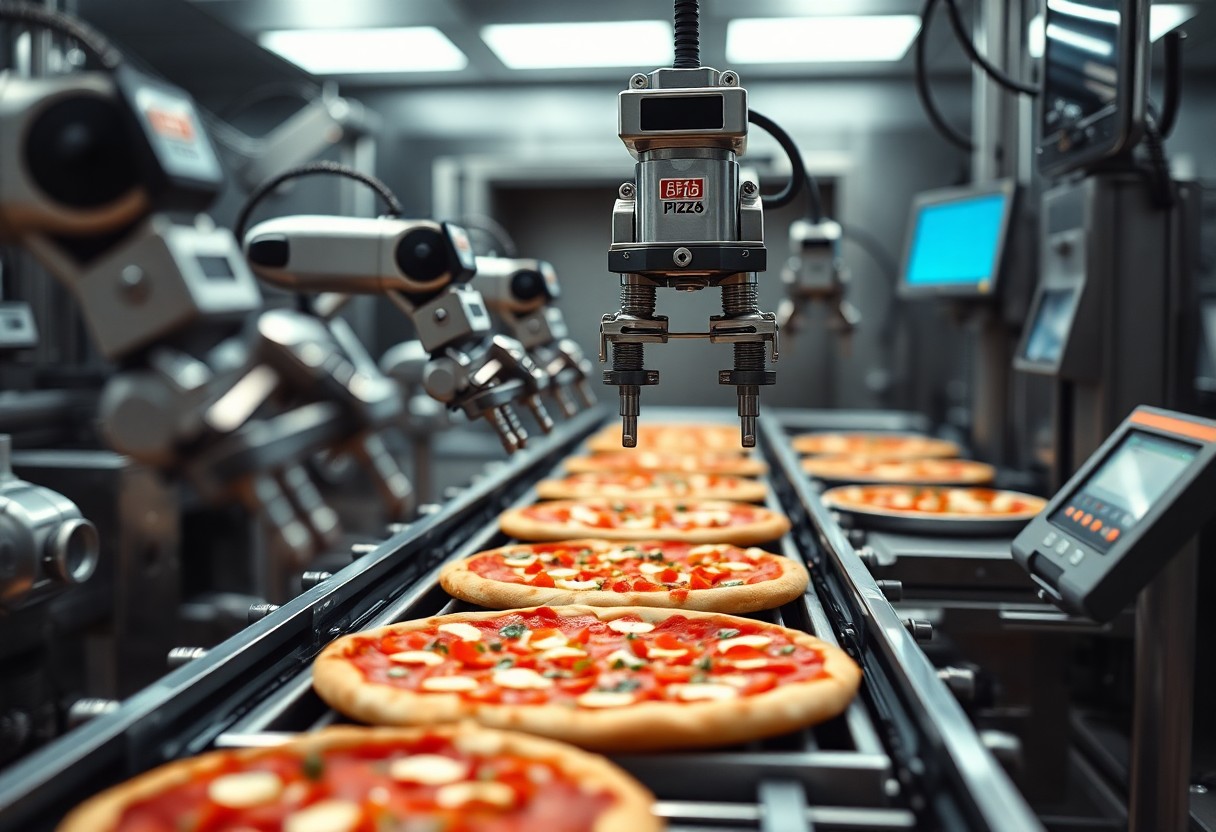
Automation is rapidly redefining robotics in food processing, enabling you to scale operations with precision, consistency, and improved hygiene while adapting lines to varied recipes and formats. Robotic vision, AI-driven control, and modular tooling let your facility handle high-mix, low-volume runs, shorten changeovers, and enhance traceability, quality control, and worker safety. Implemented strategically, robotics both elevate product consistency and give you flexibility to respond to consumer demand and regulatory pressures.
The Evolution of Robotics in Food Processing
Over five decades the industry moved from mechanized conveyors to AI-driven cells, and you now see robots beyond packaging into delicate tasks like filleting and frying. Early palletizers gave way to vision-guided pick-and-place in the 1990s, while the 2010s introduced collaborative robots and machine learning; notable examples include Miso Robotics’ Flippy pilots (2018) and Marel’s automated processing lines, illustrating how you can combine speed, repeatability, and adaptability across your plant.
Historical Context
Starting in the 1970s you encountered basic industrial robots mainly for palletizing and packaging, performing 20-60 picks per minute on rigid lines. During the 1980s-90s vendors like FANUC and ABB expanded roles into tray loading and canning, and by the late 1990s vision systems began enabling conditional handling, so your operations slowly shifted from purely mechanical automation to sensor-driven tasks.
Technological Advancements
Recent advances give you 3D vision, hyperspectral sorting, force-feedback grippers, and on-edge AI that classifies defects in milliseconds; cobots now work safely alongside people and reduce line changeover time. Companies such as Tomra, Marel, and Miso demonstrate real-world deployments where vision and AI improve yield and consistency, letting you automate irregular items like baked goods or variable-cut meat.
Digging deeper, machine learning models trained on thousands of annotated images let you detect bruising, foreign material, or bone fragments with high confidence, and you can deploy models that update continuously from your line data. Integrating real-time analytics often delivers payback within 12-24 months while enabling dynamic recipe changes, smaller batch customization, and faster qualification of new SKUs across your production footprint.
Automation in Food Processing
As lines evolve, automation stitches together sorting, cooking, dosing and packaging into continuous workflows so you can scale capacity during peak seasons without proportional hires. Vision-guided robots and servo-driven feeders handle fragile items and irregular shapes, improving throughput by 20-40% in many deployments. In practice, integrating MES data with robotic cells helps you predict maintenance windows and often delivers payback in 12-24 months, while keeping traceability across batches for audits.
Streamlining Operations
By replacing manual pick-and-place and repetitive trimming tasks, you reduce cycle variability and simplify layout complexity; recipe changeovers that once took hours can drop to minutes through quick-change end effectors and software-driven setpoints. For instance, flexible tooling lets you switch between SKUs on the fly, cutting idle time and increasing overall equipment effectiveness (OEE) by double-digit percentage points, which directly improves on-time shipments and lowers overtime labor needs.
Efficiency and Cost Reduction
Automated portioning, weight-checking and inline inspection reduce giveaway and rejects, so you lower material costs and enhance yield; many processors report labor reductions up to 40-50% and waste cuts of 20-35% after deploying robotics in food processing and machine vision. Energy savings appear when robots enable smoother line balancing and demand-driven heating/cooling cycles, and you often see ROI within 12-18 months when combining labor, material and energy gains.
Digging deeper, high-precision portioning robots achieve repeatability within ±2-5 grams, which can recover several percent of product value previously lost to over-portioning; a meat processor improving accuracy by 3% can translate that into tens of thousands of dollars annually depending on volume. Additionally, automated cleaning-in-place schedules tied to robot production metrics have lowered water and chemical use by ~25-30% in some dairy and beverage plants, further shortening payback horizons.
Customization in Food Products
As consumer preferences fragment and label demands increase, you deploy robotic cells, inline dosing and vision inspection to deliver small runs-typically 100-1,000 units-without pausing the line. Cobots and 3D food printers let you tune texture, micronutrients and portion size on the fly; Coca‑Cola Freestyle demonstrates 100+ beverage combinations as a scalable example. This approach cuts inventory, shortens lead times and lets you offer allergen-safe, regional or personalized recipes at commercial volumes.
Meeting Consumer Demands
To satisfy dietary, flavor and ethical preferences you integrate recipe-management systems, RFID tracking and barcode serialization so each unit carries its production profile. Meal‑kit and bespoke-snack operators now use robotic pick‑and‑place to assemble thousands of unique kits weekly, while inline analyzers adjust salt or sugar by ±10% per batch. These capabilities let you launch limited editions and direct‑to‑consumer custom orders without inflating SKUs or manual labor costs.
Flexible Manufacturing Systems
Flexible manufacturing relies on modular cells, quick‑change end‑of‑arm tooling and AGVs so you can reconfigure layouts in hours instead of weeks. Standard protocols like OPC UA and PLC‑based recipe control make integrations repeatable, while vision-guided robots maintain grading accuracy above 98%. With these elements, you reduce product changeover from multi‑hour shutdowns to minute‑scale swaps and scale SKUs without linear increases in floor space.
Deeper implementation uses digital twins and simulation to validate layouts and control logic before floor installation, trimming commissioning time and outage risk. Tool changers, magnetic fixtures and pneumatic quick‑connects let you swap grippers or molds in under 10 minutes, and centralized MES lets you push new recipes to cells with audit trails for traceability. Together these features let you respond to market shifts and channel-specific formulations with predictable OEE improvements.
The Role of AI and Machine Learning
AI and machine learning power the adaptive layer on top of automation, letting you move from rigid recipes to data-driven flexibility. Computer vision and neural networks can classify defects with over 95% accuracy, reinforcement learning tunes robotic motions for delicate items, and time-series models optimize throughput-studies report 10-30% increases in line efficiency. You can therefore cut waste, shorten changeover times, and tailor processes to seasonal ingredient variability using continuous model retraining on operational data.
Enhancing Robotics Capabilities
You boost robot dexterity and autonomy by combining deep learning, tactile sensing, and motion planning: convolutional networks identify occluded products, force sensors enable gentle grip on soft produce, and imitation learning shortens deployment from months to weeks. For example, pick-and-place systems trained with simulated-to-real transfer now handle mixed trays at rates exceeding 60 picks per minute while keeping damage under industry thresholds, letting your lines accept greater SKU variety without manual intervention.
Predictive Analytics in Food Processing
Predictive analytics turns sensor streams into actionable forecasts for maintenance, quality, and shelf life by using anomaly detection and regression models on vibration, motor current, temperature, and NIR spectra. Manufacturers report up to 40% reductions in unplanned downtime and faster root-cause identification when you deploy models that flag drift weeks before failure. That lets you schedule interventions during planned stops and maintain consistent product quality across shifts and facilities.
To implement predictive systems, you should combine feature engineering (FFT of vibration, moving averages of current draw) with models suited to the task-LSTM or Transformer architectures for sequential degradation, and random forests for feature-rich failure classification. Pilot projects commonly show ROI within 6-12 months: a dairy line, for instance, reduced bearing failures by 70% after integrating streaming analytics and automated work orders triggered by a 0.8+ probability score from the model.
Challenges and Limitations
Deploying robotics at scale pushes against real-world variability-high capital (robot cells $50k-$250k), long integration (6-18 months), and ROI horizons of 2-5 years. You face supply‑chain delays for custom end‑effectors, fluctuating product sizes that defeat simple pick‑and‑place algorithms, and workforce upskilling demands as technicians must learn PLCs, ROS, and food‑grade maintenance. These constraints often make phased rollouts or collaborative robots the pragmatic choice.
Technical and Operational Barriers
You must contend with imaging difficulties on wet, reflective surfaces and deformable products like berries, which increase pick‑error rates and require 3-5× more training data than rigid parts. Integration with legacy PLCs and ERP systems can add 4-8 weeks per line, and meeting operator expectations of 98-99% uptime forces investments in predictive maintenance sensors, spare‑part inventories, and specialized field technicians.
Food Safety and Regulation Concerns
Sanitary design is non‑negotiable: you need IP69K enclosures, 304/316 stainless, and CIP compatibility to meet FSMA and retailer audits. Robots can harbor biofilms in crevices, so cleaning cycles and easy‑disassembly end‑effectors are required; traceability systems must log lot IDs and operator overrides to support rapid recalls. Compliance often requires custom engineering and third‑party validation.
HACCP integration forces you to perform IQ/OQ/PQ and challenge tests that simulate worst‑case contamination; environmental swabbing is typically daily in high‑risk zones and weekly elsewhere. ATP bioluminescence provides fast hygiene checks, while retailers commonly require BRCGS, SQF, or ISO 22000 certification plus 2-5 years of traceable digital records and audit trails, so plan validation, documentation, and routine microbial testing into project timelines.
Future Trends and Innovations
Emerging systems will blend AI, vision and modular hardware to let you scale customization without sacrificing throughput; pilot deployments report 20-40% reductions in product waste and faster changeovers. Expect cloud-connected lines and edge inference that adapt recipes per batch, illustrated by recent reviews like Food Robotics – Transforming the Future of Food Processing, which documents real-world pilots and integration roadmaps for 2025-2027 rollouts.
Next-Generation Robotics
You’ll encounter soft robotics, 3D vision and AI-driven motion planning that enable mixed-line sorting and delicate handling; for example, adaptive grippers combined with machine learning now achieve defect detection accuracies approaching 95% in freshness and sizing trials, letting you run micro-batches and personalized packaging at industrial speeds while maintaining safety and repeatability.
Sustainable Practices in Food Processing
You can reduce energy and waste by pairing robotics in food processing analytics: regenerative braking on high-speed pickers and energy-efficient actuators cut line power use by up to 30%, while AI-driven trimming and sorting divert >15% more biomass to secondary uses instead of landfill in several case studies.
Deeper implementation means redesigning flows-robotic depalletizers feed anaerobic digesters with homogeneous organics, and automated portioning produces consistent yields that simplify downstream recycling. One bakery case study moved 18% of trim into animal feed via automated sorting, and a fruit packer reused rinse water after robotic presorting reduced contaminants, demonstrating how robotics in food processing unlocks circular strategies across water, energy and material loops.
Final Words
Presently you witness robotics transforming food processing by combining automation with customization; these systems streamline production, improve food safety, and let you tailor batches to consumer preferences while reducing waste and labor variability. By integrating sensors, machine learning, and flexible end-effectors, you can scale bespoke recipes and ensure consistent quality, positioning your operation to respond rapidly to market trends and regulatory demands.
