Industrialization transforms prototypes into robust, repeatable manufacturing systems; you need to grasp the engineering, process, and safety standards that convert proof-of-concept robots into scalable production assets. This post guides you through system validation, supply-chain readiness, software lifecycle management, workforce integration, and performance metrics so you can de-risk deployments, lower unit costs, and sustain continuous improvement as your robotic applications scale.
The Evolution of Robotics
You’ve moved from bespoke lab experiments to systems that integrate perception, control, and cloud orchestration; milestones like the 1961 Unimate deployment at a GM plant and the 2007 release of ROS illustrate that trajectory, while 2012’s deep‑learning breakthroughs and warehouse automation (e.g., Amazon’s acquisition of Kiva Systems in 2012) shifted robotics from isolated proof‑of‑concepts to scalable, productionized fleets you now design for throughput and resiliency.
Early Developments
You encounter the roots in industrial automation: Unimate’s hydraulic arm (1961) proved repeatable handling on automotive lines, and SRI’s Shakey (1966-71) introduced integrated planning and sensing; PLCs and teach pendants in the 1970s-80s standardized control, so early robots moved from hand‑built prototypes to predictable, programmatic tools you could reliably deploy on the factory floor.
Milestones in Robotics
You should note software and perception as turning points: ROS (2007) standardized tooling and accelerated reuse, while AlexNet (2012) cut ImageNet top‑5 error from ~26% to ~15%, unlocking reliable machine vision; concurrently, cobots like Rethink’s Baxter and Universal Robots’ series (UR5 payload ~5 kg) lowered barriers so you could automate small‑batch, human‑adjacent tasks.
For scale, examine Kiva/Amazon and software ecosystems: Amazon’s $775M 2012 Kiva acquisition popularized mobile‑robot fleets that reduced travel and increased storage density, enabling rapid e‑commerce growth, while open platforms (ROS, cloud simulation, standardized APIs) let you iterate on control, fleet management, and safety faster than ever, turning pilot projects into multi‑site rollouts with measurable ROI.
From Proof of Concept to Implementation
When you move prototypes into live lines you focus on repeatability, safety validation, and measurable ROI-pilots commonly take 6-18 months and deliver 20-50% throughput gains or 30-60% downtime reductions once optimized. You stress-test perception, edge compute, and network resilience against real variability, iterate control logic to reach 99%+ availability, and follow frameworks such as Robotics in the era of the Scaling Hypothesis to set go/no‑go gates.
Successful Case Studies
You spot consistent patterns: automotive lines reduce cycle time dramatically, e‑commerce hubs scale fulfillment velocity, and food plants convert manual batching to continuous robotic flows with clear ROI within 12-24 months.
- 1) Automotive Tier‑1 supplier: 24‑month rollout, 500 collaborative robots, 40% takt time reduction, 20% headcount reduction, payback ~18 months.
- 2) E‑commerce fulfillment center: 18‑month pilot → 2,000 mobile robots, 30% throughput increase, 15% lower cost per order, peak latency cut by 35ms per pick.
- 3) Food packaging plant: 12‑month integration, 24 robotic bagging lanes, uptime improved to 98%, waste down 22%, throughput +25% during peak shifts.
- 4) Electronics assembly line: 30‑month phased deployment, 150 precision arms, defect rate reduced 60%, yield improvement translating to a 10% margin lift.
Challenges in Transitioning
You face technical debt in legacy PLCs, inconsistent part tolerances, and safety certification requirements that extend timelines; pilot failures often stem from underestimated edge compute needs or poor network segmentation, pushing integration windows to 12-36 months instead of the planned 6-9.
You must also manage cost structure and workforce change: expect integration and validation to add roughly 15-40% on top of hardware, plan 4-8 week retraining cohorts, and use phased rollouts plus digital twins to shorten commissioning by 30-60% and lock in 6-12 month ROI horizons.
Industrial Applications of Robotics
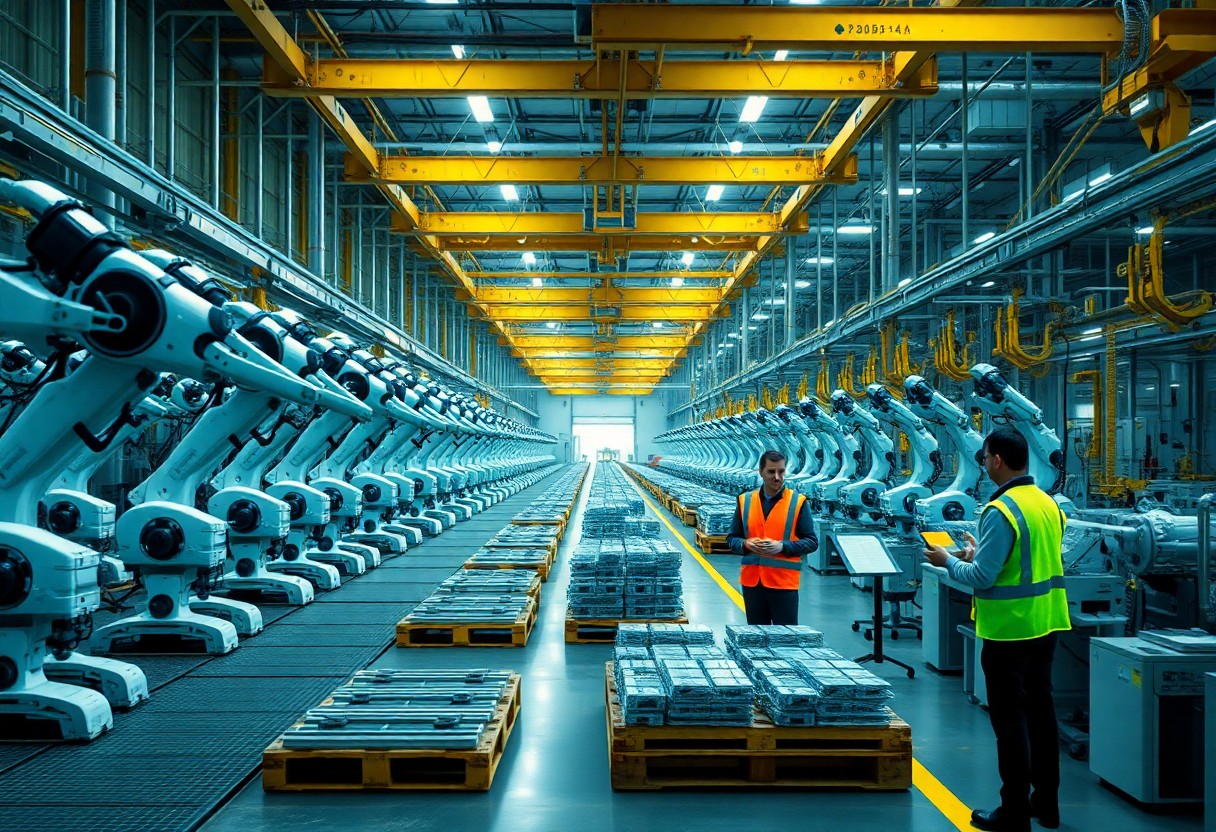
Across heavy industry and fulfillment you see robots tackling tasks once reserved for skilled technicians: arc welding and palletizing in automotive plants, micro-assembly in electronics, and autonomous mobile robots (AMRs) in warehouses. You’ll find hundreds to thousands of articulated robots in a single car factory, delta robots achieving sub-second pick cycles on electronics lines, and cloud-connected fleets that feed production KPIs into MES for real-time optimization, delivering measurable uptime and quality improvements while scaling repeatable operations.
Manufacturing
You optimize lines with a mix of 6-axis articulates for welding and dispensing, SCARA and delta for high-speed assembly, and collaborative cobots for human-in-the-loop tasks. ISO 10218 and ISO/TS 15066 shape your safety validation, and you tune payloads (from <1 kg to >1,000 kg) and reach to balance cycle time and floor space. OEMs like FANUC, ABB, and KUKA dominate heavy cells, while you pilot vision-guided bin-picking to cut changeover time and defect rates substantially.
Logistics and Supply Chain
You deploy AMRs and automated sortation to compress order-to-ship times: mobile fleets from tens to thousands of units enable dynamic slotting and reduce manual travel time. Market leaders such as Amazon (Kiva) and Ocado demonstrate how grid and swarm approaches scale throughput while integrating with WMS and TMS, and you measure success in picks-per-hour, labor hours saved, and reduced dwell time across the distribution network.
You must integrate fleet orchestration, WMS, and real-time inventory to unlock full value: path planning, charge-management strategies (opportunistic charging or battery swaps), and collision-free routing determine uptime. You’ll evaluate KPIs like orders per hour, mean time between failures, and payback horizon (often 12-36 months), and pilot with a focused SKU set-proven pilots commonly expand to multi-site rollouts once throughput and ROI are validated.
Technological Innovations Driving Scale
You leverage modular hardware, edge computing, and open standards to move pilots into mass deployments: modular cobots cut integration time by ~50%, edge inference latencies under 10 ms enable closed-loop control, and digital twins can reduce commissioning time by about 30%, so you scale from dozens to thousands of units while holding per-unit OPEX and integration risk down.
AI and Machine Learning
When you apply reinforcement, imitation, and transfer learning, robots generalize to new parts and tasks with far less hand-coding; transfer learning can cut labeled-data needs by ~70%, vision transformers push pick accuracy above 98% in industrial bin-picking pilots, and predictive analytics often reduce unscheduled downtime by 20-30% in factory deployments.
Advanced Sensor Technologies
You combine LiDAR, time-of-flight and stereo 3D cameras, force-torque sensors and high-density tactile arrays to reach sub-millimeter alignment and millimeter-level localization; sensor refresh rates up to 120 Hz and falling hardware costs let you implement dynamic safety zones and reliable perception in cluttered, fast-moving production lines.
You integrate sensor fusion on edge nodes to merge IMU, vision and force data so you can handle occlusion, vibration, and contact variability; that approach helps you sustain ~99% pick-and-place success in mixed-bin scenarios, reduces rework by roughly 40% with tactile feedback, and shortens calibration from days to hours using automated routines.
- You deploy LiDAR and ToF for robust distance mapping and dynamic obstacle avoidance.
- You use 3D stereo and structured-light cameras for precision bin-picking and assembly alignment.
- You instrument end-effectors with force-torque and tactile sensors for compliant insertion and quality checks.
- You add environmental sensors (temperature, humidity, vibration) to feed predictive maintenance models.
Sensor vs Impact
| LiDAR / ToF | Enables real-time 3D mapping and obstacle detection at ranges of meters with <10 ms update cycles |
| 3D Vision (stereo, structured light) | Delivers sub-millimeter alignment for assembly and >98% bin-picking accuracy in trials |
| Force-Torque & Tactile | Provides compliant control and reduces mechanical rework by ~40% through contact sensing |
| IMU / Environmental Sensors | Supports sensor fusion for localization and feeds predictive models to cut downtime 20-30% |
Economic Impact of Robotics
Across sectors you see measurable shifts: the World Economic Forum estimated automation would displace 85 million jobs while creating 97 million new roles by 2025, shifting labor toward tech-heavy positions. In manufacturing and fulfillment, deployments commonly improve throughput 20-40% and cut error rates, while also lowering injury claims and boosting asset utilization-effects you can quantify on balance sheets and workforce planning models.
Job Creation vs. Job Displacement
Rather than a simple net loss, you observe role transformation: routine manual tasks decline while demand rises for robot technicians, systems integrators, and data analysts. Automotive lines that adopted robotics often reallocated workers into inspection, programming, and maintenance roles; logistics hubs similarly created automation operators. Active reskilling programs typically convert a portion of displaced staff into higher-paying technical positions within 6-18 months.
Cost-Benefit Analysis for Businesses
When you model investments, factor CAPEX, integration, uptime, and labor delta: many repetitive tasks show payback in 1-3 years, especially with cobots priced $20k-$40k and cell robots delivering 20-40% productivity gains. Include reduced overtime, fewer quality defects, and lower injury-related costs to calculate ROI; financing, leases, or tax incentives often flip borderline projects into clear winners.
Total cost of ownership hinges on integration and software: plan for system integration equal to 20-40% of robot hardware costs and annual maintenance around 5-10% of CAPEX. Use digital twins and simulation to cut commissioning time by up to 30%, and evaluate leasing or accelerated depreciation to improve cash flow-practical levers that materially change project economics in your favor.
The Future of Robotics in Industry
You should plan for robotics to become embedded infrastructure rather than standalone experiments: AI-driven vision, edge compute and 5G will tie robots into real-time production loops, digital twins will let you simulate changes before deployment, and examples like Amazon’s >200,000 warehouse robots show scale is achievable; expect typical payback windows in high-volume lines to compress toward 12-24 months as you standardize hardware and software stacks.
Trends to Watch
Expect modular cobot cells, cloud-orchestrated fleets, and AI-native vision systems to dominate new installs; 5G’s sub-10 ms latency and edge inference let you run closed-loop control off-site, while partnerships such as Siemens and NVIDIA on digital twins demonstrate how simulation-driven commissioning can cut ramp-up time by weeks in complex lines.
Potential Barriers to Growth
You will confront integration complexity, cybersecurity exposure, and a skills gap: legacy PLCs and proprietary vendor stacks often force custom adapters, security incidents can be costly, and hiring automation engineers is competitive-these frictions slow enterprise rollouts despite technical readiness.
In practice, a single cyber incident can cost millions (IBM’s breach analyses cite average costs near $3.8-4.0M), supply-chain lead times for specialty actuators or vision sensors can extend 6-12 months, and integration effort commonly adds weeks to months per line; to mitigate this you should budget explicit system-integration phases, adopt open standards where possible, and invest in cross-training to reduce deployment risk.
Summing up
To wrap up, as you move from proof of concept to full-scale deployment, align technical maturity, workforce skills, and supply-chain readiness so your robotics program delivers repeatable performance, measurable ROI, and compliant safety. Focus on modular designs, robust analytics, and governance to scale efficiently while reducing operational risk and unlocking sustained productivity gains across your operations.