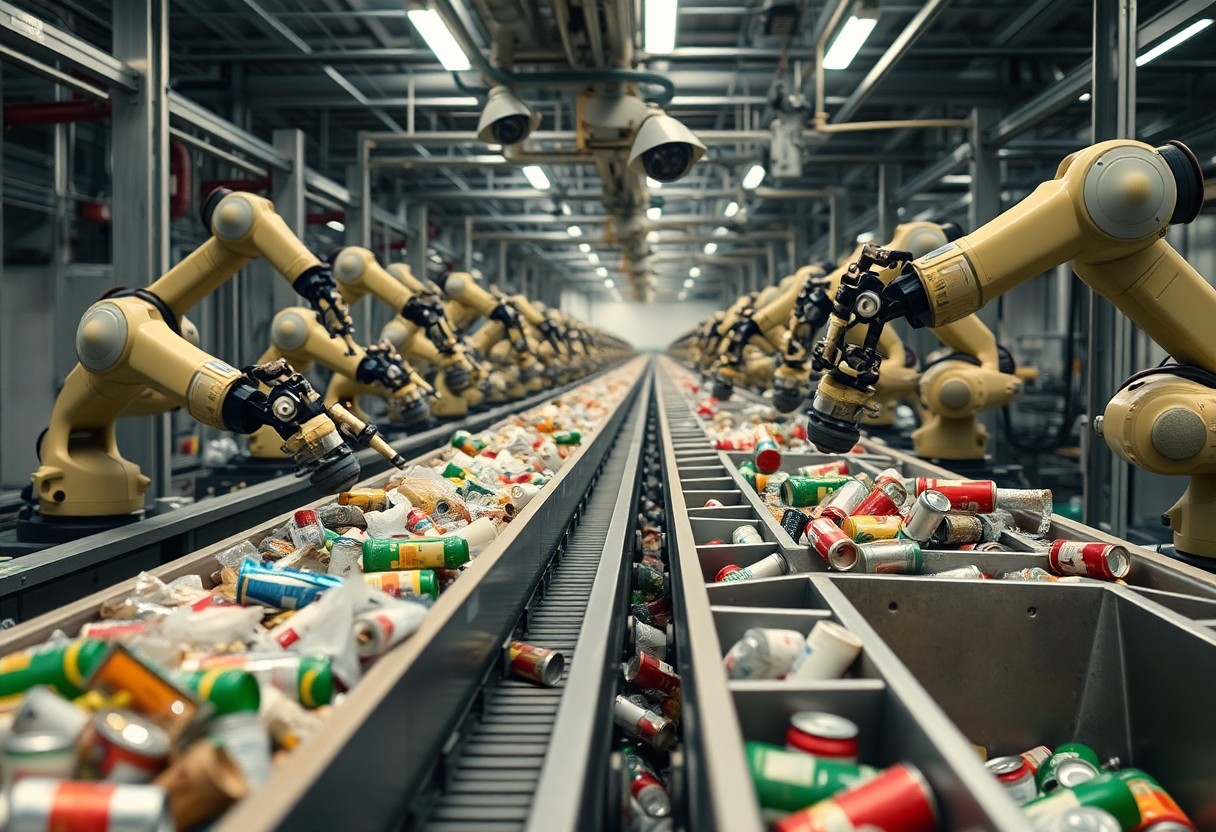
With robotics transforming waste management, you can scale automated sorting to improve material recovery, reduce contamination, and decrease labor risks while accelerating throughput. By combining machine vision, AI-driven classifiers, and adaptive grippers, your facility gains precision in identifying plastics, paper, and metals, enabling consistent quality output and cost-effective operations as volume rises. Effective deployment aligns sensors, software, and workflow design for measurable environmental and economic returns.
The Importance of Recycling
As you scale automated sorting, the broader impacts of recycling become measurable: recycling aluminum uses up to 95% less energy than primary production, only about 9% of plastic ever produced has been recycled, and U.S. municipal recycling hovers around 32% overall. Cities that invest in systems and policy-San Francisco reached roughly an 80% diversion rate-show how higher recovery and cleaner streams translate into lower emissions, stronger markets, and more resilient local infrastructure.
Environmental Benefits
You gain immediate environmental returns from better sorting: recycling aluminum slashes energy use by about 95%, recycling one ton of paper saves roughly 17 trees and substantial water, and diverting organics and food waste cuts methane from landfills-methane is about 28 times more potent than CO2 over 100 years (IPCC AR5). Cleaner bales also reduce downstream contamination, making end-markets more viable and lowering lifecycle greenhouse gas footprints.
Economic Impact
You should weigh the sector’s economic scale: U.S. recycling and reuse activities supported roughly 681,000 jobs, generated about $37.8 billion in wages and $5.5 billion in tax revenue (EPA, 2016 REI). Policy shifts like China’s 2018 National Sword forced municipalities to rethink economics, and investments in automation now help you reduce contamination, recover higher-value commodities, and stabilize revenue streams.
If you evaluate capital and operating effects, expect tangible metrics: tipping fees commonly range $30-$80 per ton across regions, and reducing contamination or improving recovery by even 5-15% can materially increase bale prices. Many operators report payback windows of roughly 2-5 years on sorting automation through labor savings, higher yields, and avoided disposal costs; scaling robotics can raise throughput and purity, directly improving your facility’s margin and market access.
Current Challenges in Waste Sorting
You face rising complexity as mixed streams, seasonal spikes, and stricter end-market specifications strain plants that process 50-500 tons/day; labor shortages and variable feedstocks drive inefficiency, while technology gaps limit yield. A recent synthesis, A review of smart solutions for waste collection, sorting …, highlights how inconsistent packaging formats and contaminant thresholds (now often under 1% for exported bales) are forcing you to rethink automation strategies to maintain throughput and material quality.
Manual Sorting Limitations
When you depend on manual pick lines, throughput and consistency suffer: human teams struggle with repetitive sorting across 8-10 hour shifts, injury and turnover rates increase operational costs, and variability in pick accuracy reduces recoverable material by sizable margins-many facilities report yield swings of 5-20% tied directly to labor variability, making it hard to guarantee feedstock quality for downstream processors.
Contamination Issues
Food residues, soiled fibers, plastic bags, and mixed polymers create contamination that jams equipment and downgrades bales; you now face tighter market acceptance after policies like China’s 2018 import restrictions forced contamination caps below 1% for many commodities, meaning a single dirty load can render an entire trailer unsellable or require costly reprocessing.
Beyond visible contaminants, chemical and cross-polymer contamination (e.g., PVC in PET streams, battery or aerosol residues) accelerates quality loss: you see lower commodity prices and increased rejection rates, and facilities must invest in wash lines, sensors, or manual rework to recover value-these interventions can raise processing costs and energy use, frequently reducing net recovered material by tens of percent unless you apply targeted automation and better upstream separation.
Robotics Technology Overview
You’ll encounter sensor fusion architectures combining RGB, NIR/hyperspectral cameras, lidar and weight sensors to ID materials at conveyor speeds; integrated PLCs and edge GPUs reduce inference latency below ~50 ms so pickers maintain throughput of multiple tons per hour. Vendors like AMP Robotics and ZenRobotics pair vision models with 6-axis arms or delta pickers to push sort accuracy toward industry-leading benchmarks, while modular cell designs let you scale by adding parallel pick stations or inline reject conveyors.
Types of Robots Used
You’ll typically deploy four classes: 6-axis articulated arms for bulky or irregular items, delta robots for high-speed lightweight pick-and-place, collaborative robots for mixed manual-robot lines, and autonomous mobile robots for internal transport and buffering. Examples include Fanuc/ABB arms handling bulky e-waste and delta systems achieving several hundred picks per hour on light recyclables. Any deployment should align robot selection with feedstock variability, throughput targets, and available maintenance resources.
- 6-axis articulated: heavy-duty sorting, complex orientations, high reach.
- Delta pickers: sub-second cycle times for light items and mixed streams.
- Cobots: safe human-robot interaction for partial automation and quick changeovers.
- AMRs: flexible conveyor alternatives for dynamic line layouts and buffering.
| Robot Type | Use Case / Typical Throughput |
|---|---|
| 6-axis articulated | Bulk items, e-waste; 30-200 picks/hr, handles loads to ~20 kg |
| Delta / SCARA | High-speed light fractions; 400-1,200 picks/hr on plastics/paper |
| Collaborative (cobots) | Hybrid lines, low to mid throughput; 50-150 picks/hr with human oversight |
| Autonomous Mobile Robots | Internal transport, dynamic buffering; flexible m/min movement, reduces fixed conveyors |
Machine Learning and AI in Robotics
You’ll rely on convolutional and transformer-based vision models, often pretrained and fine-tuned on labeled waste datasets to classify polymers, paper grades, and mixed contaminants; many deployments use edge inference on NVIDIA Jetson/Xavier or industrial GPUs to sustain 30-60 fps at line speeds. Integrations with PLCs and SCADA let you convert per-item predictions into deterministic pick paths and reject actions while logging data for continuous improvement.
You should expect a stack combining supervised classification, object detection (YOLO/Mask R-CNN variants), and instance segmentation for overlapping items, plus domain-adaptation techniques when feedstock changes seasonally. Active learning workflows let operators label edge cases; models retrain on-site or in the cloud weekly, reducing misclassifications over time. Latency, model explainability, and dataset curation matter most when scaling from pilot to multi-line installations.
Automation in Waste Sorting
By integrating robotic pick-and-place arms with hyperspectral cameras, you can move beyond single-stream optical sorters to hybrid lines that handle mixed residential and commercial streams at 10-50 tph per MRF. You’ll see robotics targeting high-value fractions (PET, HDPE, OCC) while optical and air classifiers pre-concentrate streams, cutting manual pick rates by 60-80% and reducing residual contamination by double-digit percentages in many deployments.
Case Studies of Successful Implementations
You can benchmark deployments that combine robotics, AI and legacy sorting: pilots often report 12-24 month payback, measurable purity gains and steady throughput increases, demonstrating repeatable performance when robots focus on defined pick tasks and operators manage exceptions.
- AMP Robotics + Republic Services (pilot, 2019): 3 robotic pickers processed ~9-12 tph total, raised PET recovery by ~27%, pushed mixed-fiber purity toward ~90%, and delivered an estimated payback of 12-18 months.
- TOMRA Autosort upgrade at a large European MRF (2020): integrated optical sorters with robotic pick stations, increased line throughput by ~25% to 25 tph, and improved glass/metal separation to >95% purity.
- ZenRobotics deployment in Northern Europe (2018): robotic arms focused on construction and demolition streams, boosted recoverable metal and wood separation by ~30%, handling ~10-15 tph with 85-92% target accuracy.
- Municipal MRF in North America (hybrid retrofit, 2021): added 4 robotic cells to an existing line, cut manual labor by 70%, reduced residue rates from 18% to 8%, and achieved ROI within two years.
- Private recycling center (single-stream, 2022): AI-enabled robots increased throughput per operator by 3x, decreased contamination of baled PET by ~15 percentage points, and sustained 90%+ sort precision during peak shifts.
Efficiency and Accuracy Improvements
You’ll notice immediate gains in pick speed (robots commonly reach 20-40 picks per minute) and classification accuracy once models are trained on site-specific waste streams; precision for targeted items often climbs from sub-70% with manual picks to 85-95% with AI-guided robotics, cutting rejection and re-sort cycles.
Operationally, you should plan for continuous model retraining using nightly labeled samples and a closed-loop feedback system that flags frequent misclassifications. Implementing active learning can reduce false positives by up to half within weeks, and combined with predictive maintenance you’ll keep uptime above 95%, translating algorithmic gains into sustained tons-per-hour increases and lower per-ton processing costs.
Future of Robotics in Recycling
Advances will let you handle higher variability and tighter end-market specs: expect systems that combine hyperspectral sensing, real-time edge AI, and modular grippers to push sorting purity above current averages. Companies such as AMP Robotics report material-identification accuracies exceeding 90% in pilots, and World Bank forecasts urban waste rising to about 3.4 billion tonnes by 2050, creating urgent scale demands your facilities will need to meet with automated, resilient lines.
Trends and Innovations
You’ll see self-supervised and continual-learning models reducing labelled-data needs by an order of magnitude, while hyperspectral cameras and 3D vision allow resin-level plastic ID and film detection. Robotic end-effectors are shifting to soft, adaptive tooling for irregular items, and cloud-native fleet orchestration enables multiple robots to coordinate throughput-industrial pilots already show pick rates of 20-40 items per minute per robot in mixed-stream trials.
Potential for Expansion in the Industry
Robotics can expand beyond municipal MRFs into e‑waste, construction and demolition debris, organics, and industrial scrap, where higher-value streams justify retrofit investments; a single robotic cell can often add 2-8 tonnes/hour capacity depending on feed, making targeted deployments economically attractive as commodity values rise and landfill costs increase.
More broadly, you can adopt service models like Robotics-as-a-Service to lower upfront barriers-capital expenditures typically sit in the hundreds of thousands to low millions per automated line-while operators realize payback in 2-4 years in many cases through labor reduction, higher recovered‑material yields, and fewer rejects. Regional hubs and mobile sorting units will let you scale robotics into developing markets and seasonal peak operations without full plant rebuilds.
To wrap up
Following this, you can see how robotics transforms recycling by increasing sorting accuracy, throughput, and safety while lowering operational costs; deploying AI-guided robots lets you scale material recovery, adapt to variable waste streams, and meet regulatory and sustainability targets, providing a clear roadmap for integrating automation into your circular-economy strategy.