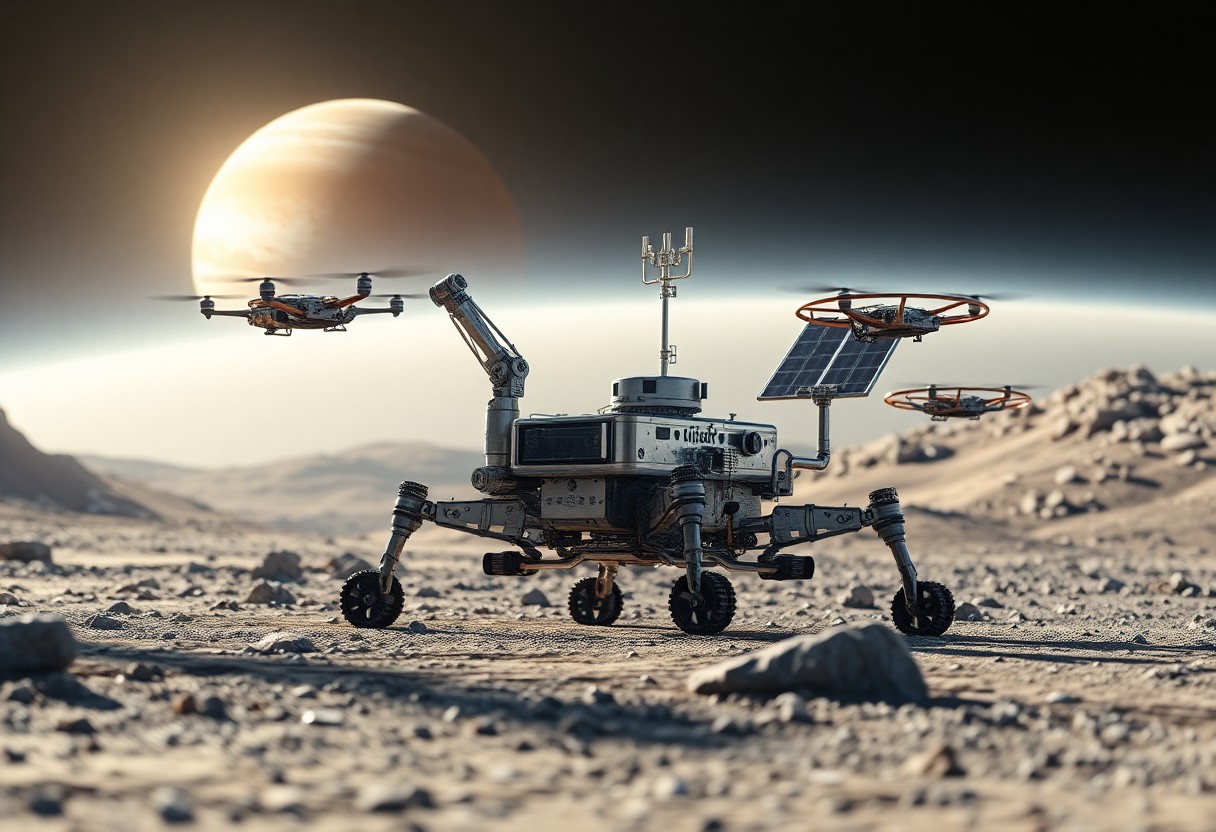
Many autonomous robots now operate beyond Earth orbit, allowing you to explore distant worlds, conduct experiments, and respond to unexpected hazards when real-time control is impossible. These systems rely on advanced perception, navigation, on-board decision-making, fault tolerance, and long-duration energy management so your missions can adapt to delays, radiation, and resource limits. Understanding their design and capabilities helps you plan resilient, efficient exploration beyond Earth’s immediate neighborhood.
The Evolution of Space Robotics
You see a clear arc from tethered manipulators to autonomous explorers: early arm servicers gave way to mobile rovers and now to self-guided servicers and aerial scouts, each phase pushing new mission profiles and operational models. Specific missions-ISS robotics in the 2000s, Mars rovers since 1997, and recent on-orbit servicing demonstrations-show how you now rely on mixed teleoperation and autonomy to extend reach, reduce risk, and enable long-duration tasks far beyond Earth orbit.
Historical Overview
You can trace milestones: Shuttle-era manipulators in the 1980s enabled assembly tasks, Canadarm2 was installed on the ISS in 2001, and Sojourner (1997) proved mobile surface science. Spirit and Opportunity (2004) demonstrated multi-year endurance, Curiosity arrived in 2012, and Perseverance landed on Feb 18, 2021. These examples illustrate how incremental successes built capability and confidence for far-reaching, more autonomous missions.
Key Technological Advancements
You encounter advances in autonomy, sensing, and propulsion that reshaped capability: visual odometry and SLAM for rovers, AI-enabled hazard avoidance on Perseverance, precision landing with Terrain-Relative Navigation, and in-space docking exemplified by Northrop Grumman’s MEV-1 docking with Intelsat-901 in 2020. Those systems let you perform complex tasks-sample caching, precise assembly, and satellite life-extension-without continuous ground control.
You should note technical specifics driving those advances: Perseverance carries 23 cameras and uses TRN to reduce landing uncertainty to tens of meters, Ingenuity achieved the first powered flight on Mars on April 19, 2021, and Hayabusa returned asteroid samples to Earth in 2010 while Hayabusa2 did so in 2020; OSIRIS‑REx delivered Bennu material in September 2023. On-orbit autonomy now fuses machine vision, LIDAR, and model‑predictive control for dexterous manipulation and autonomous rendezvous.
Types of Autonomous Space Systems
You encounter multiple classes tailored to mission needs: rovers/landers, orbiters/satellites, hoppers/drones, free‑flyers, and on‑orbit servicers. Perseverance and Chang’e 5 show how surface systems combine hazard avoidance with sample caching, while MRO and Juno illustrate orbital reconnaissance and autonomous navigation. The table below summarizes five key types and roles.
- Autonomous navigation and hazard avoidance
- Onboard science prioritization and event detection
- Precision landing and sample acquisition
- Relay communications and orbital mapping
- On-orbit servicing and assembly
| Rovers & Landers | Surface exploration, sample caching (Perseverance, Chang’e 5) |
| Orbiters & Satellites | Reconnaissance, relay, mapping (MRO, Juno) |
| Hoppers & Aerial Drones | Short-range mobility and scouting (Ingenuity, Dragonfly) |
| Free‑flyers / Interplanetary Probes | Flyby/long-range science (New Horizons, Voyager) |
| Servicers & On‑orbit Robots | Inspection, refueling, assembly (Restore-L concept, Canadarm2) |
Rovers and Landers
You use rovers and landers to access terrain directly: Perseverance employs Terrain Relative Navigation and autonomous hazard avoidance to drive tens to hundreds of meters per sol while caching samples, and Chang’e 5 executed robotic sampling and returned 1.73 kg from the Moon; autonomy lets you sequence sampling, drilling, and imaging without constant ground intervention.
Orbiters and Satellites
You depend on orbiters and satellites for high-resolution context and communications: MRO’s HiRISE images at ~25 cm/pixel for targeted follow-ups, while autonomous experiments like EO-1’s Autonomous Sciencecraft demonstrated onboard event detection and prioritized downlink, enabling faster reaction to ephemeral phenomena.
Operationally, you benefit when orbiters perform onboard fault detection, trajectory correction, and opportunistic science: Juno relies on autonomous star-trackers and attitude control during high-speed perijove passes, many smallsats run automated collision-avoidance and station-keeping routines, and onboard compression plus event selection cuts bandwidth needs. The combination of onboard processing, anomaly handling, and autonomous targeting increases science return while lowering operational cost.
Current Missions Utilizing Robots
You see robots operating across Mars and small bodies: Perseverance on Mars (landed Feb 18, 2021) and Ingenuity (first flight Apr 19, 2021) are active examples, while OSIRIS‑REx returned Bennu samples to Earth on Sep 24, 2023 and Hayabusa2 delivered Ryugu material in Dec 2020. DART’s Sept 26, 2022 kinetic impact and Psyche (launched Oct 13, 2023) show robotic roles in planetary defense and resource reconnaissance, respectively.
Mars Exploration
You rely on Perseverance (landed Feb 18, 2021) for sample caching toward a future Mars Sample Return campaign and on Ingenuity (first flight Apr 19, 2021) for aerial scouting that extends your reach beyond rover tracks. Curiosity (landed Aug 6, 2012) continues to provide geological context, and orbital assets like MRO supply high-resolution imagery that guides your robot teams to promising outcrops.
Asteroid Mining
You can trace practical steps toward asteroid resource use through robotic sample returns: Hayabusa2 delivered Ryugu samples in Dec 2020 and OSIRIS‑REx returned Bennu material on Sep 24, 2023. DART (impact Sept 26, 2022) demonstrated autonomous navigation for target engagement, while Lucy and Psyche – both robotic – are mapping Trojans and a metal-rich world to inform your prospecting strategies.
You should note that returned samples revealed organics on Bennu and hydrated minerals on Ryugu, validating prospecting priorities and informing extraction concepts such as in-situ water recovery and regolith processing. Autonomous sampling tools, millimeter-scale spectrometers, and terrain-relative navigation techniques tested by these missions form the technological foundation you’d need for any future commercial operations.
Challenges in Autonomous Systems
You face timing, reliability, and environmental threats that strain autonomy beyond terrestrial systems. Limited compute and certification, mission durations of decades (Voyager >45 years), and the need for provable safety force designs that handle radiation-induced faults, hardware degradation, and software updates without constant human oversight.
Communication Delays
With one-way light times from ~1.3 seconds (Moon) to 3-22 minutes (Mars) and tens of minutes for outer planets, you cannot rely on real-time control. Autonomy must perform hazard detection, trajectory correction, and fault recovery locally; Perseverance’s Terrain-Relative Navigation and Hayabusa2’s autonomous guidance show how onboard sensing and closed-loop control handle critical maneuvers.
Environmental Hazards
Radiation, micrometeoroids, abrasive regolith, and thermal swings impose constant risk. You encounter solar particle events that cause bit flips, micrometeoroid impacts that puncture thermal blankets, and lunar temperatures from −173°C to +127°C that stress electronics and mechanisms, so autonomy must anticipate degraded sensors and maintain operation across extreme, sudden changes.
You must design for Galactic Cosmic Rays and Solar Energetic Particles that induce single-event upsets and cumulative damage; radiation-hardened processors like the RAD750 (rated for hundreds of krad) and ECC memory are standard. Combine physical shielding and vaults (Juno’s titanium vault), software fault isolation, triple-modular redundancy, and operational workarounds-OSIRIS-REx altered its sampling plan when Bennu proved rockier than expected-to preserve mission objectives under continual environmental assault.
Future Prospects for Space Robotics
You will see rapid expansion of mixed missions: more on-orbit servicing, lunar infrastructure, and deep-space precursors using systems proven by Perseverance/Ingenuity (Mars 2021) and Canadarm2 (ISS, 2001). Mid-2020s demonstrators like NASA’s OSAM-1 aim to refuel and assemble, showing you how routine repairs and manufacturing in orbit can cut mission risk and costs. Expect task-specific robots alongside generalist platforms, with mission timelines shrinking as autonomy takes on time-sensitive operations that you can no longer manage from Earth alone.
Human-Robot Collaboration
You will rely on shared-autonomy models where humans define goals and robots execute fine motions: teleoperation with supervised autonomy for latency-prone cis-lunar tasks, and local autonomy for time-critical planetary tasks. For example, Canadarm2 enabled remote assembly and capture on the ISS since 2001, and Artemis/Gateway architectures plan telerobotic maintenance from crewed nodes. These hybrids let you intervene on anomalies while offloading routine EVA-like tasks to robotic teammates, improving safety and mission tempo.
AI and Machine Learning in Space
You should expect onboard ML for perception, planning, and fault detection to mature rapidly: Terrain-Relative Navigation on Mars 2020 proved image-based localization can enable pinpoint landing, and AutoNav on Curiosity showed stereo-based autonomy for driving. Given limited radiation-hardened compute (e.g., RAD750-class processors), teams employ model compression and FPGA accelerators to run neural observers and anomaly detectors that let your systems act without ground input.
You will see methods like sim-to-real transfer, domain randomization, and on-orbit continual learning reduce brittleness: teams train millions of synthetic scenarios to teach vision networks to generalize to lunar regolith or asteroid boulders, then distill those networks into compact models for flight CPUs. In practice, mission designers combine supervised classifiers for fault flags, reinforcement learning for adaptive control policies, and unsupervised anomaly detection for health monitoring, enabling your spacecraft to adapt to unmodeled dynamics while keeping compute, power, and radiation constraints in check.
Ethical Considerations
You confront trade-offs between scientific return and planetary protection, data ownership, and liability when robots operate millions of kilometers away; for discussion of field advances see Space Robotics at the Edge of the Unknown. You must weigh who decides on destructive sampling, how you enforce COSPAR planetary protection categories, and how autonomy shifts responsibility from mission control to your onboard systems in high-risk scenarios.
Decision-Making in Autonomous Robots
You face decision stacks that combine rule-based fault protection, model-predictive control, and reinforcement learning; for example, Progress spacecraft have used automated Kurs docking for decades while humans act as backup. You will evaluate your confidence thresholds, explainability requirements, and fallback policies; in tests you should quantify false-positive rates, latency budgets (ms-s for real-time control), and mission-level metrics like sample-collection success rates.
Impact on Future Space Exploration
You’ll see autonomy extend mission reach: robotic precursors like OSIRIS-REx (2016-2023) proved sample-return without crew, lowering risk for your crewed follow-ups. You can leverage robots for sustained operations-long-lived landers and hoppers-to scout resources and test ISRU concepts, accelerating timelines for lunar gateway logistics and Mars architectures while reducing immediate crew exposure to EVA hazards.
Beyond costs, you must account for communications: one-way light time is ~1.3 seconds to the Moon but typically 4-22 minutes to Mars, so you’ll design autonomy to handle target selection, hazard avoidance, and fault recovery without real-time human input. OSIRIS-REx’s 2016-2023 mission and automated docking history show robotics can close mission gaps; you should benchmark autonomy using mission-level KPIs-return probability, mean time between failures, and decision transparency-before committing your crewed architectures.
To wrap up
Upon reflecting, you see that autonomous robots extend your reach beyond Earth orbit by enabling long-duration science, real-time decision-making, and resilient operations in communication-delayed environments. They perform navigation, inspection, sample collection, and maintenance, lowering mission risk and cost while increasing scientific return. As autonomy matures, you will depend on adaptive learning, fault tolerance, and interoperable systems to support human exploration and sustained off-world infrastructure.