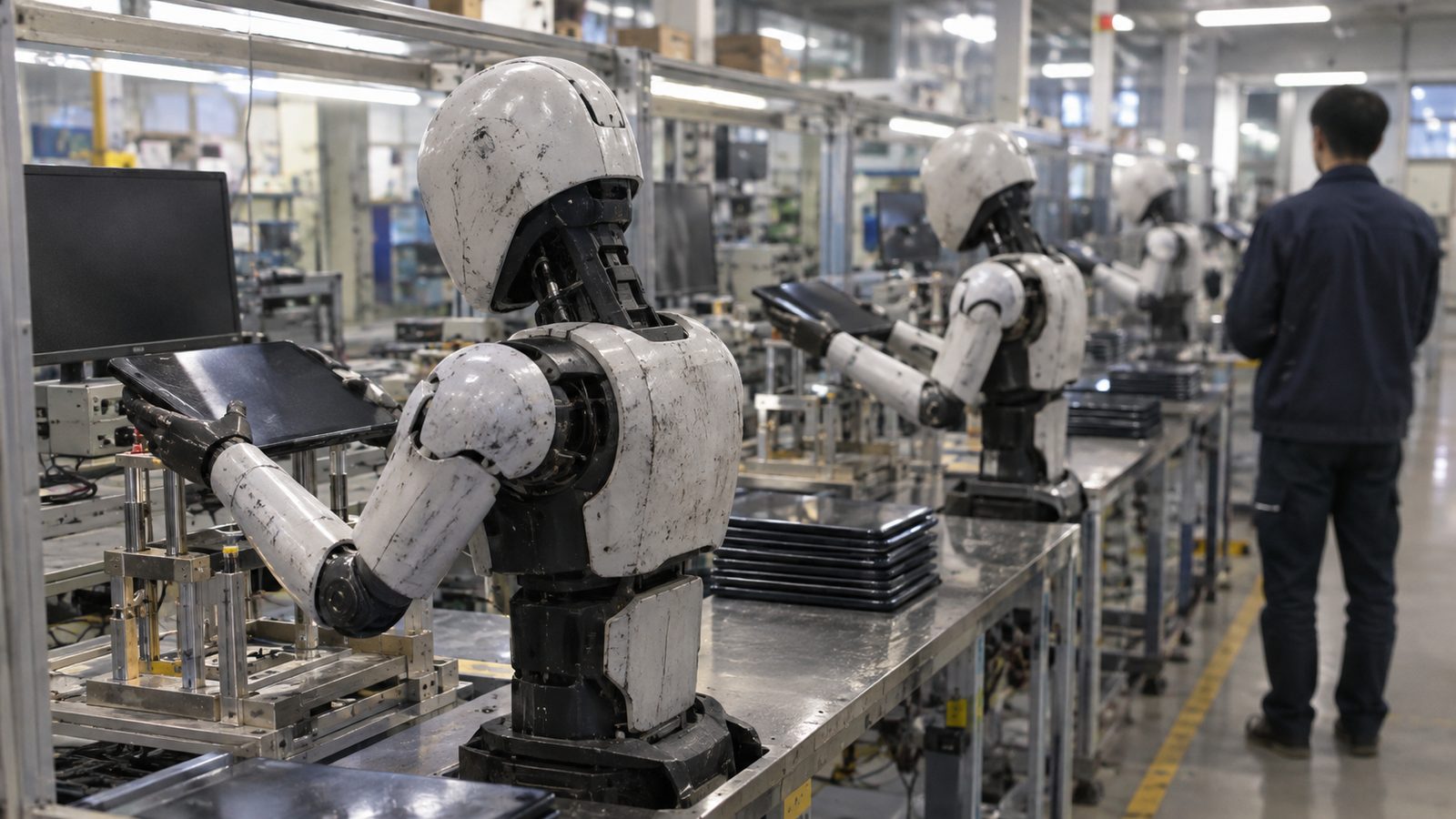
AgiBot’s G2 Humanoid Robots Now Test Tablets on a Live Factory Line
In April 2026, the Chinese robot maker AgiBot said its humanoid robots had started work on a real production line. The line belongs to Longcheer Technology, a company that builds devices for other brands. The robots work in a factory in Nanchang, China. You cannot buy one for your home.
What the robots do on the line
The robots stand at testing stations. Each station checks finished tablets for faults. A robot picks up a tablet and places it into a testing fixture, the holding frame where the checks run.
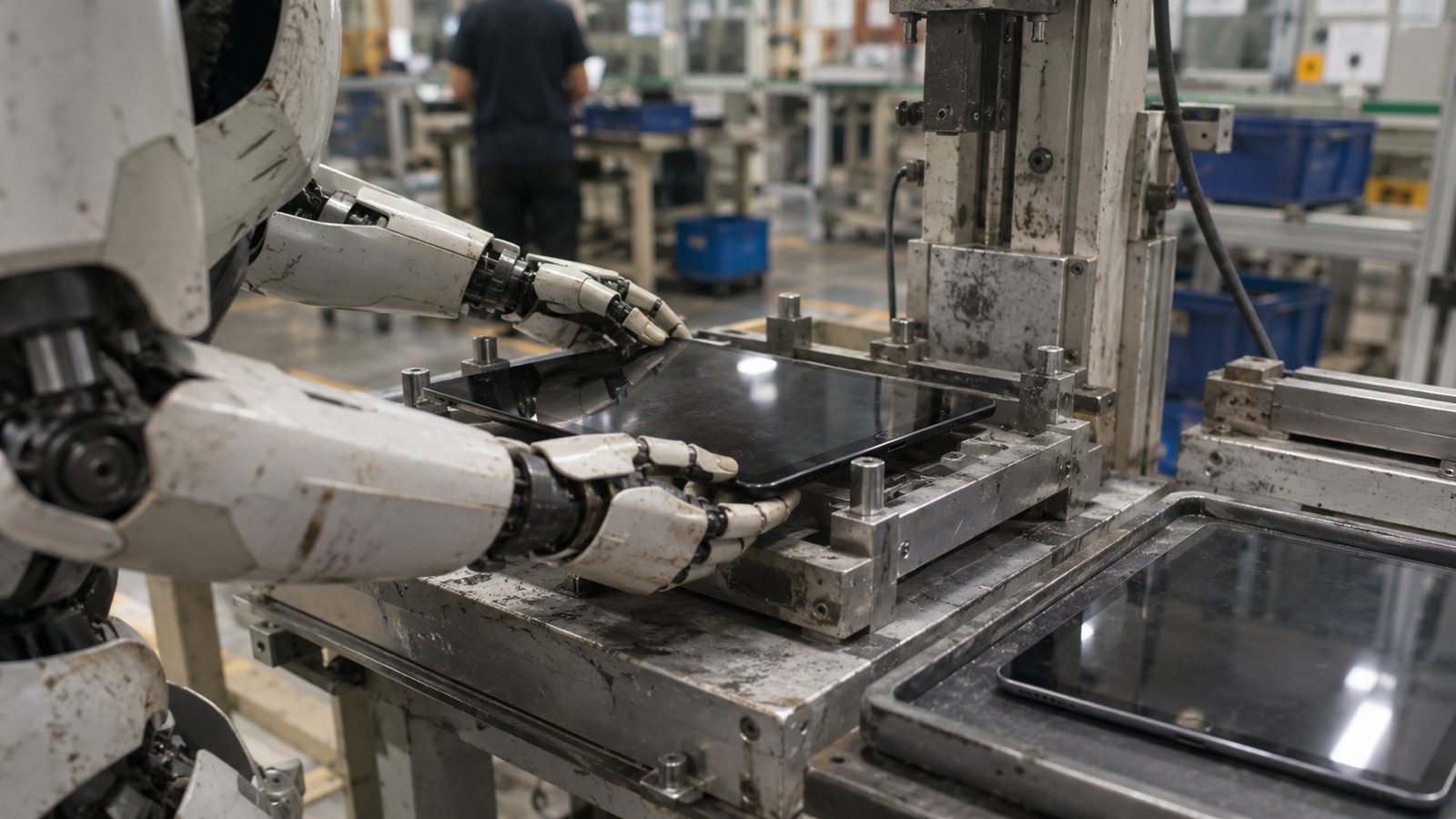
When the test ends, the robot sorts the tablet into a pile of good devices or a pile of faulty ones. The company calls this precision loading and unloading. In plain words, the robot does the handling so a person does not have to.
AgiBot says the robots place each device to within a millimetre. That is about the width of a pencil tip. The company says it wants the robots to be steady enough to repeat this all day.
What the company says the robots achieved
AgiBot reports that the robots handle up to 310 tablets an hour. That is roughly one tablet every 12 seconds. Each robot operation takes about 19 to 20 seconds.
The company also says the robots succeed more than 99 percent of the time while running non-stop. It puts output at about 3,000 units per shift. It says the robots were set up in 36 hours. Longcheer says the G2 went into mass production within four months. It also says the robots have run for more than 140 hours, with less than 4 percent of time lost to stops.
Every one of these numbers comes from AgiBot or its partner. The news reports repeat them. None of the reports includes a test run by an outside group.
What the reports leave out
The announcements do not say how many robots are working on the line today. They give one number for later: AgiBot plans to reach 100 robots by the third quarter of 2026. That is July to September.
No price is given. The announcements also do not say whether people watch the robots, or how often a person has to step in. Those are the questions a factory manager would ask first.
Why it matters to you
If you work on a factory line, this is the kind of job that changes first. It is repetitive, it is checked by machines, and it runs for hours. The same work has been done by people for decades.
If you buy a tablet or a phone, the machine that tested it may have been a robot. You will not see that in the box. Read the company claims with care, though. The strongest case for these robots is that the job is dull and repeated, which suits a machine. The weakest part is that nobody outside the company has tested the numbers.
Watch for two things in the next few months. The first is whether AgiBot reaches 100 robots on schedule. The second is whether it publishes a price, or names other factories that bought the robots.
Sources
- AGIBOT and Longcheer Technology Achieve World's First Embodied AI Deployment in Consumer Electronics Precision Manufacturing Mass-Production Line (AgiBot press release, April 14, 2026)
- 'World's first': AGIBOT G2 humanoid robots run tablet testing on live factory line (Interesting Engineering, April 16, 2026)
- AGIBOT Deploys G2 Humanoid Series for Consumer Electronics Production (Thomasnet)