The drone that bounces instead of flying – and lasts eight times longer
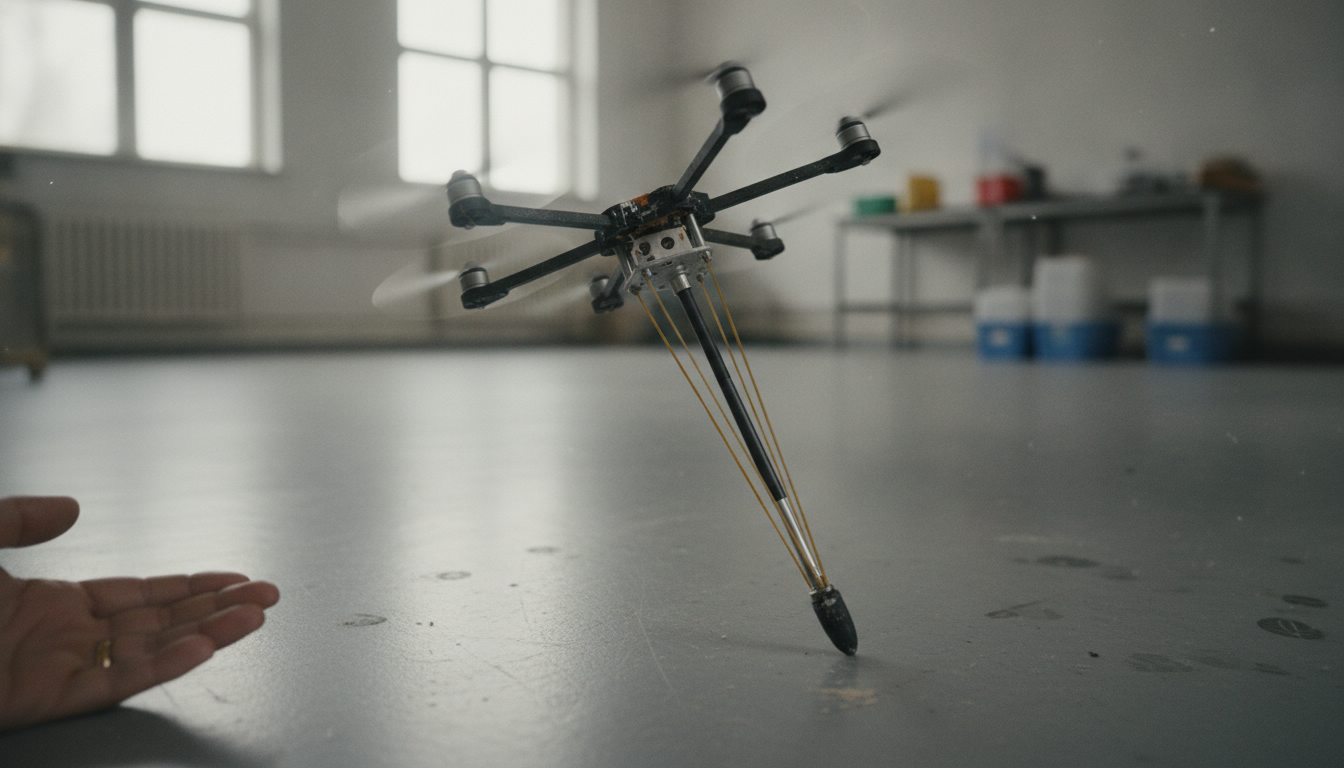
A drone the size of your palm drops onto a thin springy leg, squashes it, and is thrown straight back into the air. Then it does it again. And again.
That is the Hopcopter. Engineers at City University of Hong Kong and the Hong Kong University of Science and Technology built it, and clips of it bouncing keep going round. New Atlas, writing up the research footage, put it plainly: it “might look hilarious in motion”.
The funny part is also the clever part. Bouncing is how this thing stays out eight times longer than a normal drone.
A rubber band does the work the motors used to do
The body is an ordinary mini four-rotor drone, the small kind sold off the shelf to labs and hobbyists. The team bolted a leg underneath it.
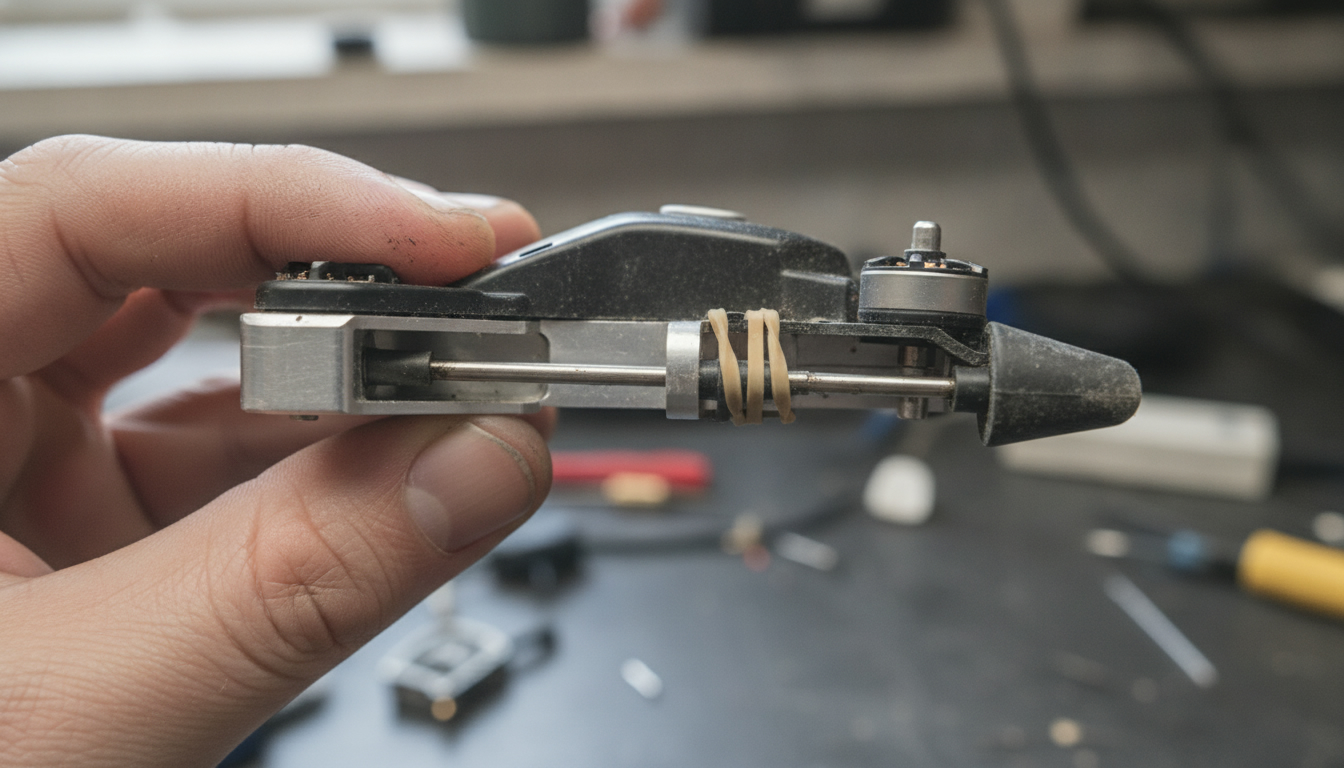
The top of the leg is a stiff carbon fibre rod. A thinner rod slides inside it and ends in a rubber-tipped point. Rubber bands, stretched tight between the two halves, are the spring.
No motor sits in that leg at all. The propellers drive the drone down into the ground, the rubber bands soak up the impact, and the leg flings the machine back up. During the rebound the motors barely work. Researchers call a machine that travels two different ways like this a hybrid locomotion robot.
The whole thing weighs 35 grams, or about 1.2 ounces. The leg is longer than twice the width of the drone’s frame, so it looks like a quadcopter standing on a walking stick.
Fifty minutes of bouncing versus six minutes of flying
A hovering drone burns power every single second it is airborne. That is why most small ones die so fast.
In the team’s tests the Hopcopter kept going for 50 minutes per battery charge while hopping. Flying normally, the same machine managed six minutes. More than eight times the working time, same battery.
Indoors it averaged hops of 1.63 metres, about 5.3 feet, at an average upward speed of 2.38 metres per second, roughly 7.8 feet per second. The researchers say that beats the best agility reported for jumping robots. That is their claim, from their own paper in the journal Science Robotics, published in April 2024 and led by Dr Songnan Bai.
It also strung together 56 jumps in a row and landed upright every time.
It turns by throwing itself at a wall
Here is the trick that makes the footage worth watching twice. The leg does not need flat ground under it.
Change the angle at which the foot meets the floor and the robot rebounds in a different direction. Aim it leg-first at a slope or a wall and it kicks off that instead, snapping into a turn far tighter than it could fly. The team says the same bouncing also softens collisions that would wreck a normal drone.
The leg is passive and simple enough, they argue, to bolt under conventional rotorcraft, so a bigger machine could carry a heavy load in a series of hops rather than one long, draining flight.
Do not expect one in a shop
The uses the researchers name are wildlife monitoring, crop inspection and search and rescue. All three are jobs where flight time, not speed, is the thing that stops you.
Be clear about what this is, though. It is a research prototype weighing about an ounce, with no price, no product and no release date attached to it. A 35-gram machine carries almost nothing.
And the whole scheme depends on something solid to push against. Loose sand, a drainage grate or a staircase takes the spring out of the idea, and the published tests do not settle how it copes with a city pavement. What they do settle is the physics: pushing off the ground now and then costs far less than holding yourself up in the air every second.