What the Numbers on a Robot Battery Actually Mean
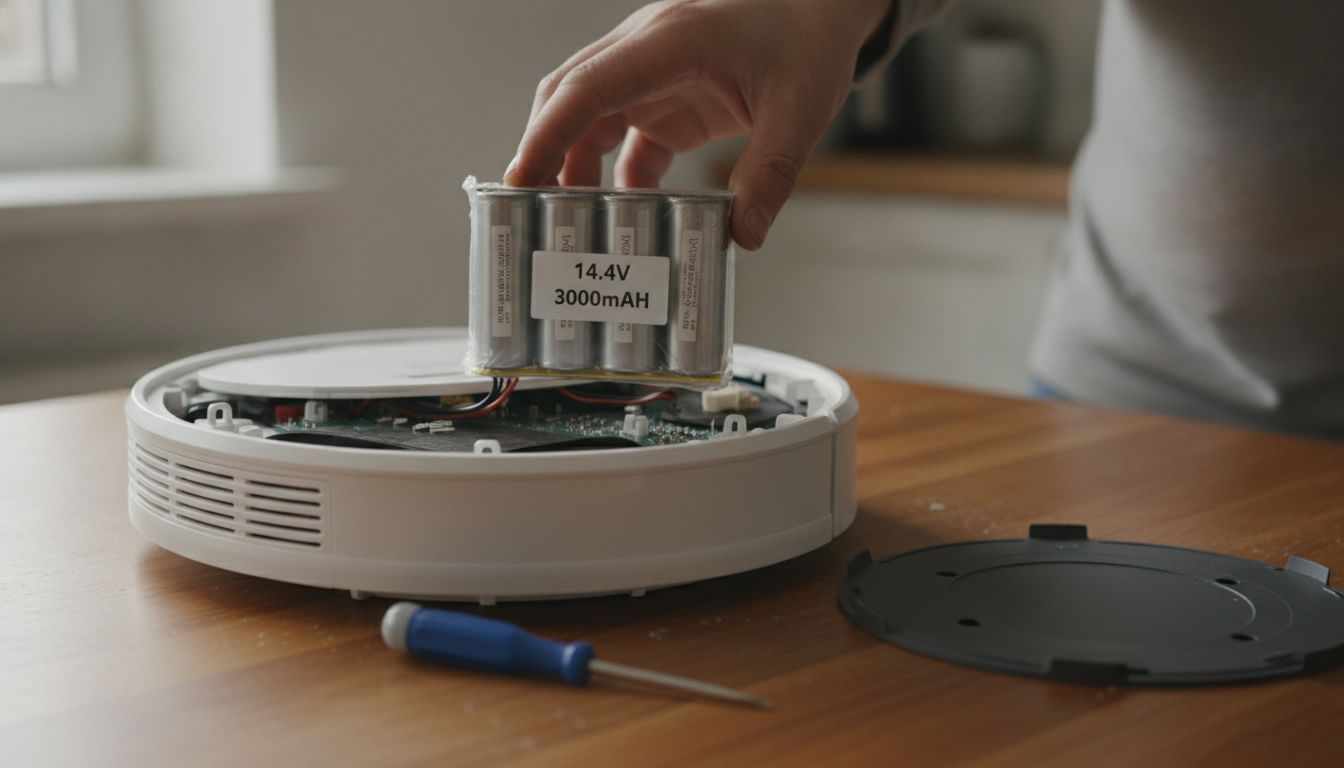
Pull the pack out of a robot vacuum and it usually says something like 14.4 V and 2,400 mAh. A drone battery adds a watt-hour number. A tool pack shouts about a C-rating.
Four or five numbers, and most shoppers guess at all of them. Here is what each one actually buys you, and which one to trust when you compare two packs.
Volts are the push, amp-hours are the size of the tank
One lithium-ion cell sits at about 3.6 volts. That is fixed by chemistry, so makers get more voltage by wiring cells in a chain.
Battery University, the technical library run by battery-test maker Cadex, gives the classic example. Four cells in a chain make a 14.4-volt pack, the number you see in laptops and plenty of home robots.
Wire cells side by side instead and the voltage stays the same while capacity doubles. Two chains of four turn a 2,400 mAh pack into a 4,800 mAh one. On a spec sheet that reads 4s2p: four in series, two in parallel.
Amp-hours (Ah) measure how much current the pack can hand out over an hour. 2,400 mAh is simply 2.4 Ah. Think of volts as water pressure and amp-hours as how much water is in the tank.
Because of that, never compare amp-hours across packs of different voltage. A 2 Ah pack at 36 volts holds far more than a 2 Ah pack at 14.4 volts.
Watt-hours is the only number that compares two packs fairly
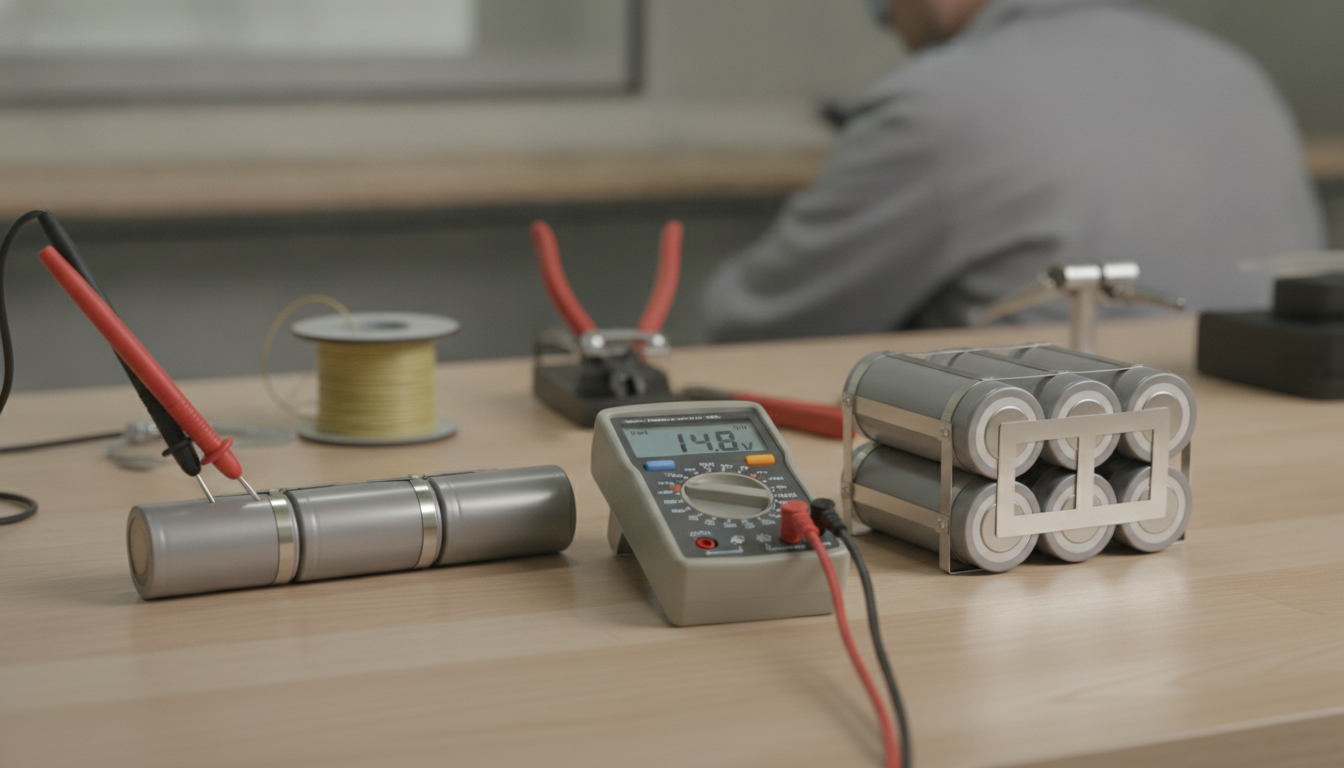
Multiply volts by amp-hours and you get watt-hours (Wh), the actual energy in the pack. A 14.4-volt, 2.4 Ah pack holds about 35 Wh.
Battery University uses a cyclist to explain the difference. How hard you push the pedals right now is watts. How long you can keep going before you are spent is watt-hours.
So if a robot pulls roughly 30 watts while it cleans, a 35 Wh pack gives you a bit over an hour on paper. Expect less in the real world, because hard pulls waste some of the charge as heat.
The C-rate says how fast you are allowed to empty it
C-rate is just a speed limit written as a multiple of the pack’s own size. At 1C, a full pack empties in one hour.
A 1 Ah pack at 1C gives 1 amp for an hour. At 2C it gives 2 amps for 30 minutes. At 0.5C it trickles out for two hours. Those are the published figures; fast discharges lose some time to internal losses.
Drone packs carry high C numbers because hovering drags current hard and constantly. A vacuum crawling around your rug does not, so a high C-rating there buys you nothing.
Cycle life, and how to tell the pack is dying rather than the robot
Makers usually quote 300 to 500 charges for lithium-ion in consumer gear, with phone cells now rated for 800 and up. Battery University warns that counting cycles is rough, because nobody agrees on what counts as one cycle.
How deep you drain it matters more. In their figures, one common chemistry gives about 300 cycles when run flat every time, but about 2,000 when only a fifth is used before recharging.
Heat and storage hurt too. A pack left full for a year at room temperature keeps about 80 percent of its capacity. At 40 °C, roughly a hot garage, that drops to 65 percent. Left at 40 percent charge instead, it keeps about 96 percent.
Here is the tell-tale sign of a dying pack. As cells age, their internal resistance climbs. The voltage then sags under load, the pack warms up, and the machine shuts off early with energy still inside.
So if your robot quits at half its old runtime and the pack feels warm when you pull it, buy a battery, not a robot. Match the voltage exactly, take the same or higher amp-hours, and ignore sellers promising capacity far above the original.
Sources
- BU-402: What Is C-rate? — Battery University
- BU-808: How to Prolong Lithium-based Batteries — Battery University
- BU-501: Basics About Discharging — Battery University
- BU-802a: How does Rising Internal Resistance affect Performance? — Battery University
- BU-302: Series and Parallel Battery Configurations — Battery University
- BU-503: Determining Power Delivery by the Ragone Plot — Battery University
- Watt Hours to Amp Hours Explained — Epoch Batteries