What a Robot Gripper Can and Cannot Pick Up
A common factory gripper can close with 235 newtons of force. That is like leaning on something with about 53 pounds, through two small metal fingers.
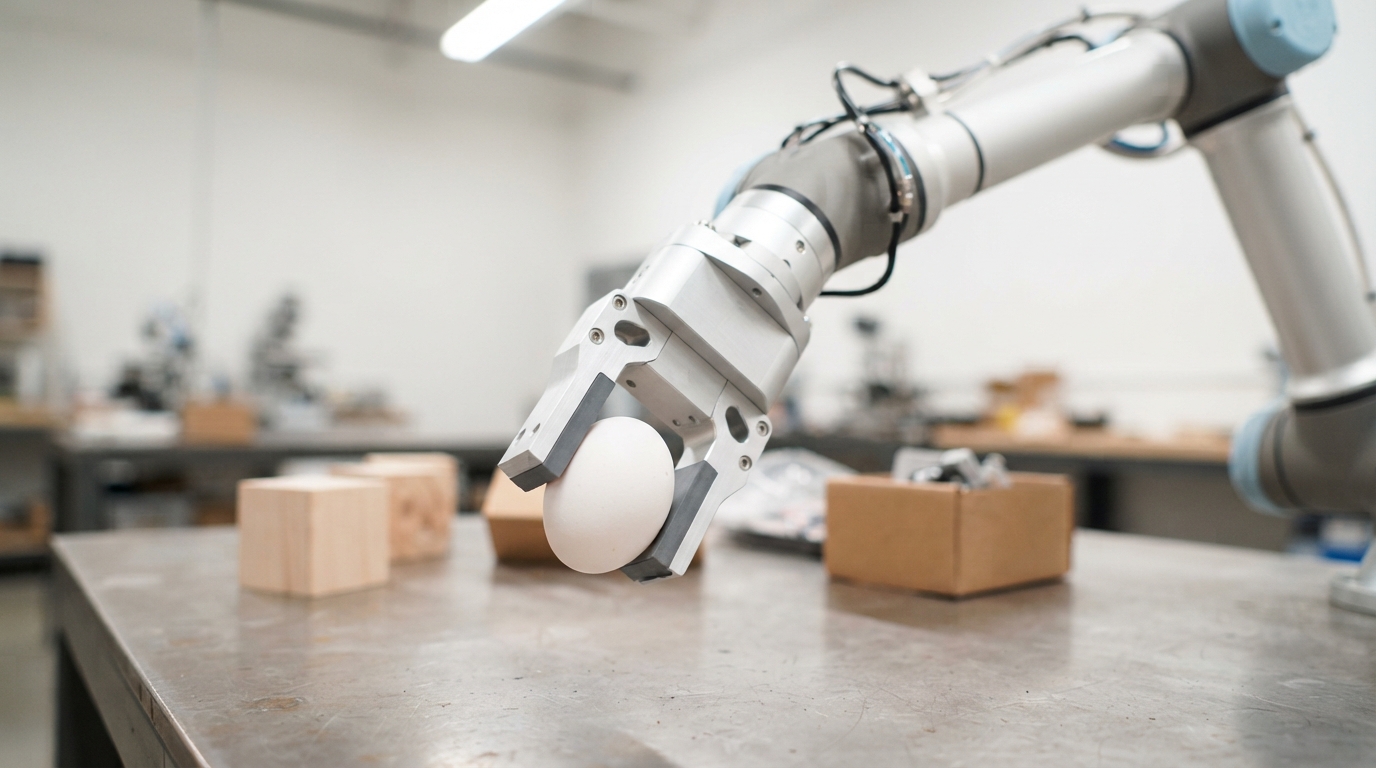
Point that at an egg and you get breakfast on the floor. Point it at a rolled-up sock and it often comes up with nothing. Here is how to tell which way it will go, before the robot tries.
A gripper is just friction fighting gravity
Most robot hands in the world are two flat jaws that close in parallel. They squeeze the object. The rubbing between the pads and the object, the friction, is what carries the weight.
Take one of the most common models on collaborative arms, the Robotiq 2F-85. Its jaws open to 85 millimetres, about 3.3 inches. The squeeze is adjustable from 20 to 235 newtons, and the supplier rates it to carry up to 5 kilos, or 11 pounds.
That one line of numbers already rules out most of your kitchen. Wider than a soda can and the fingers cannot reach around it. Heavier than a full gallon jug and the arm will not hold it.
The squeeze setting is a tightrope. Too little and the object slides out. Too much and you dent it. Jaws that hold a heavy part through a fast swing can crush something delicate if nobody tunes them, as a packaging engineer writing for Packaging Digest puts it.
Suction cheats gravity, until the surface leaks
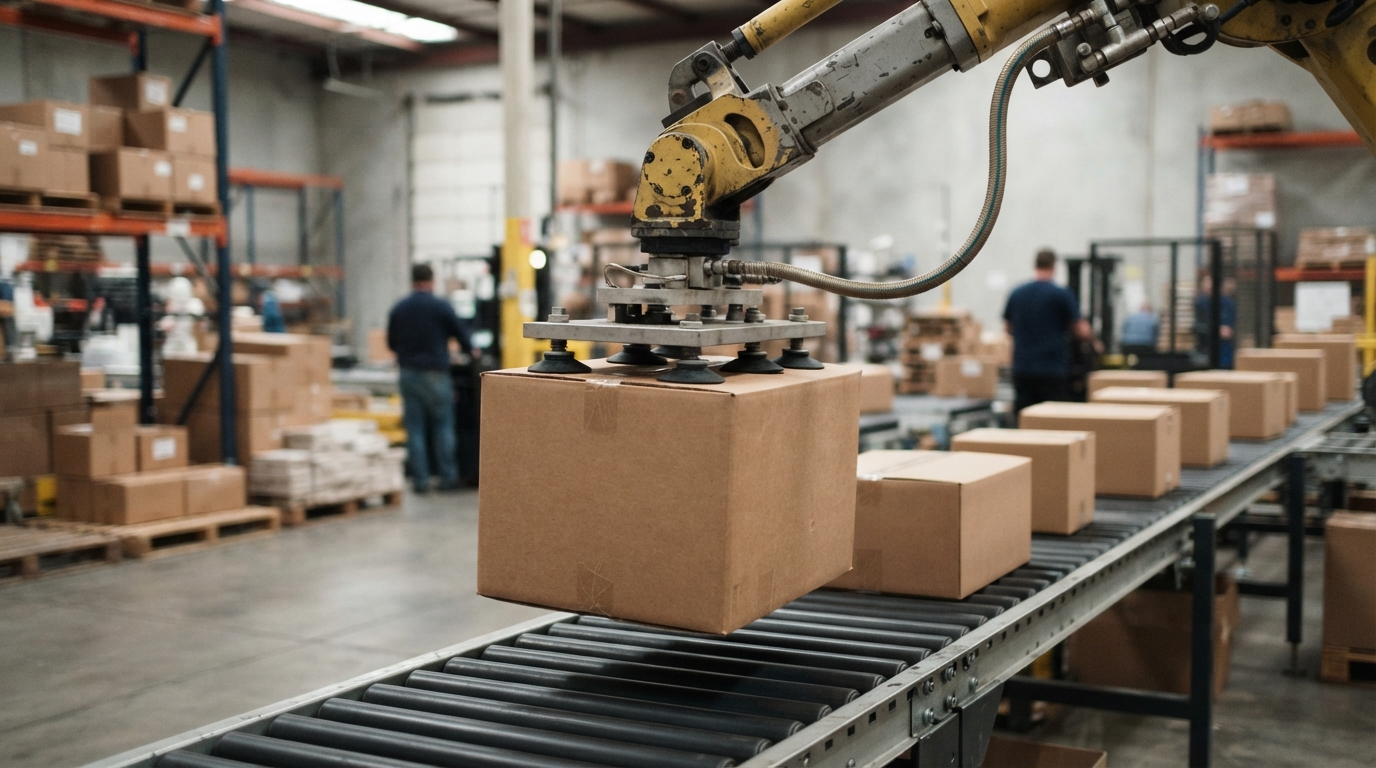
The other big family is the vacuum gripper. Rubber cups press onto one face of the object and a pump sucks the air out. Normal air pressure pushing from outside does the holding.
This is how boxes, sheets and bags get moved. It needs only one side of the object, and it can lift thin or fragile things that jaws would mangle. The trade-off is that the grip is floppier than jaws, so a part can swing loose during a fast move.
Two things break it. A small, dense part does not give the cup enough surface to hold on to. And porous materials leak air, which is why heavy-duty suction systems run on compressed air for high flow rather than small electric pumps.
Foam pads are the in-between option. They mould to odd shapes, but they put the part down less precisely than a cup does.
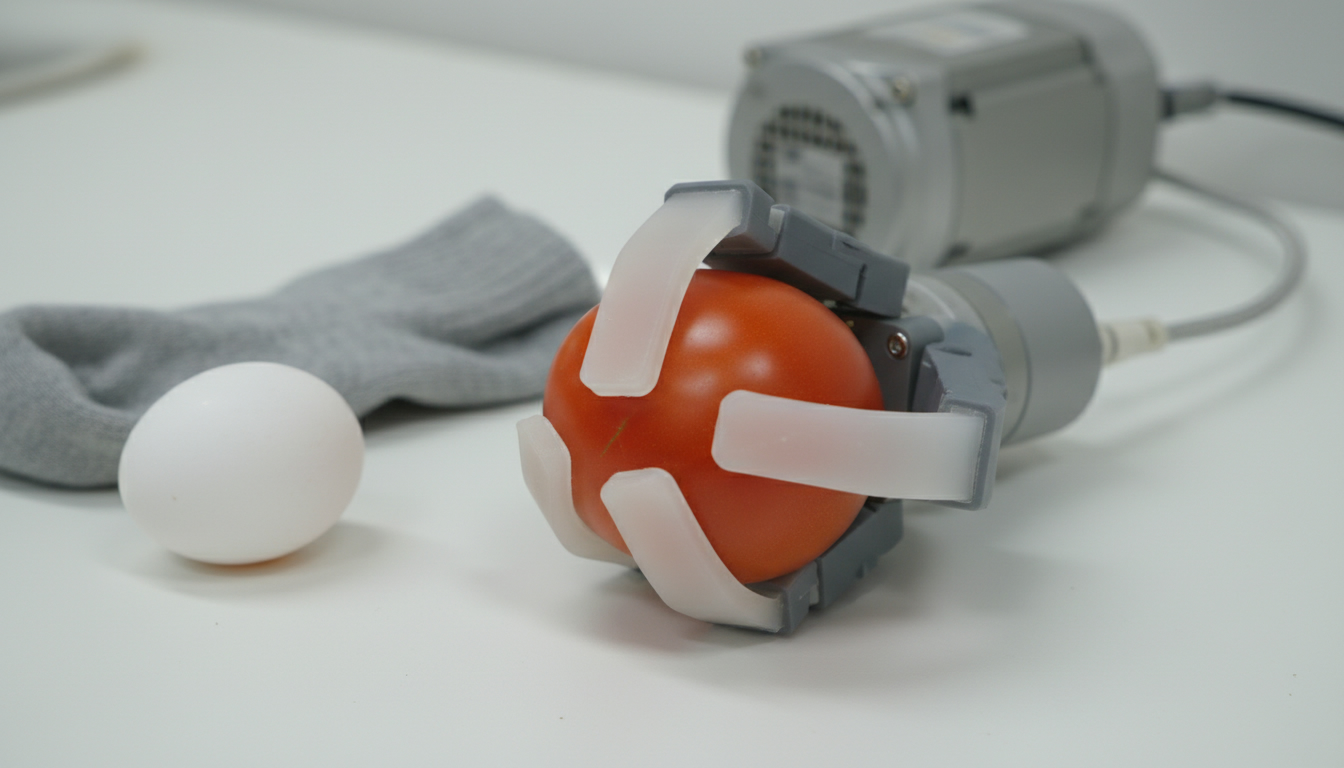
Soft fingers solved the egg. The sock is still open.
Rigid fingers assume the object is neither fragile nor squishy. Soft grippers drop that assumption. A Fin Ray finger is a flexible wedge that bends towards whatever pushes on it, the way a fish fin folds around your finger, so it wraps the object instead of pinching it.
A team writing in the journal Micromachines 3D-printed a three-finger version in one piece, weighing 68 grams, and added force feedback so the squeeze could be watched and adjusted. They picked up raw eggs, tomatoes, dates and longans with it.
Cloth is the one nobody has tidily solved. Researchers at Ghent University say folding stays hard because fabric deforms constantly, and that most folding failures come down to contact and friction. Their robot does not pinch from above at all. It slides the gripper in from the side, underneath the cloth, because a top-down pinch wrinkles it.
Four questions that predict the outcome
- Weight. Is it under the gripper’s rated payload, with room to spare? The weight hangs on friction, not on the metal.
- Shape. Does it have two roughly parallel faces the jaws can press, and does it fit inside the opening?
- Surface. Flat, smooth, clean and airtight means suction works. Dusty, porous or curved means it does not.
- Floppiness. If the thing changes shape as you lift it, a simple pinch will not do. Fabric, bags and loose cable need a different move entirely.
You can spot each failure by eye. An object that twists in the jaws at the end of a fast move was squeezed too lightly. Dented packaging was squeezed too hard. A part dropped halfway through a carry usually means the suction never sealed.
This is also why demo videos of clever robot hands are full of mugs, blocks and apples. Rigid, graspable, predictable. When a company shows you its robot folding laundry, that is the claim worth looking at twice.
Sources
- Robotiq 2F-85 Gripper – product specifications (HowToRobot product catalogue)
- How to select the right gripper for your packaging robot – Packaging Digest
- A 3D-Printed Fin Ray Effect Inspired Soft Robotic Gripper with Force Feedback – Micromachines (PMC)
- Effective cloth folding trajectories in simulation with only two parameters – Frontiers in Neurorobotics