How a Robotaxi Sees the Road, and Why Rain, Fog and Sunsets Still Trip It Up
A robotaxi has no eyes, so it uses three kinds of borrowed ones. Each kind fails in a different way, and that difference is the whole fight between Waymo and Tesla.
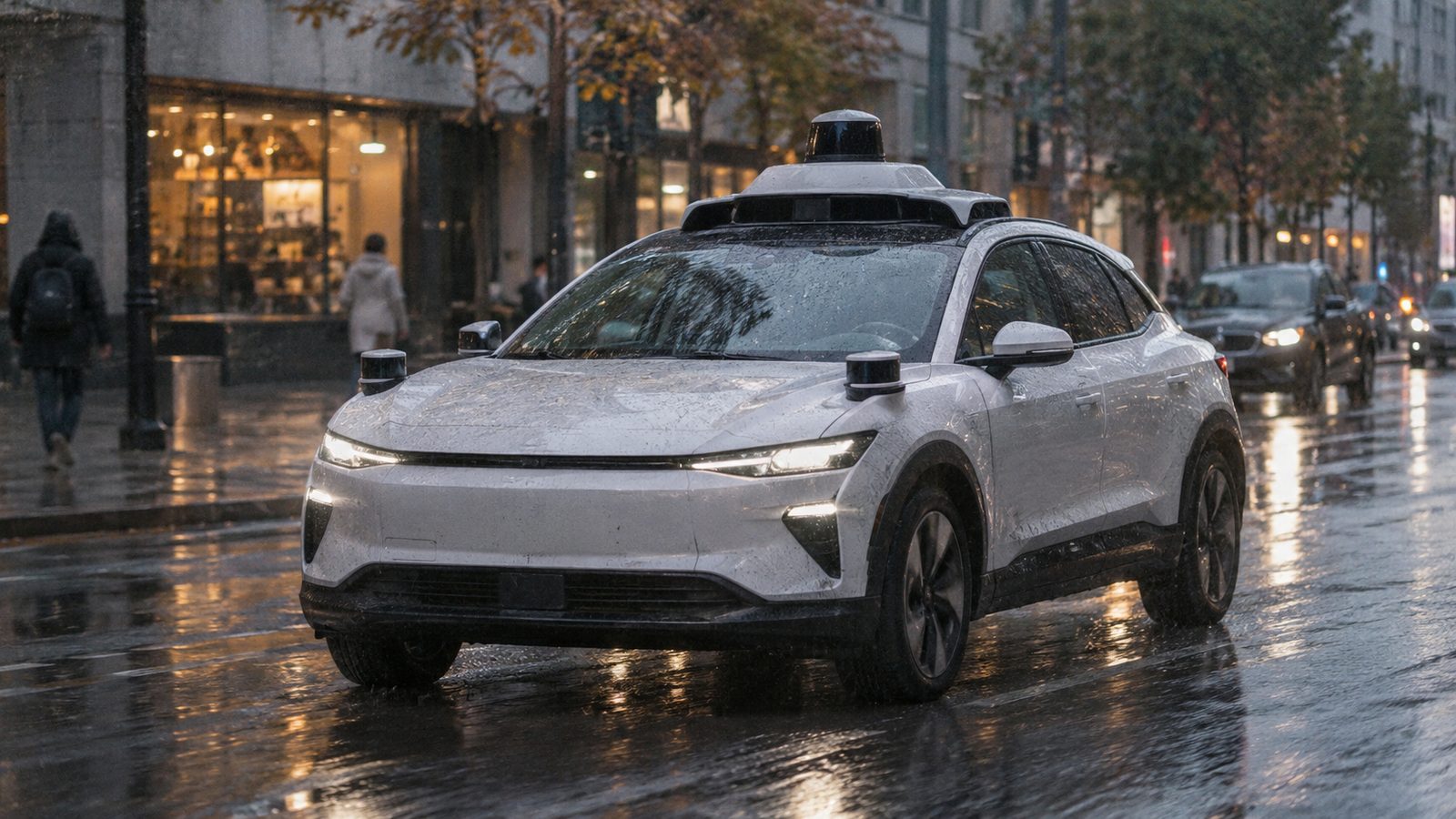
Waymo’s newest car carries 13 cameras, 4 laser scanners and 6 radar units, plus a set of outside microphones. Tesla’s driving software relies on cameras alone. Here is what each sensor actually does, and what happens to it when the weather turns.
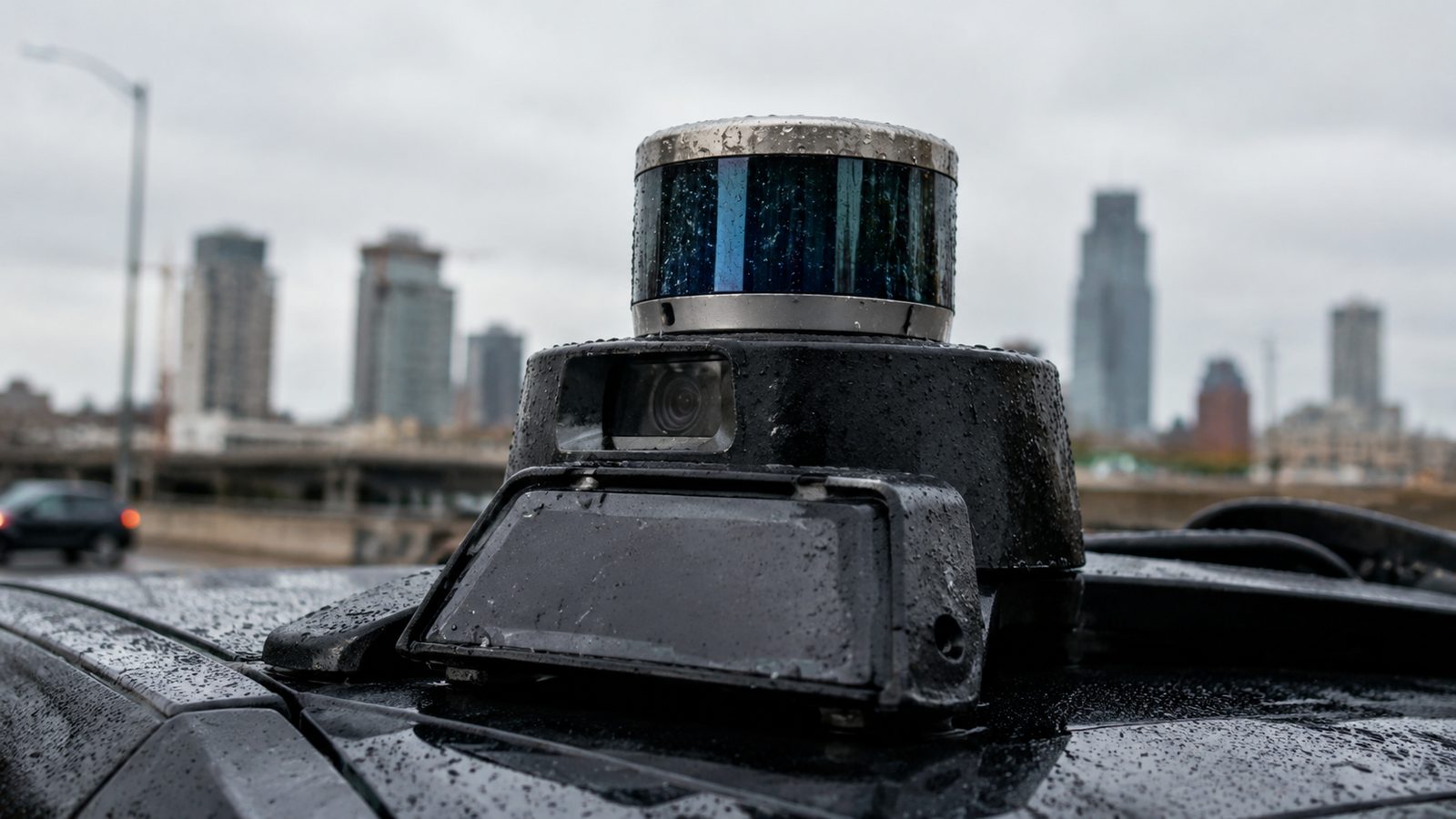
Cameras see the most, but only when there is light
A camera works like your own eye. It collects the light that bounces off the world and turns it into a picture. That makes it the only one of the three that can read a stop sign, tell red from green, or see a police officer waving.
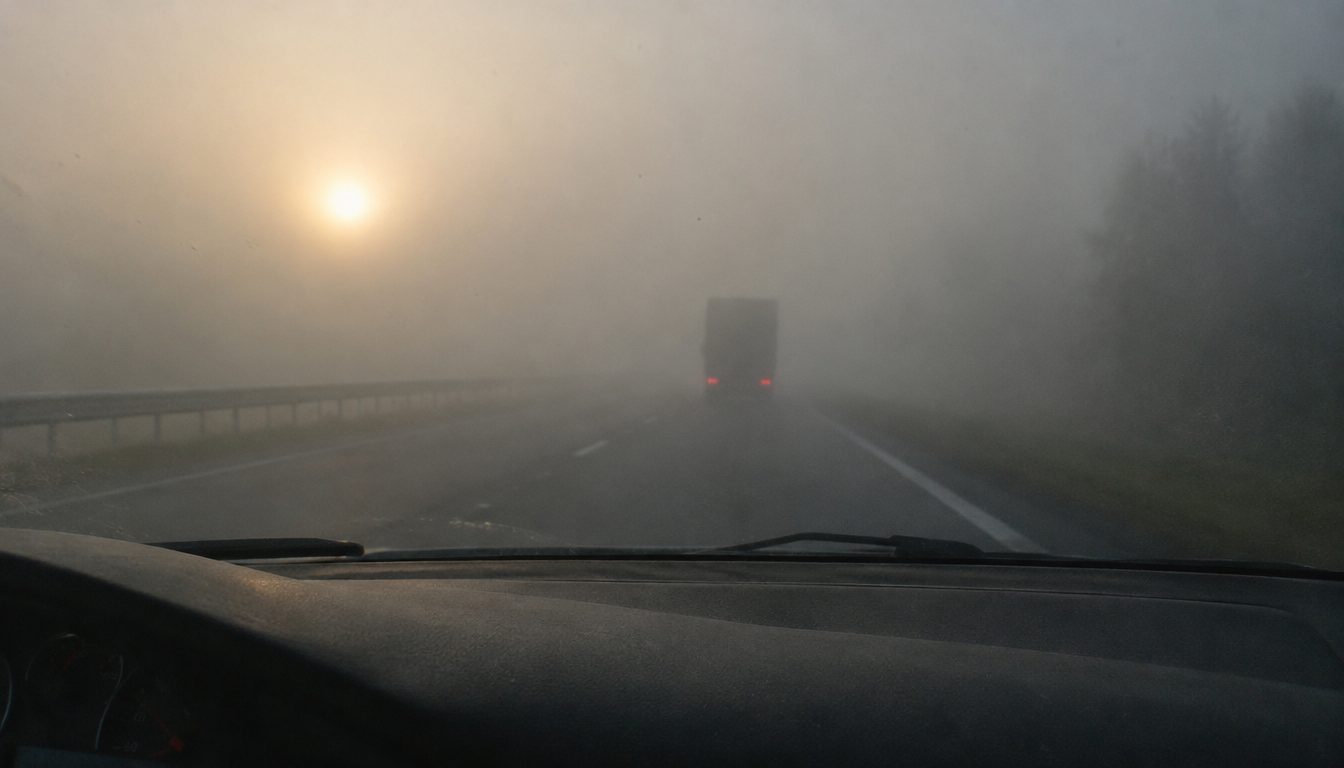
The catch is that a camera makes no light of its own. Rivian, which is adding a laser scanner to its cars, puts it bluntly: cameras are “a passive light sensor,” so they do worse at night and in fog. Low sun, thick dust and water on the lens hit them too. Think of driving into a sunset with a dirty windshield.
A camera also has to guess how far away things are. It works out distance from the picture, the way you judge a car’s distance from its size. Researchers quoted by IEEE Spectrum, the engineers’ magazine, say that guessing goes wrong more easily when a scene is confusing.
The laser scanner brings its own light
A laser scanner (lidar) works like shouting in a canyon and timing the echo. Waymo says its scanners “send millions of laser pulses in all directions” and measure how long each one takes to bounce back. The result is a 3D map of dots, with an exact distance to every object, even in full darkness.
That is its strength. Rivian says a laser scanner “can actually double visibility at night.” Its weakness is that laser light is still light. Researchers who test sensors in bad weather report that cameras and laser scanners both struggle there, while radar barely notices. A laser scanner also cannot read colors, so it cannot tell you whether the light is red.
Radar sees through the weather, but blurrily
Radar sends out radio waves, the same kind of signal your car’s adaptive cruise control may already use. Waymo says its radar uses very short radio waves (millimeter waves) to measure an object’s distance and speed, and that it is “effective in rain, fog, and snow.” One research team writes that radar is “barely affected” by bad weather.
What radar gives up is detail. Its picture is sparse and noisy, a scatter of points rather than a sharp image. Signals can also bounce off shiny surfaces and come back confused. Radar knows something big is ahead and how fast it moves. It struggles to say exactly what it is.
Waymo buys backup. Tesla bets on software
Waymo’s argument is backup. The company says its three kinds of sensors overlap, so when cameras are impaired, the laser scanners and radar keep the car’s view intact. It claims the system sees up to 500 meters away, day and night, and serves riders in fog, rain and hail. Those are Waymo’s own claims, without published test numbers behind them.
Tesla went the other way. In May 2021 it stopped fitting radar to new Model 3 and Model Y cars built for North America. Its then head of artificial intelligence said the camera-only system, trained on a huge library of driving video, beat the old one. Cameras are also cheap, so every car can carry them. Critics answer that one type of sensor means no backup when that type fails.
That worry is now an official question. The National Highway Traffic Safety Administration, the federal road-safety regulator, is investigating Tesla’s “Full Self-Driving (Supervised)” over nine crashes. Its July 2026 letter asks whether the system notices when glare, fog or airborne dust has blinded it, and warns the driver in time. The agency has not found a defect so far.
So what should you expect? In clear daylight, every approach sees well. The differences show up exactly when you would want help most: at dusk, in a downpour, on a dusty road. Those are the moments one company paid extra hardware for, and the other is betting its software can handle.
Sources
- Waymo: Meet the 6th-generation Waymo Driver
- Waymo: The Waymo Driver
- CleanTechnica: New Waymo Driver – Cheaper, Drives in More Weather
- IEEE Spectrum: Tesla Places Big Bet on Vision-Only Self-Driving
- The Drive: Rivian will add lidar in 2026, says Tesla's cameras aren't enough
- Bansal et al.: Pointillism – 3D bounding box estimation with multi-radars (arXiv)
- Sezgin et al.: Safe Autonomous Driving in Adverse Weather (arXiv)
- NHTSA: Information request EA26002 to Tesla, July 2, 2026