

What the Numbers on a Robot Battery Actually Mean
Pick up the battery from a robot vacuum, a drone or a cordless tool. You will see three or four numbers on the label. Most people read the volts and ignore the rest.
That is backwards. The volts tell you the least. Here is what each number means, and what you can do with it.
Only one number lets you compare two packs
Think of electricity as water in a pipe. Volts (V) are the pressure. Amps (A) are how much is flowing right now.
Voltage does not stay still. A lithium cell is full at about 4.2 volts and counts as empty at about 3.0 volts, says Battery University, the reference site run by battery-test equipment maker Cadex. Packs stack cells in a row, so four cells read roughly 16.8 volts full and 12 volts flat. The number on the label sits somewhere in the middle.
Amp-hours (Ah) are the size of the tank. A 1Ah battery can push one amp for one hour. Small packs use milliamp-hours, which are thousandths: 2,600mAh is 2.6Ah.
Now the useful one. Watt-hours (Wh) are volts multiplied by amp-hours. That turns two packs of different voltages into one comparable figure. A 14.4V, 2.6Ah pack holds about 37Wh.
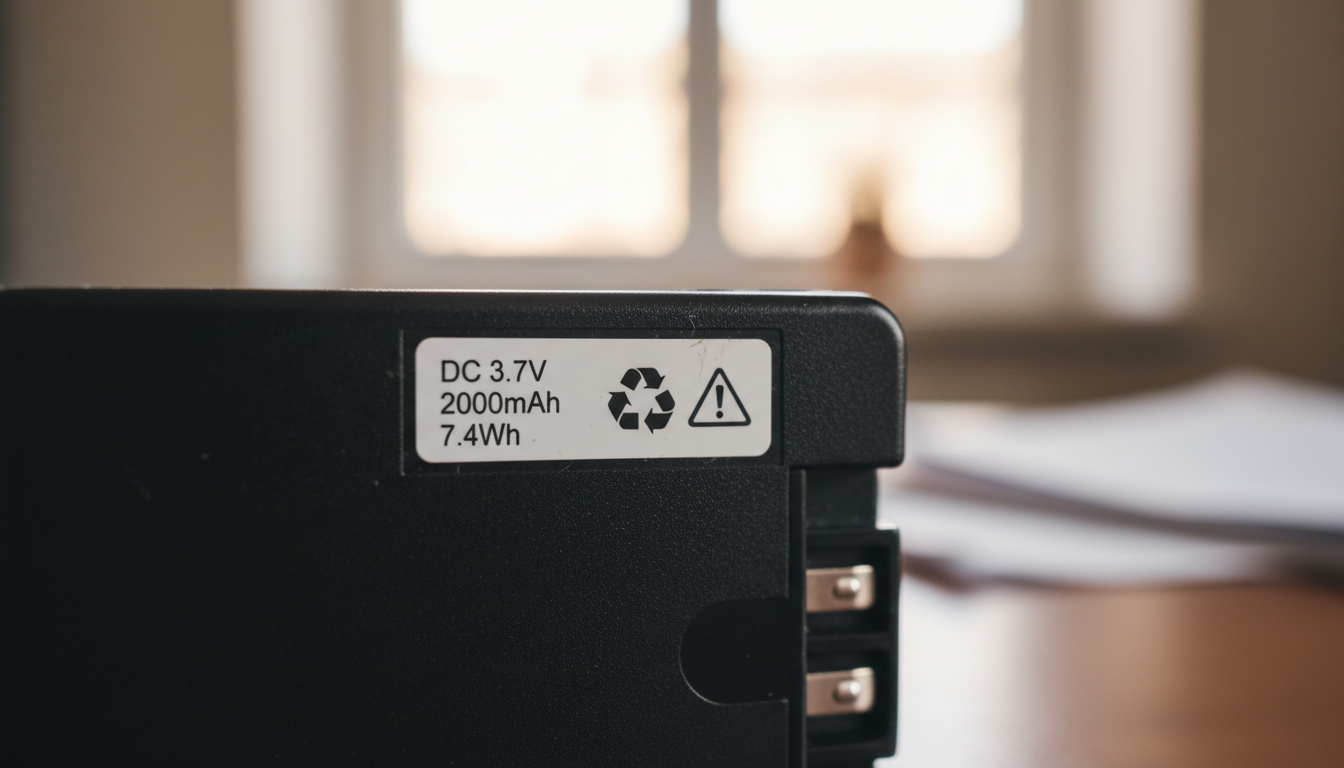
Watt-hours also give you a rough runtime. Divide the watt-hours by the watts the machine pulls. A 37Wh pack feeding a 40-watt load lasts a bit under an hour; some energy always leaves as heat.
Airlines use the same number. The Federal Aviation Administration, the US agency that writes flying rules, allows rechargeable batteries up to 100Wh in carry-on bags. Packs of 101 to 160Wh need the airline’s approval, and you may bring two spares. Above 160Wh they stay home. Spare batteries never go in checked luggage.
The C number says how fast you may empty it
Drone and hobby packs often carry a number like 1C, 5C or 30C. That is the drain rate, measured against the pack’s own size.
At 1C the battery empties in an hour. At 2C it empties in 30 minutes, at 5C in 12 minutes. Battery University lists exactly that ladder.
Pulling harder costs you. Run a cell at 2C and you get roughly 95 percent of its rated capacity or less, because losses inside turn into heat. Everyday cells built for long runtime often have a safety circuit that refuses to discharge faster than 1C. Cells built for punch, the kind in power tools, take up to 10C.
A high C number is not extra capacity. It is permission to drain fast.
Your runtime shrinks because of how you charge
Makers of consumer gear usually rate lithium packs at 300 to 500 charge cycles. In one Cadex lab test, eleven phone cells started at 88 to 94 percent of rated capacity and fell to 73 to 84 percent after 250 full cycles.
How deep you run the pack matters more than how often you plug it in. Charging full and running flat gets a common lithium pack about 300 cycles. Using only 40 percent each time gets about 1,000. Short, frequent charges beat long, deep ones.
Heat plus a full battery does the quiet damage. Stored for a year at room temperature, a pack left at 40 percent charge keeps about 96 percent of its capacity. Left at 100 percent, it keeps about 80 percent. Left full at 40C, roughly a hot garage in July, it keeps about 65 percent.
You notice this as a robot that used to clean the whole floor and now quits in the hallway. The battery did not break. It got smaller.
Store packs half full and cool
For a spare you are not using, aim for roughly 40 to 50 percent charge and a cool spot. Battery University puts the sweet spot near 59F (15C) and says the exact charge level does not have to be precise.
So: the shelf in a hallway cupboard, not the car trunk or the sunny windowsill. A full tool pack baking in the garage all summer is the worst case in that table.
Watch for the warning signs. The FAA describes lithium packs running away into fire when they are damaged, overheated, soaked or overcharged, and sometimes through a factory fault alone, with no warning. A pack that swells, smells, gets hot while idle or smokes is finished. Stop using it, keep it away from anything that burns, and do not take it on a plane.
Sources
- Battery University, BU-402: What Is C-rate?
- Battery University, BU-808: How to Prolong Lithium-based Batteries
- Battery University, BU-702: How to Store Batteries
- Battery University, BU-503: Determining Power Delivery by the Ragone Plot
- FAA, Airline Passengers and Batteries (Guidance and FAQs)
- Watt Hours to Amp Hours Explained