How a Robot Lawn Mower Knows Where Your Yard Ends
A robot mower has no idea where your lawn stops. To the machine, your flowerbed, your driveway and the creek out back all look like more ground to drive on. Somebody has to tell it where the grass ends.
There are three main ways to do that: a buried wire, a satellite position, or a camera that looks for grass. Each one fails in its own way. Knowing which way it fails tells you which mower suits your yard.
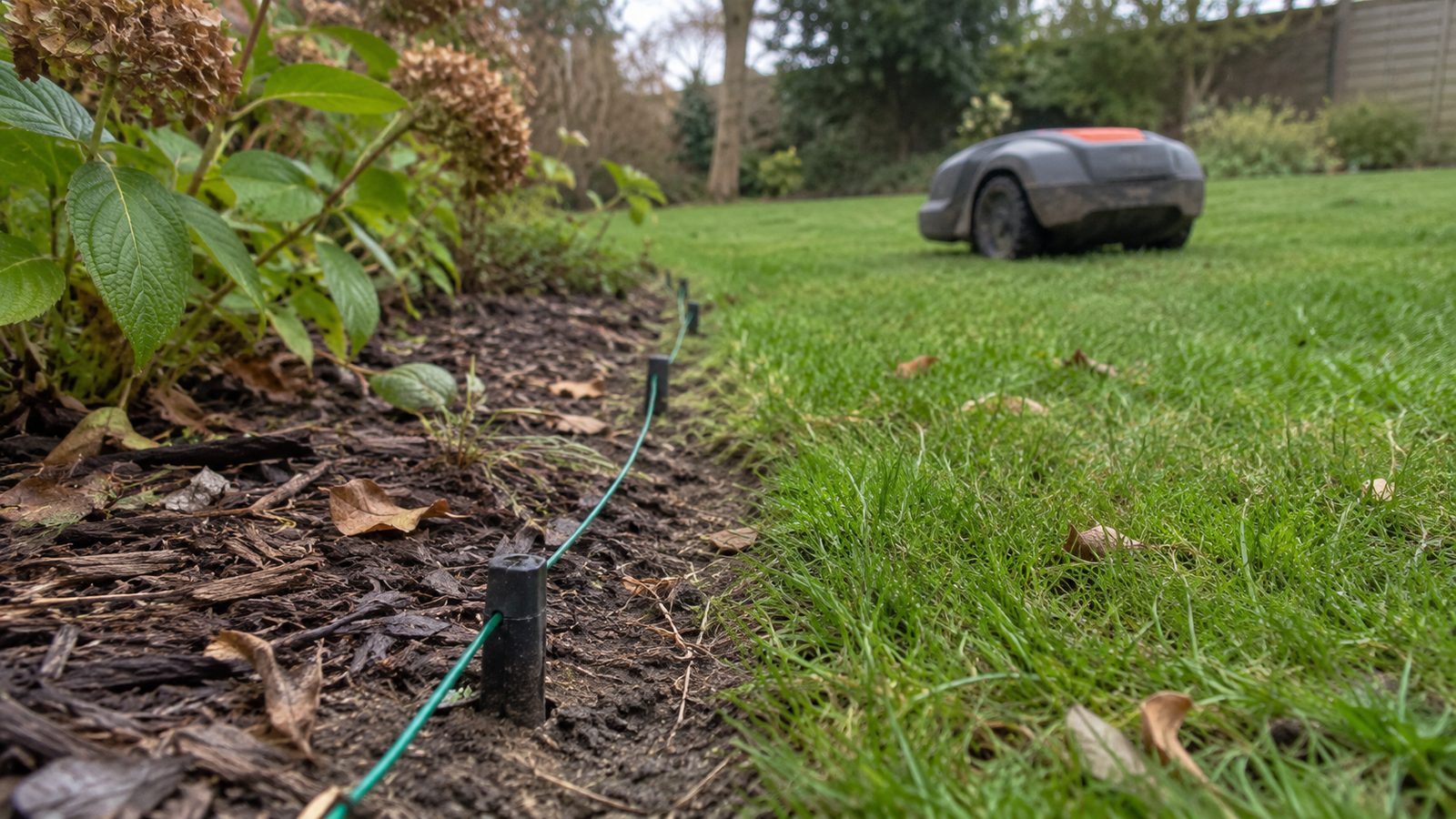
The oldest way is a thin wire around the edge of the lawn
Most older robot mowers need a low-voltage wire laid around the lawn edge, according to eufy’s guide to mower navigation. You staple it to the ground or bury it. The charging station sends a weak signal through that wire, and the mower senses it. When the mower reaches the wire, it turns back.
Think of it as a fence the mower can feel but you cannot see. You also run the wire around anything the mower should avoid, like a tree or a pond. Husqvarna adds a second wire, the guide wire, that leads the mower home to charge. The company says this lets its mowers squeeze through gaps as narrow as 24 inches.
The weak spot is the wire itself. A spade or an edger can cut it. When that happens, Husqvarna’s support pages say the light on the charging station flashes blue and the mower reports ‘No loop signal’. Then you walk the lawn to find the break. The fix is cheap: trim about 2 feet off each broken end and join them with a small connector.
Laying the wire takes several hours, according to the mower maker Mammotion. If you move a flowerbed later, you move the wire too.
Phone-style GPS is not nearly precise enough for a lawn
Wire-free mowers draw the boundary on a map in an app instead. To stay inside it, the mower has to know where it is to within a couple of inches.
Ordinary GPS cannot do that. The US government’s GPS website says a smartphone is usually accurate to within about 16 feet under open sky. Sixteen feet off, and your mower is in the neighbor’s yard.
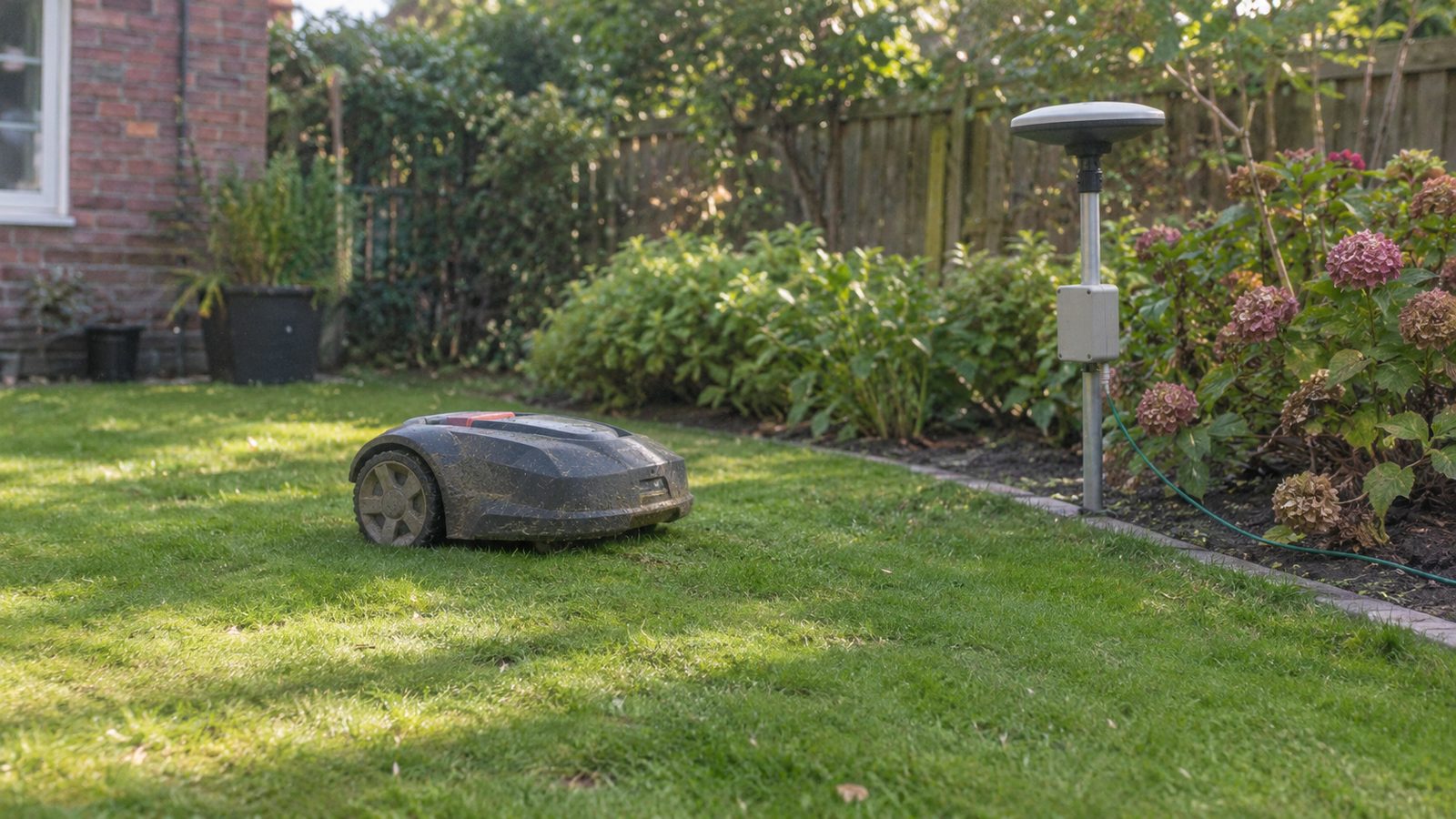
So these mowers use a trick called RTK (base station works out how wrong the satellite signals are and sends a correction, so a machine knows its position to within about an inch.">real-time kinematic positioning). A small base station sits at one fixed spot in your yard. Because it never moves, it can work out how wrong the satellite signals are at that moment. It sends that correction to the mower, by radio or over the internet. It is like a friend standing at a known spot, calling out how far off your map is. With a clear sky, the satellite-positioning company Swift Navigation puts the result at about half an inch to an inch.
The weak spot here is the sky. Trees, buildings and fences block or weaken the satellite signal, eufy’s guide says. Husqvarna lists narrow passages and dense groups of trees as typical problem spots. Its fix for those patches is a short loop of wire laid around them. When the mower loses the satellites there, it stops at that wire and waits for the signal to come back. Husqvarna also says the charging station itself must stand where the satellite signal is good.

Cameras and laser scanners try to see the edge instead
A third group of mowers uses cameras and software. They learn to tell grass apart from paving or mulch, much as you would by looking. That makes them good with toys, garden furniture and other things that move around, eufy says.
Their weak spot is what they see. Lighting matters, according to the mower maker Sunseeker. Eufy adds that very overgrown grass and fuzzy lawn edges can confuse them. Some mowers use a laser scanner instead, which measures the distance to walls, fences and beds. That works best in yards with plenty of fixed objects. A wide, empty lawn gives it little to measure against.
Whatever the method, the mower also has a last line of defense. Husqvarna says its mowers bump gently into an object, stop and reverse. Lift one off the ground and the blades shut off at once.
Match the mower to your yard before you buy
- Open lawn, few tall trees: a satellite mower with a base station fits best. The vendors themselves say these do best with a clear view of the sky.
- Big trees, narrow side yards, tall house walls: a wire mower, or a satellite mower that can add wire for the shady patches.
- A busy yard full of toys and furniture: camera-based mowers are built for that, if your lawn has clear edges.
- Tight budget: Mammotion puts wired mowers at about $600 to $1,200 and GPS mowers at about $1,500 to $4,000 or more.
Before you buy, stand where you would put the charging station and look up. If you see mostly leaves, a wire-free satellite mower will struggle there. And if your mower keeps stopping in the same spot, that spot is your clue. It is usually the place where the wire broke or the sky closed in.
Sources
- eufy: Robot lawn mower navigation types
- Husqvarna: How do Automower robotic lawn mowers work?
- Husqvarna: How to find and repair a wire break in your Automower installation
- Husqvarna: EPOS Support by Wire for lawn areas with weak satellite signal
- GPS.gov: GPS Accuracy
- Swift Navigation: What is RTK (Real-Time Kinematic)?
- Mammotion: Robot lawn mower, GPS or wire?
- Sunseeker: Wire-free robot lawn mowers explained