

Lenovo’s new walking exoskeleton costs about $1,000. Here’s what that money buys you
Lenovo’s Lecoo brand has put a powered walking aid on sale in China. It straps around your waist and thighs and weighs 1.8 kilograms, just under 4 pounds. Small motors at the hips help each step. It is called the Xingzhe ONE. The launch price is RMB 6,999, roughly $1,000, and the regular price is RMB 7,999.
You can’t order it in the US yet. It is listed on JD.com, one of China’s biggest online shops, with sales starting November 28. But its price sits right where hip exoskeletons that Americans can already buy start. That makes it a useful yardstick if you’re thinking about one.

A walking exoskeleton pushes your thighs, not your whole body
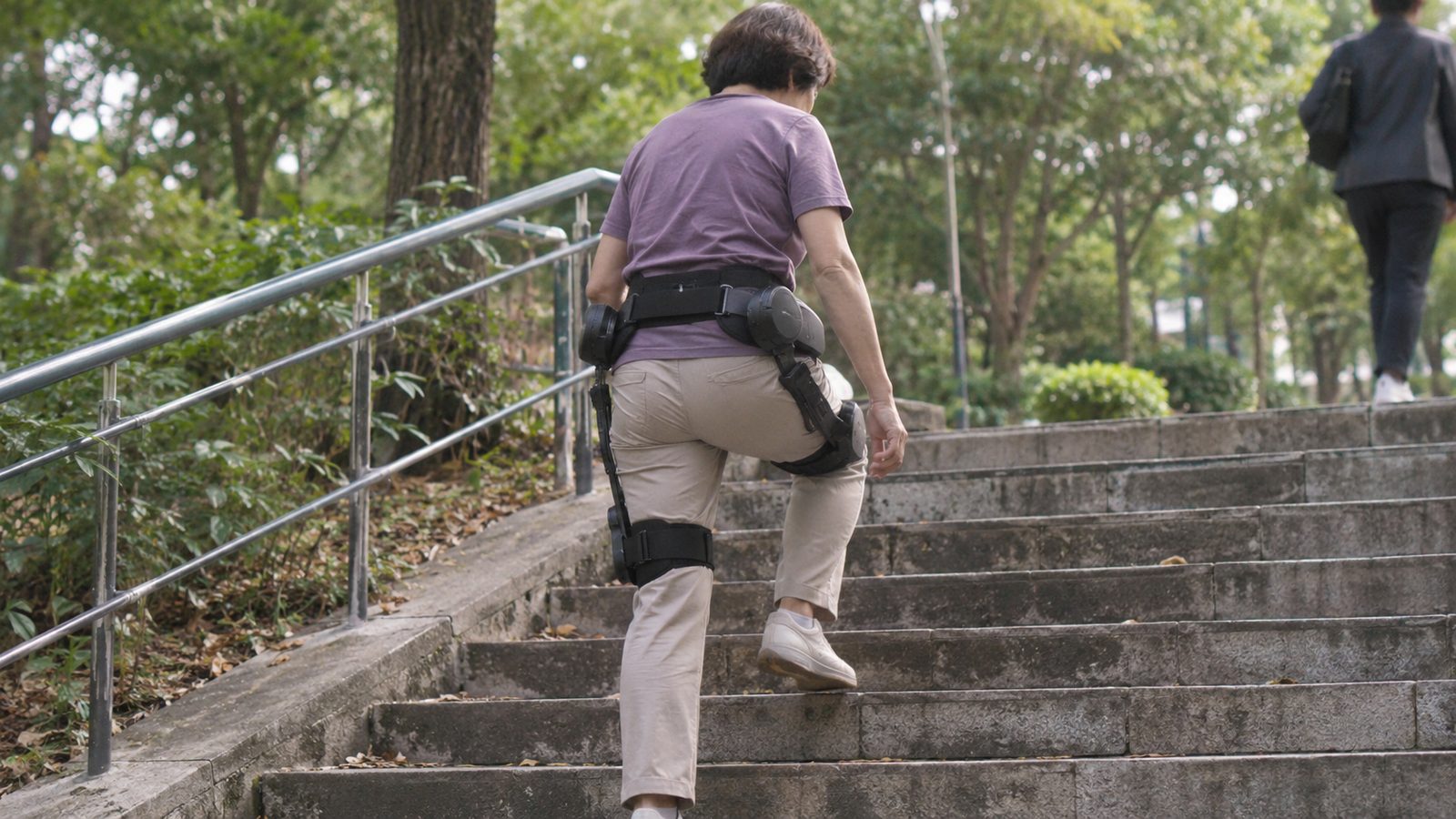
Forget the full-body suits from the movies. These consumer devices are a belt with a motor on each hip and a strap above each knee. Sensors track how you move. When you swing a leg forward, the motor gives that thigh a push in the same direction.
Lecoo says its device is built to recognize six kinds of movement: slopes, stairs, hiking, running, cycling and gravel. It then adjusts the help to match. You can turn the strength up or down with one button, according to IT Home, the Chinese tech site that first reported the launch.
The specs to check, and what Lecoo claims
- Weight: 1.8 kg. That matches the weight Cybernews gives for Hypershell, the best-known US brand.
- Push: up to 38 newton-metres of twisting force at the hips, with 900 watts of peak motor power. Lecoo claims walking becomes at least 45% more efficient. No independent test backs that number yet.
- Battery: two removable 3,000mAh packs. Lecoo quotes about three hours at the third assist level. It calls that a theoretical figure.
- Weather: rated IP54. That means it handles dust and splashes, but it is not waterproof.
- Getting it on: three support points and one buckle. Lecoo says you can put it on or take it off in about 15 seconds.
- Safety: protection against motor overload and battery overheating, a guard against the joints being yanked, and warnings when something looks wrong.
There’s one catch. Lecoo says the six movement types will be switched on gradually. In plain words, not all of them work on day one. They arrive later through software updates. Judge it on what it does the day you buy it.
In the US, $1,000 to $2,000 buys you a Hypershell
Hypershell is the brand US shoppers see most. Cybernews lists four models: the X Go at $999, the X Pro at $1,199, the X Carbon at $1,799 and the X Ultra at $1,999. Those are list prices, before one-time discounts. The pricier models are lighter, use stronger materials and have more peak power.
Cybernews says most models go up to 10.8 miles on a charge, and the X Go up to 18.6 miles. Full-power use lasts about 90 minutes. Charging takes about 80 minutes over USB-C. Lenovo’s device costs about as much as the entry model. Its extra trick is a second battery you can swap in halfway through a hike.
The health benefits are still mostly company claims
The biggest gap is proof. Cybernews points out that the benefits of exoskeletons like these are not clinically proven. The big numbers, like Lecoo’s 45% or Hypershell’s claimed 40% cut in fatigue, come from the companies themselves.
Battery life shrinks fast at high power. Some Hypershell users say the push feels like too much, as if their own legs are no longer doing the work. And these are not medical devices. Cybernews notes that Hypershell is not approved for rehabilitation. If you have a joint problem, talk to your doctor or physical therapist first.
Our take: a giant like Lenovo selling one at around $1,000 shows these are turning into ordinary gadgets. More big brands should mean more choice. If you hike steep trails or your legs tire on long walks, a hip exoskeleton can make sense now. If you’re hoping it fixes a medical problem, wait for real studies.
What to buy
- Hypershell X Go (entry-level hip exoskeleton, $999 list) – Suits first-time buyers who mainly walk or commute; it is the cheapest model and Cybernews gives it the longest range, but it is not the lightest or most powerful.
- Hypershell X Pro ($1,199 list) – For regular hikers who want more push on rough ground; it costs $200 more than the X Go, and Cybernews quotes up to 10.8 miles per charge.
- Hypershell X Ultra ($1,999 list) – For serious hikers who will pay for a lighter titanium-alloy frame and more peak power; it costs twice the entry model for gains most casual walkers won't notice.