How a Robot Hand Feels What It Is Holding
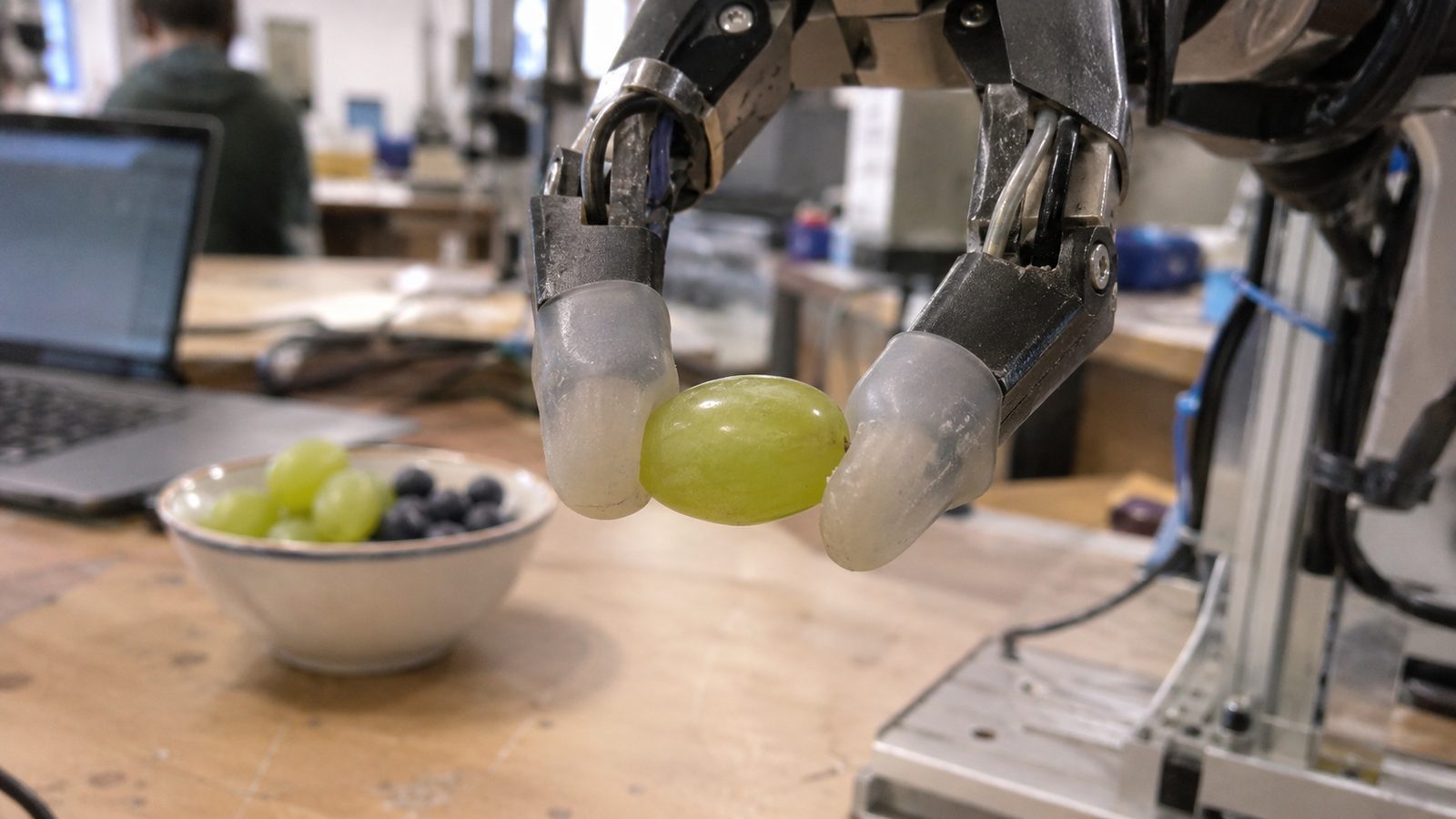
When you pick up a grape, you don’t think about it. Your fingers press just hard enough. If it starts to slip, you squeeze a little more before it falls. A robot has to do the same thing with sensors and software. Most robots still do it half-blind.
This is how a robot fingertip actually feels something. It’s also why so many grippers crush fruit or drop cups, and how to tell a real sense of touch from a press-release one.
Cameras can see the grape but not the squeeze
A robot’s cameras tell it where an object is. They can’t tell it how hard its fingers are pressing. They also can’t see whether the object has started to slide. Meta’s robotics researchers say touch lets a machine sense things that are “inaccessible through vision.”
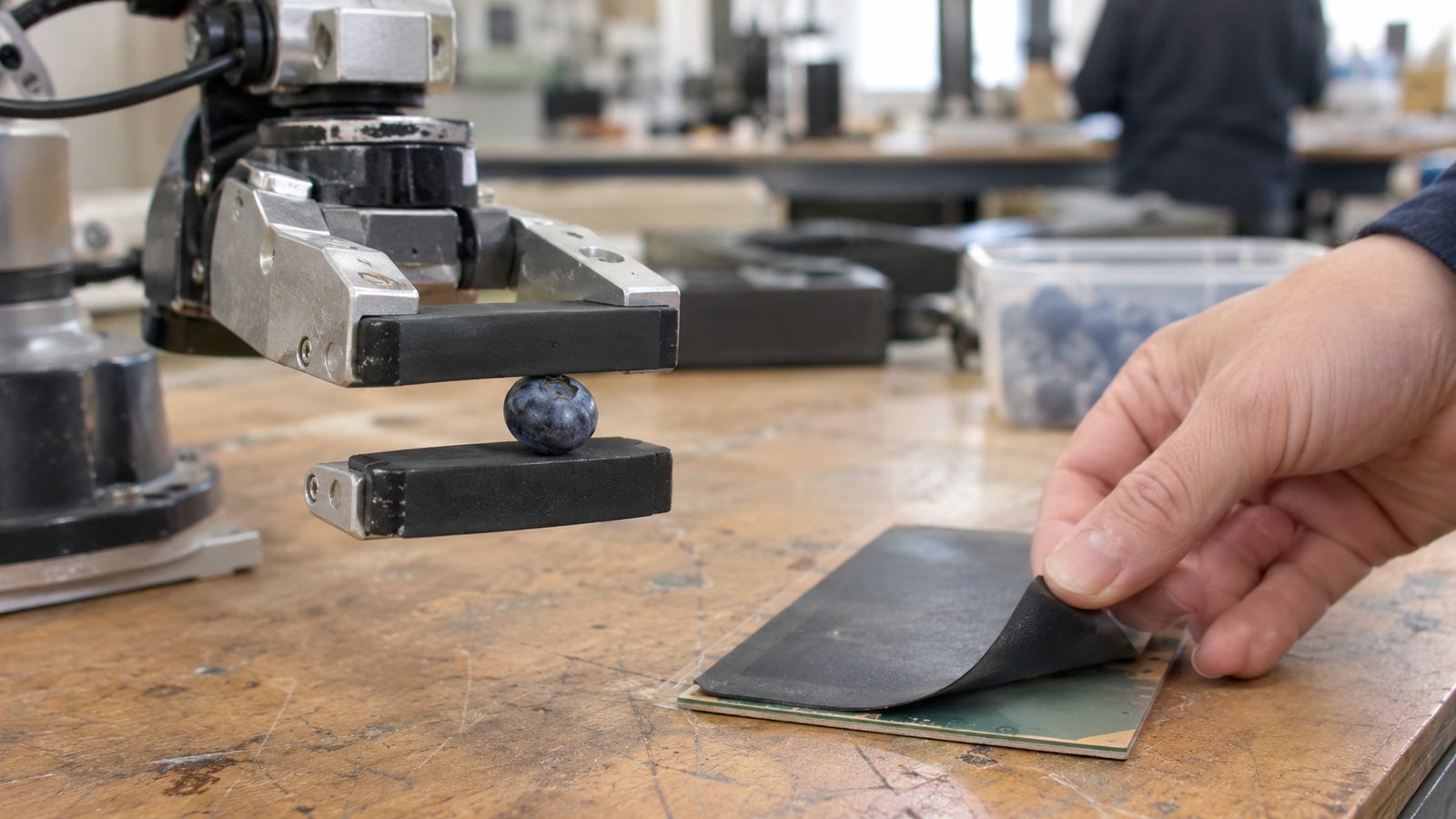
Some grippers try to estimate grip strength from inside their own motors. Meta’s ReSkin team tested that on delicate items like grapes and blueberries. They report that the gripper’s built-in force sensing could not finish the task. With a touch skin on its jaws, it could.
Without real touch, a robot has to guess. If it guesses high, the grape bursts. If it guesses low, the cup slides out of its hand.
Most robot fingertips feel by watching soft rubber bend
Press your thumb into a stress ball and look at the dent. The shape of the dent tells you what pressed it. Many touch sensors work on exactly that idea.
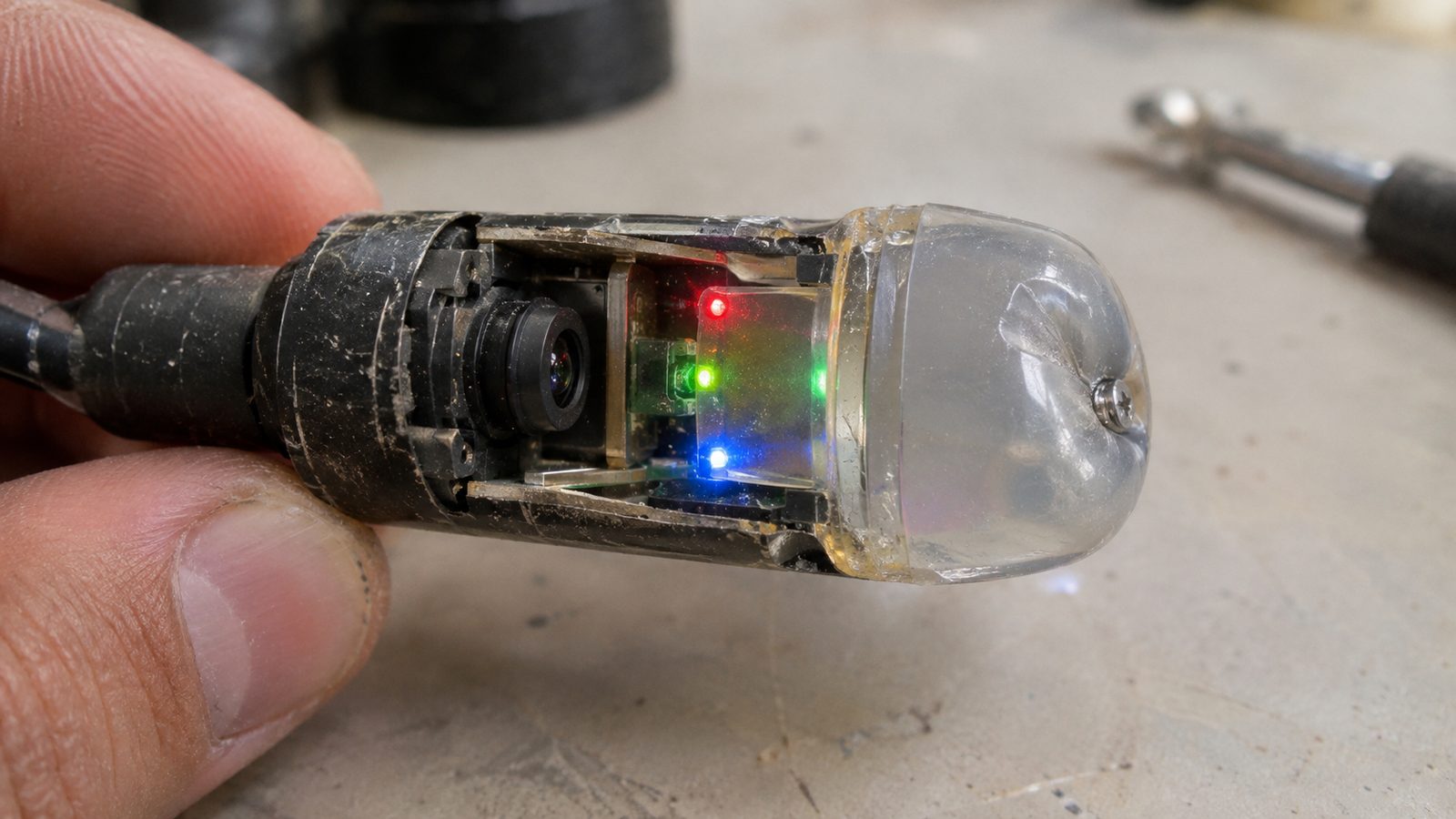
The camera-in-a-finger design. MIT researchers built a fingertip sensor called GelSight. It’s a pad of soft, clear silicone gel with a thin painted coating on the outside. Behind the gel sit a tiny webcam-style camera and red, green and blue lights. Each light shines from a different direction.
When the finger touches something, the gel dents. Each colored light casts shadows at a different angle. From those shadows, software works out the 3D shape of the dent. The detail is fine enough that one research robot used the texture of a USB logo to line up a plug.
Some versions print small dots on the gel. When an object starts to slide, the dots shift sideways before it actually slips away. Think of feeling a wet glass begin to move in your hand. That early warning gives the robot time to tighten its grip.
The magnetic skin design. Meta and Carnegie Mellon University built ReSkin, a rubbery sheet 2 to 3 millimeters thick with tiny magnetic particles mixed in. Pressing the sheet changes the magnetic field around it, a bit like a compass needle twitching when a magnet moves nearby. Small magnetic sensors underneath pick up the change. Software turns it into where the skin was touched and how hard.
Meta says ReSkin checks for touch up to 400 times a second. It can locate a touch to within 1 millimeter. It costs under $6 per skin when bought 100 at a time.
Each tiny sensing spot in a touch sensor is called a taxel, short for “touch pixel.” Meta says its newest lab fingertip, Digit 360, has more than 8 million of them.
Touch sensors wear out, and that is the hard part
Fingertips get rubbed, poked and squeezed all day. The ReSkin team points out that soft materials change over time. They also change differently depending on how they’re used. A sensor that was accurate on day one can slowly drift.
If that happens, the robot’s idea of “gentle” drifts too. You would notice it as a grip that slowly becomes too tight or too loose. ReSkin’s answer is a skin that lasts more than 50,000 touches. After that you peel it off like a sticker and put on a new one. Its software then recalibrates itself.
Figure AI makes the same complaint. The company says that when it surveyed the sensors on the market, none could stand up to real-world use. So it built its own. NYU robotics professor Lerrel Pinto has said current sensors are “either too expensive, offer poor resolution, or are simply too unwieldy for custom robots.”
A real touch claim comes with numbers
Figure’s claim for its Figure 03 humanoid is a good example of a specific one. The company says each fingertip sensor can detect three grams of pressure. That’s about the weight of a paperclip resting on your finger. Figure says this lets its software tell a secure grip from a slip that’s about to happen. Meta claims its research fingertip can detect forces as small as 1 millinewton, a far smaller push. That’s a lab tool, though, not a robot you can buy.
When a company says its robot “has a sense of touch,” look for answers to these questions:
- Where is it? Fingertips only, or fingers and palm too?
- How light a touch? A number in grams beats the word “sensitive.”
- Can it feel sliding? Pressing and slipping are different signals. Look for the word “slip.”
- How long does the skin last? Ask for a touch count and whether the skin can be replaced.
- Does the robot use it? Look for demos with soft or fragile things, not just boxes. Figure shows thin sheet metal and floppy plastic bags.
Touch is the least developed of a robot’s senses. A humanoid that comes with a force number and a plan for wear is ahead of one that only promises “human-like touch.”
Sources
- Introducing Figure 03 (Figure AI)
- Advancing embodied AI through progress in touch perception, dexterity, and human-robot interaction (Meta AI)
- ReSkin: a versatile, replaceable, low-cost skin for AI research on tactile perception (Meta AI)
- Slip Detection with Combined Tactile and Visual Information (arXiv)
- GelSlim: A High-Resolution, Compact, Robust, and Calibrated Tactile-sensing Finger (arXiv)
- Generation of GelSight Tactile Images for Sim2Real Learning (arXiv)
- GelSight, Meta AI release Digit 360 tactile sensor for robotic fingers (The Robot Report)