Robots are no longer limited to factories, research laboratories, or science-fiction movies. Many people now interact with robotic systems without thinking of them as robots.
They clean floors, cut lawns, move packages through warehouses, carry supplies through hospitals, deliver food, assist workers, and perform repetitive physical tasks with limited human intervention.
But not every automated device is a robot. A chatbot, smart speaker, or software assistant may use artificial intelligence, but it does not physically sense and act on the world in the same way a robot does.
This guide looks at 10 real examples of robots being used in everyday life, explains what they actually do, and shows how modern robotics is becoming part of ordinary homes, workplaces, and public spaces.
What Actually Counts as a Robot?
A robot is generally a physical machine that can sense its environment, process information, and perform physical actions.
Most modern robots combine three basic capabilities:
Sensing allows the robot to understand something about its surroundings using cameras, distance sensors, encoders, pressure sensors, GPS, LiDAR, or other technologies.
Control and decision-making allow onboard computers or controllers to determine what the robot should do next.
Physical movement or action allows the robot to move, lift, clean, cut, transport, manipulate, or interact with objects.
That distinction matters. Artificial intelligence can exist entirely in software, while a robot interacts physically with the real world.
Everyday Robots at a Glance
| Type of robot | Common environment | Main task |
|---|---|---|
| Robot vacuum | Homes | Autonomous floor cleaning |
| Robotic lawn mower | Gardens and yards | Automated grass cutting |
| Pool-cleaning robot | Homes and commercial pools | Cleaning pool floors and walls |
| Delivery robot | Campuses and public areas | Transporting food and small goods |
| Warehouse mobile robot | Warehouses | Moving inventory and containers |
| Hospital service robot | Hospitals | Transporting supplies and equipment |
| Restaurant service robot | Restaurants | Moving meals, dishes, or supplies |
| Educational robot | Schools and homes | Teaching programming and robotics |
| Robotic pet | Homes and care environments | Interactive companionship |
| Collaborative robot | Workshops and factories | Assisting people with physical tasks |
1. Robot Vacuum Cleaners
Robot vacuum cleaners are probably the most familiar example of consumer robotics.
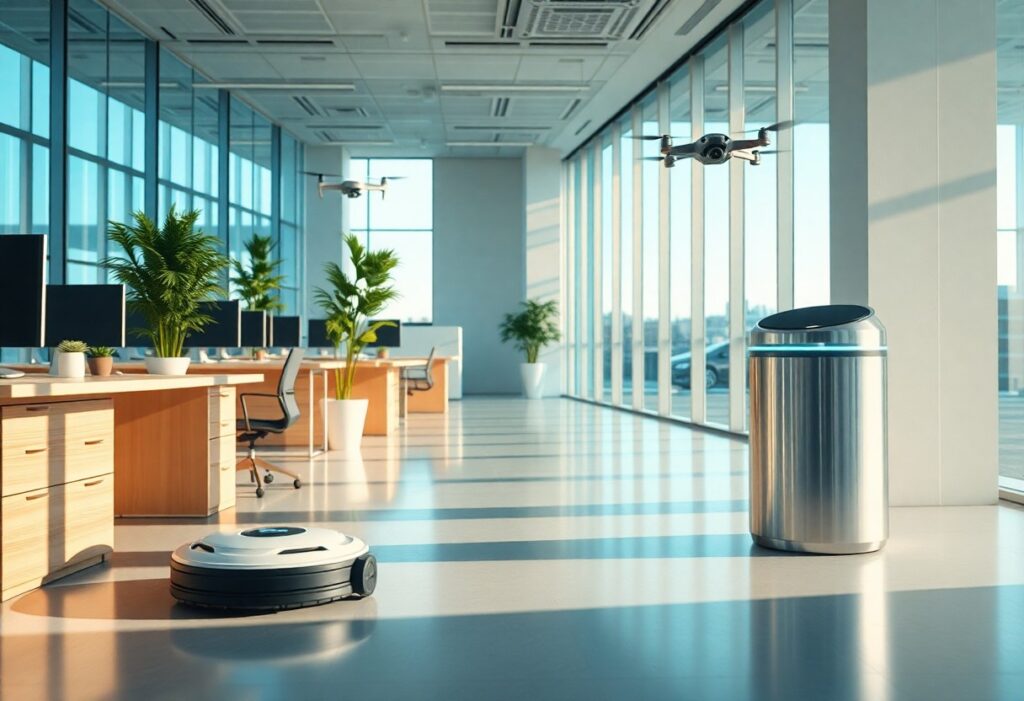
Unlike a conventional vacuum cleaner, a robot vacuum can move around a home without being continuously controlled by a person. Depending on the model, it may use cameras, infrared sensors, wheel encoders, LiDAR, or other sensors to navigate between rooms and avoid obstacles.
Many modern models can build a map of a home, return automatically to a charging dock, clean selected rooms, and resume cleaning after recharging.
What makes these devices robots is not simply that they are automatic. They combine environmental sensing, navigation, decision-making, and physical movement to complete a real-world task.
For many households, this is already one of the clearest examples of robotics becoming part of everyday life.
2. Robotic Lawn Mowers
The same idea is now being used outside the home.
Robotic lawn mowers can maintain a lawn automatically while requiring much less direct involvement from the homeowner. Earlier systems commonly relied on boundary wires, while newer machines may use GPS, cameras, satellite positioning, or other navigation technologies.
A robotic mower normally follows a programmed schedule, monitors its operating area, cuts the grass, and returns to its charging station when necessary.
Safety sensors can also help detect lifting, tilting, obstacles, or unexpected conditions.
These machines demonstrate how robotics is moving from indoor cleaning into routine outdoor maintenance.
3. Robotic Pool Cleaners
Swimming pools require regular cleaning to remove dirt, leaves, algae, and other debris.
Robotic pool cleaners automate much of that physical work.
A pool-cleaning robot can travel along the bottom of a swimming pool, and some models can climb walls or clean around the waterline. Motors move the machine while brushes loosen dirt and an internal filtration system collects debris.
Unlike simple suction cleaners powered entirely by a pool’s pump, many robotic cleaners operate as self-contained machines with their own drive and control systems.
This makes pool maintenance another household task increasingly handled by robotics.
4. Autonomous Delivery Robots
Small delivery robots are becoming visible on university campuses, business districts, residential developments, and other controlled environments.
These machines are designed to transport meals, groceries, parcels, or other small items over relatively short distances.
A delivery robot may combine cameras, ultrasonic sensors, GPS, wheel encoders, and other navigation technologies to understand its position and avoid obstacles.
The robot still operates within limits. Difficult road conditions, stairs, construction areas, weather, and unpredictable pedestrian activity can all present challenges.
However, delivery robots show how autonomous mobile machines can move beyond controlled industrial environments and operate closer to everyday public life.
5. Warehouse Mobile Robots
If you receive online orders regularly, robots may already have played a role in getting those products to you.
Modern warehouses increasingly use autonomous mobile robots and other robotic systems to transport inventory.
Instead of requiring an employee to repeatedly walk long distances to retrieve products, mobile robots can move shelves, containers, carts, or individual items between storage areas and workstations.
These systems can reduce repetitive transportation tasks and allow workers to spend more time on activities requiring judgment, dexterity, or problem-solving.
Warehouse robotics is especially important because it demonstrates how humans and robots can work within the same larger process rather than robots simply replacing an entire job.
6. Hospital Service Robots
Hospitals contain countless repetitive transportation tasks.
Medicines, laboratory samples, linens, meals, medical supplies, and other materials frequently need to move between departments.
Service robots can help perform some of these trips.
A hospital transport robot may navigate corridors, call or interact with elevators in supported facilities, travel between designated locations, and deliver secure containers.
These robots are not replacements for doctors or nurses. Their value is usually in handling repetitive logistical work so healthcare staff can spend more time on tasks requiring human expertise and patient interaction.
Hospitals are therefore an important example of robotics being used primarily for support work, rather than attempting to automate every part of an occupation.
7. Restaurant Service Robots
Some restaurants now use mobile service robots to move meals, empty dishes, or supplies between kitchens and dining areas.
These robots typically travel along mapped routes while using sensors to avoid people and obstacles.
A member of staff may load several trays onto the robot and select a destination. The robot then transports the items to the required table or service area.
The technology works best when the environment is reasonably structured. Crowded spaces, narrow passages, unexpected obstacles, and complex customer requests still require human involvement.
Restaurant robots are therefore better understood as assistants that handle repetitive transportation rather than replacements for the entire restaurant staff.
8. Educational Robots
Robots are also increasingly used as learning tools.
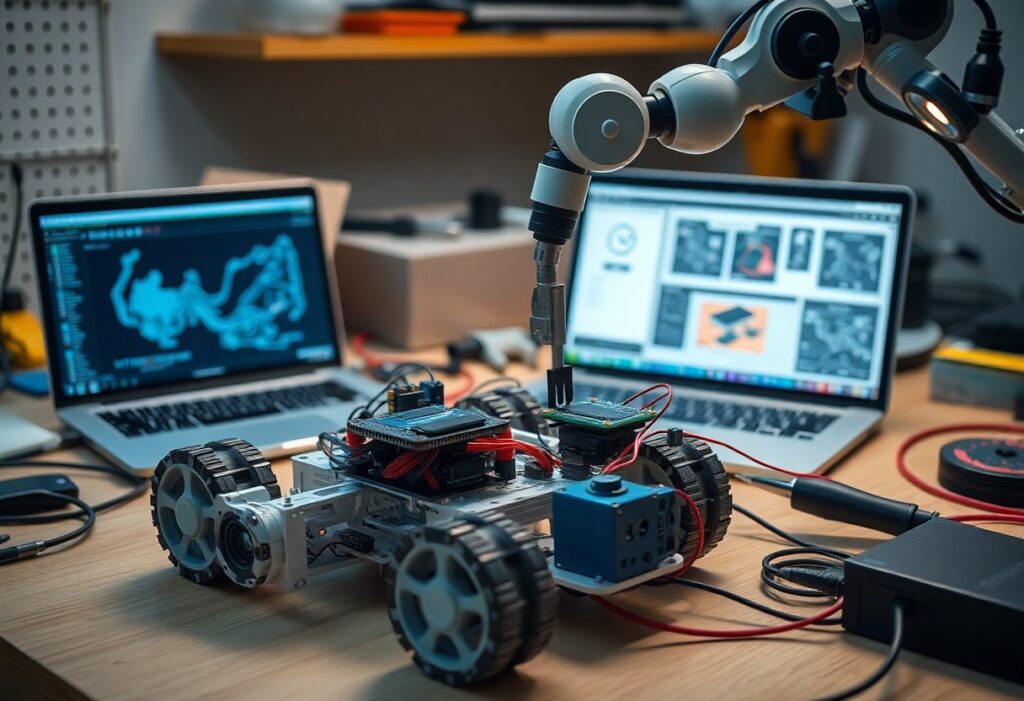
Educational robots allow students to experience programming, electronics, sensors, motors, mechanical design, and automation through physical projects.
Instead of writing code that only changes something on a computer screen, students can see their program cause a machine to move, follow a line, avoid an obstacle, operate a robotic arm, or respond to sensor input.
This connection between software and physical behavior can make robotics particularly useful for teaching engineering and problem-solving.
Educational robotics also gives beginners an accessible path into more advanced subjects such as autonomous navigation, computer vision, control systems, and artificial intelligence.
9. Robotic Pets and Companion Robots
Not every robot is designed primarily for productivity.
Robotic pets and companion robots are built around interaction.
Depending on the system, a companion robot may react to touch, voice, movement, facial presence, or other input. Motors can produce head, body, eye, or limb movements, while speakers and displays can provide additional feedback.
Some are primarily toys. Others are designed for education, entertainment, research, or use in care environments.
The important distinction from a virtual assistant is that a companion robot has a physical body capable of sensing and responding within its environment.
This area of robotics also raises interesting questions about how humans form emotional connections with machines.
10. Collaborative Robots
Collaborative robots, often called cobots, are designed to perform tasks alongside people.
They are widely associated with manufacturing, but smaller collaborative robots are also appearing in workshops, laboratories, packaging operations, food production, and other environments.
A cobot arm might help with repetitive activities such as positioning components, loading machines, packaging products, applying materials, or moving objects.
Unlike traditional industrial robots that often operate inside dedicated safety enclosures, collaborative systems may include features intended to support closer human interaction, although proper risk assessment and safety controls are still required.
Cobots show an important direction for robotics: instead of asking whether humans or robots should perform a task, engineers can design processes where each handles the part they are better suited to perform.
Robots vs AI: They Are Not the Same Thing
Robotics and artificial intelligence are closely related, but they are not interchangeable terms.
A chatbot can use sophisticated artificial intelligence without being a robot because it does not have a physical mechanism that acts on the environment.
Likewise, a robot does not necessarily require advanced AI. A simple industrial robot may repeatedly follow programmed movements using conventional control systems.
Some modern machines combine both technologies.
For example, a mobile robot might use AI-based computer vision to identify objects while motors and mechanical systems physically move the machine through its environment.
A useful way to think about the difference is:
AI helps a system interpret information and make decisions. Robotics allows a machine to physically act on those decisions.
Why Everyday Robotics Is Growing
Several technologies have made practical robots more accessible.
Sensors have become smaller and less expensive. Battery technology has improved. Motors and electronic controllers are widely available. Computer vision and machine-learning tools can help machines understand increasingly complex environments.
At the same time, businesses and consumers have identified tasks that are particularly suitable for robots: repetitive transportation, cleaning, monitoring, material handling, and other predictable physical activities.
That does not mean every task should be automated.
Robots still struggle with unpredictable environments, unusual objects, complex social situations, maintenance requirements, and tasks that humans perform easily through experience and common sense.
Understanding both their strengths and their limitations gives a much more realistic picture of modern robotics.
Are Robots Already Part of Everyday Life?
For many people, yes.
A person may have a robot vacuum cleaning their home while a robotic mower maintains the garden. An online order may move through a warehouse with the help of autonomous mobile robots. Hospital supplies may be transported by a service robot, while an educational robot introduces a student to programming.
Many of these machines are not humanoid, and most do not resemble the robots shown in science-fiction films.
That is one of the most interesting things about modern robotics.
The robots becoming part of everyday life are often specialized machines designed to perform one physical task reliably and repeatedly.
As sensing, navigation, control systems, batteries, and artificial intelligence continue to improve, we are likely to see robots become even more common in homes, workplaces, healthcare facilities, logistics networks, and public environments.
The real robotics revolution may not arrive as a single humanoid machine.
It may already be happening quietly, one specialized robot at a time.