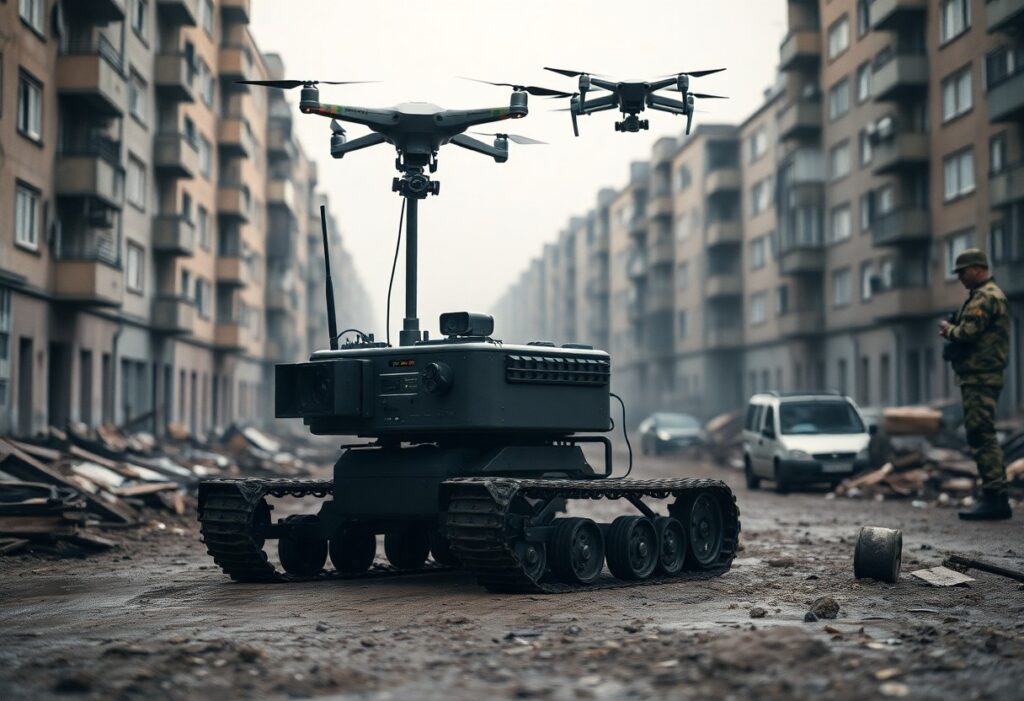
Many military observers now recognize robotic systems as central to modern battlefield awareness, and in Ukraine, you see them operating just behind the front lines. Unmanned ground and aerial vehicles gather real-time visual and electronic data, allowing commanders to assess enemy movements without risking personnel. A mid-sized SaaS firm might rely on automated analytics, but here, the automation is physical, persistent, and often decisive.
The Steel Eyes of the Steppe
Across the open plains of eastern Ukraine, robotic systems now serve as persistent watchers, scanning horizons where human scouts once risked exposure. You rely on these machines to maintain constant vigilance, their sensors active day and night, feeding real-time data back to command units nestled in distant bunkers.
The silent observer in the tall grass
A small tracked drone, no larger than a shoebox, lies motionless in the high grass near a contested village. Its thermal sensor detects the faint heat bloom of an approaching armored vehicle long before engine noise carries across the field. You receive the alert through a secure feed, allowing time to reposition or prepare.
The cold logic of the lens
Optical sensors on reconnaissance robots process images without fatigue, bias, or hesitation. Each frame is analyzed for anomalies-a disturbed patch of soil, a glint of metal-triggering alerts only when predefined thresholds are met. You benefit from decisions stripped of emotion, driven purely by pattern and probability.
These imaging systems use edge-based processing to filter irrelevant data before transmission, reducing bandwidth needs in areas with spotty connectivity. A mid-sized SaaS firm developing similar AI filtering for industrial monitoring adapted its model from battlefield-tested drone software, showing how military-grade perception is shaping commercial sensing. Algorithms distinguish between animal movement and human activity by gait analysis, ignoring a passing fox while flagging a crawling soldier. You receive only what matters, when it matters.
Beyond the Human Limit
Robots extend your operational reach far beyond what human soldiers can endure, functioning in environments where fatigue, cold, or danger would otherwise force withdrawal. These machines maintain vigilance for hours without rest, detecting movement through thermal signatures invisible to the naked eye. A single ground-based unit can scout an entire grid sector while you remain safely behind cover, reducing exposure without sacrificing situational awareness.
Forging paths through the minefields
Unmanned ground vehicles equipped with ground-penetrating radar allow you to clear routes through suspected minefields without risking lives. One such robot, adapted from agricultural chassis designs, has been used to mark and detonate anti-personnel devices in Kharkiv’s outskirts, enabling safe passage for supply convoys and medevac teams during active shelling.
The burden of the battery
Power constraints limit how long you can deploy a robot before retrieval or recharge becomes necessary. Most small reconnaissance units rely on commercial lithium-ion packs that last under four hours in subzero conditions, forcing tactical pauses that adversaries may exploit. Cold weather reduces efficiency, and spare batteries add weight that affects mobility.
Extended missions demand energy solutions that current hardware struggles to provide. You might carry extra batteries, but each one increases the robot’s mass and lowers its agility on uneven terrain. Some units now experiment with hybrid fuel-cell prototypes that extend operational time, though these remain rare and logistically complex to maintain in forward positions.
The Signal and the Noise
Amid the chaos of modern warfare, electronic emissions shape the battlefield as much as gunfire. You rely on robots not just to see, but to listen, as they parse through layers of data to isolate meaningful signals from the surrounding static of jamming and deception.
Electronic whispers across the front
Every radio transmission, radar pulse, or cell signal near the front lines leaves a trace. You deploy reconnaissance drones equipped with spectrum analyzers to capture these faint electronic whispers, mapping enemy communication nodes and identifying command post locations through subtle RF leaks.
Evading the invisible net
Enemy electronic warfare units cast wide nets, hunting for digital footprints. You program your robots to operate in short bursts, minimizing transmission time and switching frequencies unpredictably, making them difficult to detect or triangulate.
Operating in silence is not just about turning off transmitters. You use pre-programmed routes and terrain masking, allowing robots to glide beneath the radar coverage of mobile EW units. One Ukrainian unit reported success using a modified Leleka-100 drone that approached a Russian position from a valley blind to enemy sensors, returning with signal logs undetected.
Small Machines for Large Wars
Robots no longer serve only as experimental tools in Ukraine’s conflict zones-they are now important assets on the front lines. Small unmanned systems, often built or modified in local workshops, conduct reconnaissance in areas too dangerous for personnel. These compact machines traverse trenches, scale rubble, and transmit real-time footage, providing actionable intelligence without risking lives. Their size and adaptability make them ideal for asymmetric warfare, where agility outweighs firepower.
Logistics of the workshop
A typical repair and assembly hub operates out of a repurposed garage or basement, equipped with 3D printers, spare motors, and donated electronics. Technicians, often civilian volunteers with engineering backgrounds, refurbish damaged drones or assemble new units from modular kits. One such workshop in Kharkiv reported assembling over fifty reconnaissance bots in a single month, using parts sourced from consumer drones and industrial suppliers abroad.
The cost of a mechanical life
Losing a robot in combat costs less than sending a soldier into the same danger. A basic reconnaissance drone may require a few hundred dollars in materials, a fraction of the expense tied to human injury or capture. These machines absorb risk, allowing units to scout enemy positions without exposing personnel. Their expendability reshapes tactical decision-making, especially in prolonged engagements where survival depends on information.
Each robot lost in the field represents a calculated trade-off between intelligence gained and resources spent. A mid-sized SaaS firm might measure efficiency in server uptime, but here, efficiency is measured in missions completed per unit cost. Some units deploy swarms of simple bots, accepting high attrition rates because the data they return justifies repeated deployment. This model shifts military economics, prioritizing scalable, replaceable systems over irreplaceable human lives.
Intelligence Gathered in Shadows
Robots used in Ukraine for reconnaissance are transforming how battlefield intelligence is collected, operating where humans cannot. These systems move silently through contested zones, capturing data without exposing personnel. Robots used in Ukraine for reconnaissance often return with imagery and signals intelligence that shape tactical decisions within hours.
Mapping the hidden trenches
Autonomous drones equipped with thermal sensors identify heat differentials in soil, revealing recently dug fortifications. You detect patterns invisible to satellite imaging, such as camouflaged entry points or ventilation shafts. A single flight can generate a 3D map of enemy trench networks stretching over several kilometers.
Relaying the coordinates of fate
Target data gathered by ground robots is transmitted through encrypted channels to artillery units in real time. You initiate fire missions before enemy positions adjust or withdraw. Coordinates from a tracked reconnaissance unit once led to the neutralization of a mobile missile launcher within nine minutes of detection.
The New Way of Seeing
High-resolution electro-optical sensors and thermal imaging now feed real-time battlefield data directly to command units, transforming how you interpret the front lines. What once required manned overflights or risky patrols now arrives silently from drones hovering beyond visual range, offering persistent surveillance over key terrain. These systems detect heat signatures from hidden artillery or movement under tree lines, giving you an operational picture that updates by the minute.
Change in the old tactics
Traditional reconnaissance relied on small teams infiltrating enemy lines, exposing soldiers to high risk for limited intelligence returns. Now, you deploy unmanned systems to scout positions, reducing human exposure while increasing mission frequency. Units that once waited days for aerial imagery now receive live feeds from drones launched minutes before an operation, shifting the tempo of decision-making.
The evolution of the ground drone
Early ground drones were little more than remote-controlled toy cars with cameras strapped on, useful for peeking around corners but easily disabled. You now use ruggedized, all-terrain models equipped with encrypted comms, obstacle avoidance, and multispectral sensors. Some can climb rubble, operate in near-total darkness, or relay signals between dismounted troops and command nodes.
Manufacturers and military units have co-developed ground drones capable of surviving direct fire and continuing operations after impacts that would disable conventional electronics. You deploy these units to inspect suspicious objects, deliver supplies under fire, or conduct silent perimeter checks at night. One model, adapted from a commercial platform, was modified in-field to tow lightweight munitions, turning it into a mobile strike asset during urban clearance operations.
To wrap up
Robots now serve as your forward observers in Ukraine’s reconnaissance missions, operating in zones too dangerous for personnel. Units like the Ukrainian 3rd Separate Assault Brigade deploy drones such as the PD-2 to identify artillery positions and track troop movements in real time. These systems feed actionable data directly to command cells, enabling precision strikes with systems like HIMARS. You rely on persistent surveillance from small UAS platforms to detect ambushes and minefields, reducing risk to dismounted scouts. Russian forces, too, use Lancet drones not just for attack but to confirm target validity before engagement. Your situational awareness now depends on machine persistence, not just human endurance. A single FPV drone can loiter over a forested area for 40 minutes, transmitting thermal feeds back to a forward controller. These systems do not replace soldiers but extend your reach, turning static front lines into fluid, sensor-driven battlespaces. You now see through distributed optics, making reconnaissance not an event but a continuous stream.